



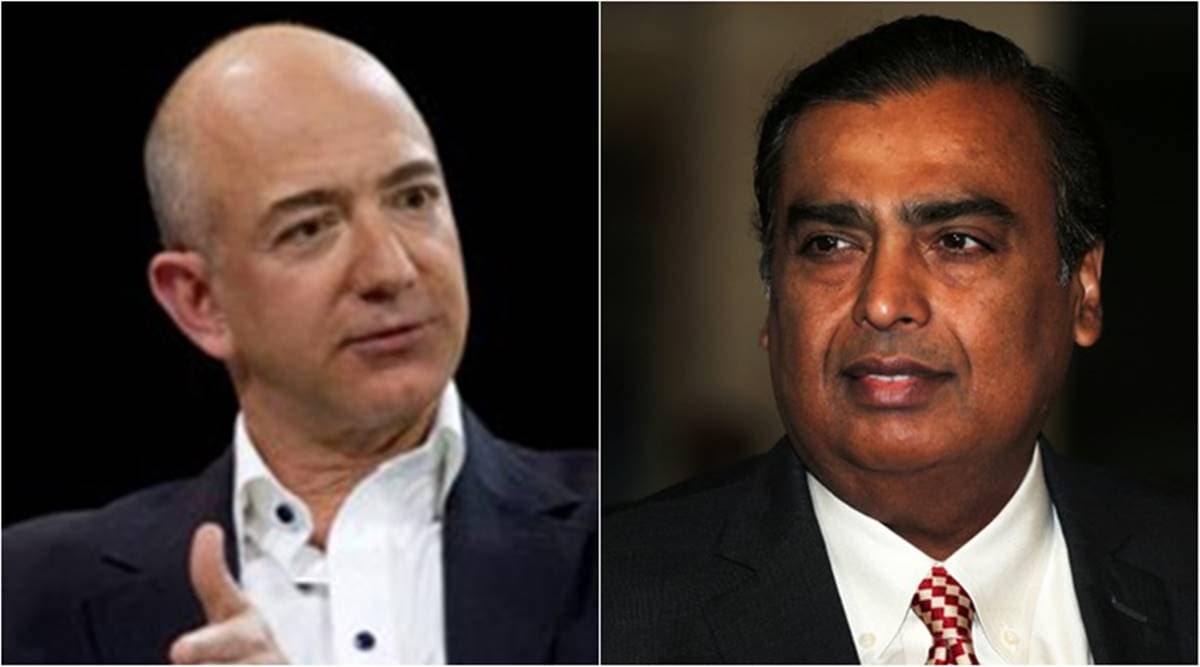
Jeff Bezos-Mukesh Ambani spat tests India’s allure for foreign investors

Agencies
February 9, 2021

Image result for Jeff Bezos-Mukesh Ambani spat tests India’s allure for foreign investors

The tussle between two of the world’s richest men -- Jeff Bezos and Mukesh Ambani -- to dominate India’s estimated $1 trillion retail market is testing foreign investor patience with flip-flopping court rulings.

This week saw new developments in Amazon.com Inc.’s legal battle to block Ambani’s Reliance Industries Ltd. from acquiring Future Retail Ltd.’s assets, in what would be the country’s largest retail-sector deal. Last week, a single judge at a high court in New Delhi restrained Future Group firms from selling their assets. On Monday, a set of judges at the court overruled that decision. Amazon can appeal the latest ruling in the country’s Supreme Court.

The keenly watched case may set an important legal precedent for investors on whether emergency decisions by foreign arbitrators are valid in India. Amazon had petitioned Indian courts with an order from an emergency arbitration court in Singapore that barred Future Retail from making a deal with Reliance.

It could also help overseas investors judge the validity of agreements in India, which the World Bank has ranked among the bottom 15% of countries in terms of enforcing contracts, worse than Venezuela, Syria and Senegal.

“Not giving effect to a foreign arbitration award undermines India’s already floundering reputation as a good place to invest and do business in,” said Bharat Chugh, a former civil judge in Delhi and now a lawyer practicing in India’s top court. Speedy enforcement of contracts and foreign arbitration rulings are important for overseas investors when assessing the attractiveness of an investment destination, he said.

Spokespeople at Reliance Industries, Amazon’s local unit and Future Group weren’t able to comment immediately on the latest ruling. Future Retail’s lawyers have argued in court that the deal is their only chance to avoid bankruptcy and save jobs.

The rulings in Amazon’s case come after two big foreign arbitration awards against India. In September, an international arbitration tribunal said India acted unfairly in a $3 billion tax dispute with Vodafone Group Plc and in another ruling ordered India to return $1.2 billion to Cairn Energy Plc for a similar failure. India has challenged the Vodafone ruling in Singapore, India’s federal government informed Parliament on Monday.

It’s common for companies investing in India to opt for foreign arbitrations as the judicial process in the country can take years. After an overseas arbitrator makes a decision, companies can seek its enforcement via an Indian court if the opposing side doesn’t comply.

Singapore Order

In the Amazon-Future Retail case, in October a Singapore emergency arbitration tribunal ordered the Future Group to halt the sale to Reliance. Amazon cited a partnership agreement with a Future Group firm for a customer loyalty promotion that restricted the group from selling assets to Mukesh Ambani’s company and allowed arbitration in Singapore to settle disputes.

Future Retail has argued in court that the pact with another group firm doesn’t bind it and the Singapore’s emergency arbitration order wasn’t enforceable in India. That prompted Amazon to petition the Delhi High Court to ensure compliance.

Last week, a high court judge halted the deal and said he was of the initial view that the order from the emergency arbitration court in Singapore is valid and can be enforced in India. On an appeal by Future, a two-judge panel allowed the deal, saying Future Retail wasn’t a party to the agreement between Amazon and Future Coupons Pvt. A detailed hearing of the case will be held from Feb. 26, the judges said on Monday.

“Last week’s order would have been some solace to foreign investors worried about the arbitration enforcement regime in India, but the order passed on Monday against Amazon would raise fresh concerns,” said Samudra Sarangi, a partner at law firm Panag & Babu. “An appeal before the Supreme Court may be inevitable.”


Comments

Add new comment

  • Coastaldigest.com reserves the right to delete or block any comments.
  • Coastaldigset.com is not responsible for its readers’ comments.
  • Comments that are abusive, incendiary or irrelevant are strictly prohibited.
  • Please use a genuine email ID and provide your name to avoid reject.
News Network
December 16,2025

bengal.jpg

The deletion of over 58 lakh names from West Bengal’s draft electoral rolls following a Special Intensive Revision (SIR) has sparked widespread concern and is likely to deepen political tensions in the poll-bound state.

According to the Election Commission, the revision exercise has identified 24 lakh voters as deceased, 19 lakh as relocated, 12 lakh as missing, and 1.3 lakh as duplicate entries. The draft list, published after the completion of the first phase of SIR, aims to remove errors and duplication from the electoral rolls.

However, the scale of deletions has raised fears that a large number of eligible voters may have been wrongly excluded. The Election Commission has said that individuals whose names are missing can file objections and seek corrections. The final voter list is scheduled to be published in February next year, after which the Assembly election announcement is expected. Notably, the last Special Intensive Revision in Bengal was conducted in 2002.

The development has intensified the political row over the SIR process. Chief Minister Mamata Banerjee and her Trinamool Congress have strongly opposed the exercise, accusing the Centre and the Election Commission of attempting to disenfranchise lakhs of voters ahead of the elections.

Addressing a rally in Krishnanagar earlier this month, Banerjee urged people to protest if their names were removed from the voter list, alleging intimidation during elections and warning of serious consequences if voting rights were taken away.

The BJP, meanwhile, has defended the revision and accused the Trinamool Congress of politicising the issue to protect what it claims is an illegal voter base. Leader of the Opposition Suvendu Adhikari alleged that the ruling party fears losing power due to the removal of deceased, fake, and illegal voters.

The controversy comes amid earlier allegations by the Trinamool Congress that excessive work pressure during the SIR led to the deaths by suicide of some Booth Level Officers (BLOs), for which the party blamed the Election Commission. With the draft list now out, another round of political confrontation appears imminent.

As objections begin to be filed, the focus will be on whether the correction mechanism is accessible, transparent, and timely—critical factors in ensuring that no eligible voter is denied their democratic right ahead of a crucial election.

Comments

Add new comment

  • Coastaldigest.com reserves the right to delete or block any comments.
  • Coastaldigset.com is not responsible for its readers’ comments.
  • Comments that are abusive, incendiary or irrelevant are strictly prohibited.
  • Please use a genuine email ID and provide your name to avoid reject.
News Network
December 16,2025

bengal.jpg

The deletion of over 58 lakh names from West Bengal’s draft electoral rolls following a Special Intensive Revision (SIR) has sparked widespread concern and is likely to deepen political tensions in the poll-bound state.

According to the Election Commission, the revision exercise has identified 24 lakh voters as deceased, 19 lakh as relocated, 12 lakh as missing, and 1.3 lakh as duplicate entries. The draft list, published after the completion of the first phase of SIR, aims to remove errors and duplication from the electoral rolls.

However, the scale of deletions has raised fears that a large number of eligible voters may have been wrongly excluded. The Election Commission has said that individuals whose names are missing can file objections and seek corrections. The final voter list is scheduled to be published in February next year, after which the Assembly election announcement is expected. Notably, the last Special Intensive Revision in Bengal was conducted in 2002.

The development has intensified the political row over the SIR process. Chief Minister Mamata Banerjee and her Trinamool Congress have strongly opposed the exercise, accusing the Centre and the Election Commission of attempting to disenfranchise lakhs of voters ahead of the elections.

Addressing a rally in Krishnanagar earlier this month, Banerjee urged people to protest if their names were removed from the voter list, alleging intimidation during elections and warning of serious consequences if voting rights were taken away.

The BJP, meanwhile, has defended the revision and accused the Trinamool Congress of politicising the issue to protect what it claims is an illegal voter base. Leader of the Opposition Suvendu Adhikari alleged that the ruling party fears losing power due to the removal of deceased, fake, and illegal voters.

The controversy comes amid earlier allegations by the Trinamool Congress that excessive work pressure during the SIR led to the deaths by suicide of some Booth Level Officers (BLOs), for which the party blamed the Election Commission. With the draft list now out, another round of political confrontation appears imminent.

As objections begin to be filed, the focus will be on whether the correction mechanism is accessible, transparent, and timely—critical factors in ensuring that no eligible voter is denied their democratic right ahead of a crucial election.

Comments

Add new comment

  • Coastaldigest.com reserves the right to delete or block any comments.
  • Coastaldigset.com is not responsible for its readers’ comments.
  • Comments that are abusive, incendiary or irrelevant are strictly prohibited.
  • Please use a genuine email ID and provide your name to avoid reject.
News Network
December 15,2025

Mangaluru, Dec 15: Air India Express has announced that it will resume direct flight services between Mangaluru and Muscat from March 2026, restoring an important international air link for passengers from the coastal region.

Airport authorities said the service will operate twice a week—on Sundays and Tuesdays—from March 1. The initial flights are scheduled on March 3, 8 and 10, followed by March 15 and 17, with the same operating pattern to continue thereafter. The flight duration is approximately three hours and 25 minutes.

The Mangaluru–Muscat route was earlier operated under the 2025 summer schedule, with services beginning on July 14. At that time, Air India Express had operated four flights a week before suspending the service.

Officials said the summer schedule will come into effect from March 29, after which changes in flight timings and departure schedules from Mangaluru are expected. Passengers have been advised to check the latest schedules while planning their travel.

The resumption of direct flights to Muscat is expected to significantly benefit expatriates, business travellers and others, further strengthening Mangaluru’s air connectivity with the Gulf region.

Comments

Add new comment

  • Coastaldigest.com reserves the right to delete or block any comments.
  • Coastaldigset.com is not responsible for its readers’ comments.
  • Comments that are abusive, incendiary or irrelevant are strictly prohibited.
  • Please use a genuine email ID and provide your name to avoid reject.