



‘Madrasas unsuitable place for children to receive proper education’: NCPCR’s claim in SC

News Network
September 12, 2024

New Delhi, Sep 12: Madrasas are "unsuitable" places for children to receive "proper education" and the education imparted there is "not comprehensive" and is against the provisions of the Right to Education Act, the National Commission for Protection of Child Rights (NCPCR) has told the Supreme Court.

The child rights body told the top court that children, who are not in formal schooling system, are deprived of their fundamental right to elementary education, including entitlements such as midday meal, uniform etc.

The NCPCR said madrassas merely teaching from a few NCERT books in the curriculum is a "mere guise" in the name of imparting education and does not ensure that the children are receiving formal and quality education.

"A madrassa is not only a unsuitable/unfit place to receive 'proper' education but also in absence of entitlements as provided under Sections 19, 21,22, 23, 24, 25, and 29 of the RTE Act," it said.

"Further, madrasas do not only render an unsatisfactory and insufficient model for education but also have an arbitrary mode of working which is wholly in absence of a standardised curriculum and functioning," the NCPCR said in its written submissions filed before the top court.

The child rights body stated that due to the absence of provisions of the RTE Act, 2009, the madrassas are also deprived of entitlement as in Section 21 of the Act of 2009.

"A madrassa works in an arbitrary manner and runs in an overall violation of the Constitutional mandate, RTE Act and the Juvenile Justice Act, 2015. It cannot be overlooked that a child getting education in such an Institution will be devoid of basic knowledge of school curriculum which is provided in a school.

"A school is defined under Section 2(n) of the RTE Act, 2009, which means any recognised school imparting elementary education. A madrassa being out of this definition has no right to compel children or their families to receive madrassa education," the NCPCR said.

It said most of the madrassas fail to provide a holistic environment to students, including planning social events, or extracurricular activities for 'experiential learning.

In a breather to about 17 lakh madrassa students, the apex court on April 5 had stayed an order of the Allahabad High Court that scrapped the Uttar Pradesh Board of Madarsa Education Act, 2004 calling it "unconstitutional" and violative of the principle of secularism.

Observing that the issues raised in the petitions merit closer reflection, a three-judge bench headed by Chief Justice D Y Chandrachud had issued notices to the Centre, the Uttar Pradesh government and others on the pleas against the high court order.

The top court said had the high court "prima facie" misconstrued the provisions of the Act, which does not provide for any religious instruction.

The high court had on March 22 declared the Uttar Pradesh Board of Madarsa Education Act, 2004, "unconstitutional" and violative of the principle of secularism, and asked the state government to accommodate students in the formal schooling system.

The high court had declared the law ultra vires on a writ petition filed by advocate Anshuman Singh Rathore.

It had said the state has "no power to create a board for religious education or to establish a board for school education only for a particular religion and philosophy associated with it."

"We hold that the Madarsa Act, 2004, is violative of the principle of secularism, which is a part of the basic structure of the Constitution," the high court had said.

The petitioner had challenged the constitutionality of the UP Madarsa Board as well as objected to the management of madrassas by the Minority Welfare Department instead of the education department.

Comments

Add new comment

  • Coastaldigest.com reserves the right to delete or block any comments.
  • Coastaldigset.com is not responsible for its readers’ comments.
  • Comments that are abusive, incendiary or irrelevant are strictly prohibited.
  • Please use a genuine email ID and provide your name to avoid reject.
News Network
December 7,2025

Mangaluru, Dec 7: A 34-year-old fruit and vegetable trader in Mangaluru has reportedly lost ₹33.1 lakh after falling victim to an online investment scam run through a fake mobile app.

Police said the scam began in September, when the victim received a link on Facebook. Clicking it connected him to a WhatsApp number, where an unidentified person introduced a high-return investment scheme and instructed him to download an app.

To build trust, the fraudster asked him to invest ₹30,000 on September 24. The trader soon received ₹34,000 as “profit,” convincing him the scheme was genuine. Over the next two months, he transferred money in multiple instalments via Google Pay and IMPS to different scanner codes and bank accounts shared by the scammers. Between September 24 and December 3, he ended up sending a total of ₹33.1 lakh.

When he later requested a refund of his investment and promised returns, the scammers demanded additional payments, claiming he needed to pay a “service tax” first. Even after he paid a small amount, no money was returned, and the scammers continued pressuring him for more.

A case has been registered at the CEN Crime Police Station.

Comments

Add new comment

  • Coastaldigest.com reserves the right to delete or block any comments.
  • Coastaldigset.com is not responsible for its readers’ comments.
  • Comments that are abusive, incendiary or irrelevant are strictly prohibited.
  • Please use a genuine email ID and provide your name to avoid reject.
News Network
December 7,2025

envoy.jpg

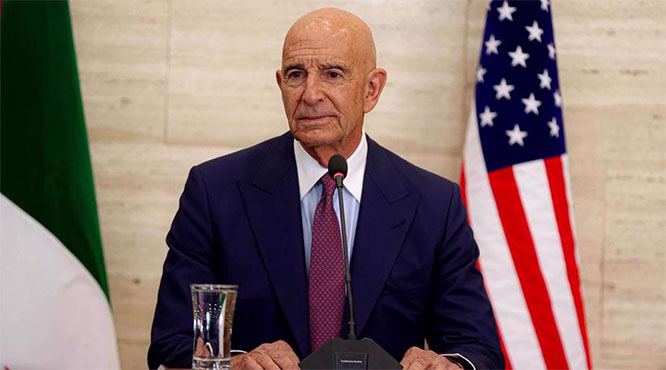
Since 1946, the United States has attempted 93 coups or “regime change” operations across the world — including two in Iran, US Special Envoy for Syria Tom Barrack has admitted.

Speaking to the UAE-based IMI Media Group, in remarks published by The National, Barrack said Washington tried twice to overthrow the Iranian government but failed both times. 

“For (Trump) then to be imputed with regime change — we had two regime changes in Iran already. Neither one worked. So I think wisely leave it to the region to solve,” said Barrack, who also serves as the US ambassador to Turkey.

His comments come six months after the US joined Israel in airstrikes against Iran during ongoing indirect nuclear negotiations between Tehran and Washington.

On June 13, Israel launched an attack on Iran that killed at least 1,064 people and hit civilian infrastructure. Days later, the United States targeted three nuclear facilities — Fordow, Natanz and Isfahan — in what Iran called a clear violation of international law. Iranian retaliation eventually forced a halt to the assault on June 24.

Barrack further claimed that US President Donald Trump and Foreign Secretary Marco Rubio are “not into regime change” and prefer a regional approach driven by Middle Eastern countries themselves. According to him, regional dialogue and non-interference by outside powers offer a more durable path forward.

He added that Washington is still open to an agreement with Tehran if Iranian authorities show “seriousness” and willingness to engage constructively.

However, Iran maintains the US has not shown readiness for meaningful talks. In an interview with Japan’s Kyodo News, Iranian Foreign Minister Abbas Araghchi said negotiations could advance only if Washington acknowledges Iran’s right to peaceful nuclear energy and lifts unilateral sanctions.

Comments

Add new comment

  • Coastaldigest.com reserves the right to delete or block any comments.
  • Coastaldigset.com is not responsible for its readers’ comments.
  • Comments that are abusive, incendiary or irrelevant are strictly prohibited.
  • Please use a genuine email ID and provide your name to avoid reject.
News Network
December 4,2025

indigoflight.jpg

Domestic carrier IndiGo has cancelled over 180 flights from three major airports — Mumbai, Delhi and Bengaluru — on Thursday, December 4, as the airline struggles to secure the required crew to operate its flights in the wake of new flight-duty and rest-period norms for pilots.

While the number of cancellations at Mumbai airport stands at 86 (41 arrivals and 45 departures) for the day, at Bengaluru, 73 flights have been cancelled, including 41 arrivals, according to a PTI report that quoted sources.

"IndiGo cancelled over 180 flights on Thursday at three airports-Mumbai, Delhi and Bengaluru," the source told the news agency.

Besides, it had cancelled as many as 33 flights at Delhi airport for Thursday, the source said, adding, "The number of cancellations is expected to be higher by the end of the day."

The Gurugram-based airline's On-Time Performance (OTP) nosedived to 19.7 per cent at six key airports — Delhi, Mumbai, Chennai, Kolkata, Bengaluru and Hyderabad — on December 3, as it struggled to get the required crew to operate its services, down from almost half of December 2, when it was 35 per cent.

"IndiGo has been facing acute crew shortage since the implementation of the second phase of the FDTL (Flight Duty Time Limitations) norms, leading to cancellations and huge delays in its operations across the airports," a source had told PTI on Wednesday.

Chaos continued at several major airports for the third day on Thursday because of the cancellations.

A spokesperson for the Kempegowda International Airport (KIA) in Bengaluru said that 73 IndiGo flights had been cancelled on Thursday.

At least 150 flights were cancelled and dozens of others delayed on Wednesday, airport sources said, leaving thousands of travellers stranded, according to news agency Reuters.

The Directorate General of Civil Aviation (DGCA) has said it is investigating IndiGo flight disruptions and has asked the airline to submit the reasons for the current situation, as well as its plans to reduce flight cancellations and delays.

It may be mentioned here that the pilots' body, Federation of Indian Pilots (FIP), has alleged that IndiGo, despite getting a two-year preparatory window before the full implementation of new flight duty and rest period norms for cockpit crew, "inexplicably" adopted a "hiring freeze".

The FIP said it has urged the safety regulator, the DGCA, not to approve airlines' seasonal flight schedules unless they have adequate staff to operate their services "safely and reliably" in accordance with the New Flight Duty Time Limitations (FDTL) norms.

In a letter to the DGCA late on Wednesday, the FIP urged the DGCA to consider re-evaluating and reallocating slots to other airlines, which have the capacity to operate them without disruption during the peak holiday and fog season if IndiGo continues to "fail in delivering on its commitments to passengers due to its own avoidable staffing shortages."

Comments

Add new comment

  • Coastaldigest.com reserves the right to delete or block any comments.
  • Coastaldigset.com is not responsible for its readers’ comments.
  • Comments that are abusive, incendiary or irrelevant are strictly prohibited.
  • Please use a genuine email ID and provide your name to avoid reject.