



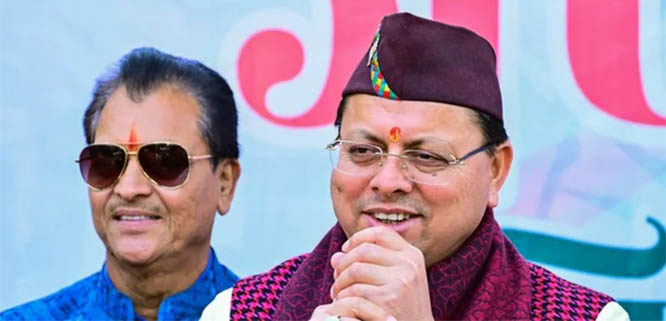
Uttarakhand becomes first state to implement Uniform Civil Code

News Network
January 27, 2025

uccuttarakhand.jpg

The Uniform Civil Code (UCC), a law that has faced long-standing criticism from the Opposition, will officially come into effect in Uttarakhand on January 27, making it the first state in independent India to put into effect such a law.

According to the state’s chief minister Pushkar Singh Dhami, the government has completed all preparations to implement the law, including getting approval of the rules for the implementation of the Act and training of officials concerned. The rationale given for the law is that it will bring about ‘uniformity in the society and ensure equal rights and responsibilities for all citizens.’

"UCC is just an offering made by our state in the great 'yagya' being performed by the Prime Minister to make the country a developed, organised, harmonious and self-reliant nation," PTI quoted Dhami as saying in a statement.

The BJP had made a promise to implement the Uniform Civil Code in Uttarakhand in the run-up to the 2022 assembly polls.These polls saw the party storming to power for a second consecutive term, something never done by any other party in the state since its creation in 2000.

According to CM Dhami, the historic mandate was because of the party's commitment to passing the UCC.

The Uniform Civil Code journey in Uttarakhand

The Uttarakhand state cabinet cleared a proposal to form an expert panel on the Uniform Civil Code in March 2022 in the first cabinet meeting after winning the assembly elections. The panel, headed by retired Supreme Court Judge Ranjana Prakash Desai, was constituted on May 27, 2022 to prepare the draft of the UCC.

The Desai committee submitted a comprehensive draft in four volumes, prepared after one and a half years of dialogue with different sections of the state's population. It was sent to the state on February 2, 2024 and just a few days later, the Uttarakhand assembly passed the UCC bill. President Droupadi Murmu gave it her assent in March 2024, nearly two years after the initial proposal.

Another expert committee was at work after that, headed by former chief secretary Shatrughna Singh. It was formed to frame the rules and regulations for the implementation of the Act. The Sinha committee submitted its report to the state government late last year.

The state cabinet gave its approval recently and authorised the chief minister to decide a date for its implementation. Dhami decided the date to be January 27, 2025, a day after the country celebrated its 76th Republic Day.

What is in the Uttarakhand UCC?

The Uniform Civil Code Act of Uttarakhand will govern and regulate the laws relating to marriage and divorce, succession, live-in relationships and related matters.

It sets equal marriageable age for men and women, grounds of divorce and procedures across all religions, and bans polygamy and 'halala'.

Doon University Vice Chancellor Surekha Dangwal, who was part of the panel that drafted the UCC and was among those who framed the rules for its implementation, described to PTI the provisions aimed at bringing about gender parity in matters of marriage, divorce and succession, treating all children as legitimate including those born of void or voidable marriages, simplifying the process of preparing a will and regulating live-in relationships as the most outstanding in the UCC. She termed gender parity across all religions as the spirit of UCC.

According to Duggal, the UCC makes registration of all marriages and live-in relationships mandatory. She also said that the government has created facilities to help people register their marriages online so that they do not have to run around government offices for it.

"Another remarkable feature of the UCC is that it treats all children as legitimate. We have in fact totally done away with the term illegitimate in the context of children," she said. The UCC also makes a special provision for defence personnel called "privileged will" which can be made both in writing or by word of mouth.

Any soldier or air force personnel engaged in an expedition or actual warfare or a mariner at sea can make a privileged will for which rules have been kept flexible.

UCC criticism

Opposition leaders have criticized the UCC, arguing that it may lead to societal division along religious lines and might be impractical and overly ambitious.
The debate surrounding the UCC extends beyond Uttarakhand, as Article 44 of the Indian Constitution advocates for a uniform civil code across the country. Prime Minister Narendra Modi has referenced the Supreme Court's direction on the need for a common code, stressing that fulfilling the vision of the Constitution's framers remains a national goal.

Uttarakhand's implementation of the UCC is likely to set a precedent, with other states potentially following suit. The success of the law's implementation will depend on its ability to balance individual rights and social harmony.

As Uttarakhand stands at the forefront of this legal revolution, the coming weeks will offer a clearer picture of how the UCC will be received, both in the state and across India. The state's experience with the UCC will undoubtedly shape the future of personal law reform in the country.

What is the implementation process?

Shailesh Bagauli, secretary (home), stated that the government will issue two notifications: one for the implementation of the UCC and another for the rules and regulations, officially launching the UCC in the state.

Dhami had promised to implement the UCC if re-elected during the 2022 state polls. After becoming CM, he appointed a five-member committee led by Justice Ranjana Prakash Desai to draft the code, which received feedback from over 2.3 lakh people, representing nearly 10% of Uttarakhand's families.

The 740-page draft was presented to the chief minister on February 2, 2024, approved by the cabinet on February 4, tabled in the assembly on February 6, and passed the following day. Governor Lt Gen Gurmit Singh (retd) approved the bill on February 28 and President Droupadi Murmu subsequently signed it on March 11.

Comments

Add new comment

  • Coastaldigest.com reserves the right to delete or block any comments.
  • Coastaldigset.com is not responsible for its readers’ comments.
  • Comments that are abusive, incendiary or irrelevant are strictly prohibited.
  • Please use a genuine email ID and provide your name to avoid reject.
News Network
January 19,2026

New Delhi: Setting speculation to the rest, the CPI(M) has made it clear that it is open to have an electoral understanding with the Congress “to defeat” the Trinamool Congress and the BJP in West Bengal Assembly election even as it is all set to take on the grand old party in Kerala accusing it of “found wanting” in fighting the Hindutva forces.

The CPI(M) also said that it will contest the Tamil Nadu election “with DMK and its allies to defeat the BJP and its allies”, amid a section in the Congress triggering confusion about its participation in the M K Stalin-led coalition over demand over power-sharing and more seats. It is also willing to join hands with Congress and others in Assam and Puducherry to defeat the BJP.

The decisions came at a three-day meeting of the CPI(M) Central Committee in Thiruvananthapuram, which ended on Sunday after reviewing the poll preparations in the poll-bound states.

The CPI(M)'s decision came even as a section led by West Bengal Congress president Subhankar Sarkar is averse to tying up with the Left Front, claiming that their party is not benefitted by the electoral understanding. Both Congress and CPI(M)-led Left Front had electoral understanding in 2016 and 2021 Assembly elections and 2024 Lok Sabha polls.

Congress and the Left Front fought together for the first time in 2016 when Congress won 44 seats and the CPI(M) got 26. In 2021, the Left Front and the Congress drew a blank. In the 2024 Lok Sabha polls, Congress managed to win one seat while the Left did not win any. In the 2019 Lok Sabha polls, both fought against each other with Congress winning two and the Left none.

“In Bengal, the party will work for the defeat of both the TMC and the BJP, which are trying to polarise the society. We will try to rally all the forces that are ready to work against them,” the CPI(M) said in a statement without naming Congress by name. Senior leaders said there is no change in its strategy of pooling all non-BJP, non-TMC votes.

However, the party was critical of the Congress in Kerala where both will fight against each other.

The CPI(M) said it would "expose the BJP-led Union government’s denial of rightful dues to Kerala, the fiscal constraints imposed and the overall attack on federalism" as also "expose the failure of the Congress to effectively counter this attack on federalism, as the largest opposition party in the Parliament".

"The Congress, especially in Kerala, was found wanting in the fight against communal RSS-BJP, ideologically and this will also be exposed before the people," it added.

In Assam, it said, the CPI(M) will work for the mobilisation of all the anti-BJP parties and forces and defeat the rabidly communal and divisive BJP government. The Left parties are cooperating with Congress in the north-eastern state. In Puducherry, it said it will work for the defeat of the BJP alliance government.

Comments

Add new comment

  • Coastaldigest.com reserves the right to delete or block any comments.
  • Coastaldigset.com is not responsible for its readers’ comments.
  • Comments that are abusive, incendiary or irrelevant are strictly prohibited.
  • Please use a genuine email ID and provide your name to avoid reject.
News Network
January 16,2026

gaurimurder.jpg

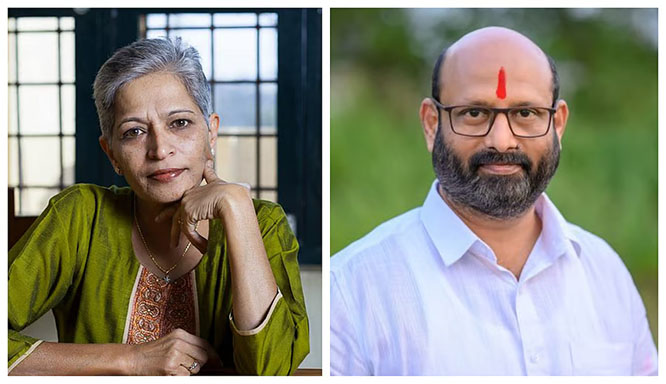
Mumbai: In a shocking development, Shrikant Pangarkar, an accused in the murder of journalist-activist Gauri Lankesh and the Nalasopara arms and ammunition haul case, has won the Jalna Municipal Corporation (JMC) elections as an independent candidate.

Pangarkar emerged victorious from Ward 13 of the JMC, where he was pitted against the BJP. Notably, the Shiv Sena led by Deputy Chief Minister Eknath Shinde, which contested the Jalna civic polls independently, did not field a candidate in the ward.

Gauri Lankesh was shot dead outside her residence in Bengaluru on September 5, 2017. A prominent journalist and activist, she edited Lankesh Patrike, a Kannada weekly founded by her father P Lankesh, and later ran her own publication, Gauri Lankesh Patrike.

Pangarkar was granted bail by the Karnataka High Court on September 4, 2024, in the Lankesh murder case. Ahead of the October 2024 Assembly elections, he was inducted into the Shiv Sena and appointed chief of the party’s Jalna campaign. However, following intense criticism, then Chief Minister Eknath Shinde revoked the appointment.

A former municipal councillor in Jalna between 2001 and 2006 from the undivided Shiv Sena under late Balasaheb Thackeray, Pangarkar later became associated with right-wing organisations.

In August 2018, he was arrested by the Maharashtra Anti-Terrorism Squad (ATS) in connection with the seizure of crude bombs and weapons in Nalasopara and booked under the Explosives Act, Explosive Substances Act, and the Unlawful Activities (Prevention) Act (UAPA). He is currently out on bail in both cases.

Soon after the election results were declared, Pangarkar’s supporters celebrated his victory.

After filing his nomination, Pangarkar had said he was returning to politics after a gap and had received an encouraging response from voters. “I have worked for the people earlier and have returned again,” he said, asserting that the cases against him had no bearing on the elections. “The matter is before the court. I stand before the nyay devta. There may be misunderstandings by agencies, but the court will decide. I am 100 per cent innocent,” he maintained, adding that the Lankesh murder case was unrelated to the civic polls and pertained to Karnataka.

Comments

Add new comment

  • Coastaldigest.com reserves the right to delete or block any comments.
  • Coastaldigset.com is not responsible for its readers’ comments.
  • Comments that are abusive, incendiary or irrelevant are strictly prohibited.
  • Please use a genuine email ID and provide your name to avoid reject.
News Network
January 23,2026

Karnataka Governor Thaawarchand Gehlot read only three lines from the 122-paragraph address prepared by the Congress-led state government while addressing the joint session of the Legislature on Thursday, effectively bypassing large sections critical of the BJP-led Union government.

The omitted portions of the customary Governor’s address outlined what the state government described as a “suppressive situation in economic and policy matters” under India’s federal framework. The speech also sharply criticised the Centre’s move to replace the Mahatma Gandhi National Rural Employment Guarantee Act (MGNREGA) with the Viksit Bharat–Guarantee for Rozgar and Ajeevika Mission (Gramin) Act, commonly referred to as the VB-GRAM (G) Act.

Governor Gehlot had earlier conveyed his objection to several paragraphs that were explicitly critical of the Union government. On Thursday, he confined himself to the opening lines — “I extend a warm welcome to all of you to the joint session of the State legislature. I am extremely pleased to address this august House” — before jumping directly to the concluding sentence of the final paragraph.

He ended the address by reading the last line of paragraph 122: “Overall, my government is firmly committed to doubling the pace of the State’s economic, social and physical development. Jai Hind — Jai Karnataka.”

According to the prepared speech, the Karnataka government demanded the scrapping of the VB-GRAM (G) Act, describing it as “contractor-centric” and detrimental to rural livelihoods, and called for the full restoration of MGNREGA. The state government argued that the new law undermines decentralisation, weakens labour protections, and centralises decision-making in violation of constitutional norms.

Key points from the unread sections of the speech:

•    Karnataka facing a “suppressive” economic and policy environment within the federal system

•    Repeal of MGNREGA described as a blow to rural livelihoods

•    VB-GRAM (G) Act accused of protecting corporate and contractor interests

•    New law alleged to weaken decentralised governance

•    Decision-making said to be imposed by the Centre without consulting states

•    Rights of Adivasis, women, backward classes and agrarian communities curtailed

•    Labourers allegedly placed under contractor control

•    States facing mounting fiscal stress due to central policies

•    VB-GRAM (G) Act accused of enabling large-scale corruption

Comments

Add new comment

  • Coastaldigest.com reserves the right to delete or block any comments.
  • Coastaldigset.com is not responsible for its readers’ comments.
  • Comments that are abusive, incendiary or irrelevant are strictly prohibited.
  • Please use a genuine email ID and provide your name to avoid reject.