Islamic style funeral: Simple burial for Saudi king who lived in palaces

[email protected] (CD Network)
January 23, 2015

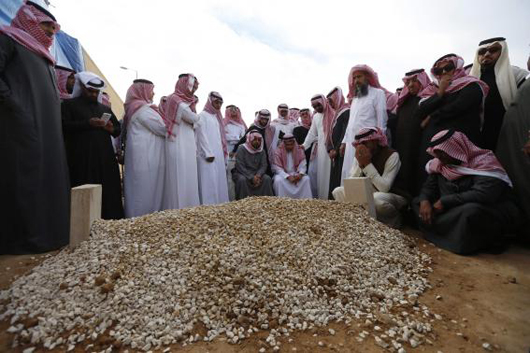
Riyadh, Jan 23: Saudi Arabia's King Abdullah, one of the richest men in the history of the world, was carried in a simple white shroud to an unmarked grave on Friday in a Riyadh cemetery where many of his commoner subjects rest, in keeping with ascetic traditions.

It was an Islamic-style burial without any innovation in the religion. There was no official mourning period in Saudi Arabia and flags around the kingdom all flew at full staff. Despite his apparent popularity among his subjects, there were no spontaneous gatherings on city streets to mark his passing.
saudi1

Government offices, closed for the Middle East's normal Friday-Saturday weekend, will open as usual on Sunday.

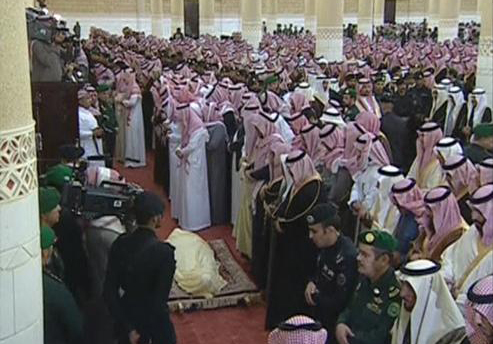
While the afternoon prayer that preceded Abdullah's burial took place before ranks of Muslim leaders, Saudi princes, powerful clerics and billionaire Arab businessmen, his body was transported to the Masjid in a city ambulance.

It was borne through the crowds on a carpet on a simple stretcher, laid in front of the faithful at prayer and then carried by Abdullah's male relatives to the graveyard, where it was laid in the ground with no ceremony.

It was a change for the king who, during his lifetime, travelled in the luxury one might expect of the absolute monarch of the world's leading oil exporter. A 2006 U.S. diplomatic cable noted that he personally asked a U.S. envoy for his Boeing 747 to be outfitted with all the same security systems as the Air Force One of his friend, then-President George W. Bush.

Compared to the opulent style of many of his brothers and nephews, Abdullah lived frugally, choosing to holiday in a desert camp instead of brash Mediterranean palaces. He was also known for curbing some of his family's excesses once in power, ordering princes to pay their phone bills and book seats on the national airline in advance.

As per Islam, elaborate shrines contradict the ideal of egalitarianism that should unite all Muslims. Many Islamic scholars have interpreted the tenet as requiring the destruction of shrines to Sufi saints and Shi'ite imams across the Middle East.

Abdullah's predecessors and other half brothers have also been interred in unmarked graves in the al-Aoud cemetery where he was buried on Friday, as well as in other simple graveyards in the kingdom's other cities.

The Al Saud family has also always striven to distinguish itself from European monarchies, preferring to hark to the tribal roots of its leadership in which ordinary Saudis theoretically remain able to petition kings.

Nevertheless, there is no shortage of monuments to Abdullah in Saudi Arabia: his name adorns a giant university in Jeddah, a scholarship fund, a "medical city" hospital complex in Makkah, the state renewable energy agency and a boulevard in Riyadh recently given a lavish upgrade.

Abdullah and his successor Salman style themselves as both king and Custodian of the Two Holy Masjids - a clear indication of how they view the importance of their religious credentials in underpinning their legitimacy.

saudi2 copy

saudi3

saudi4

Comments

Add new comment

  • Coastaldigest.com reserves the right to delete or block any comments.
  • Coastaldigset.com is not responsible for its readers’ comments.
  • Comments that are abusive, incendiary or irrelevant are strictly prohibited.
  • Please use a genuine email ID and provide your name to avoid reject.
News Network
December 7,2025

SHRIMP.jpg

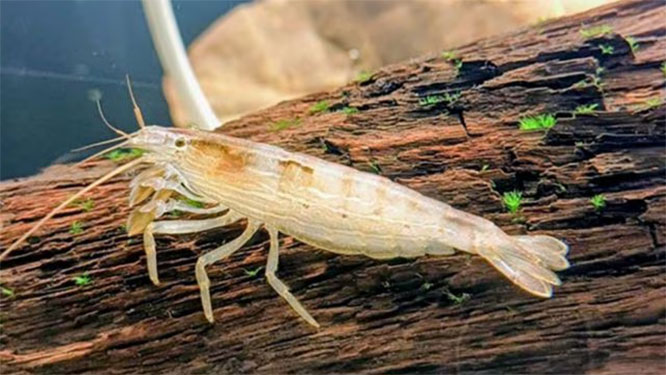
Mangaluru, Dec 7: A rare bamboo shrimp has been rediscovered on mainland India more than 70 years after it was last reported, confirming for the first time the presence of Atyopsis spinipes in the country. The find was made by researchers from the Centre for Climate Change Studies at Sathyabama Institute of Science and Technology, Chennai, during surveys in Karnataka and Odisha.

The team — shrimp expert Dr S Prakash, PhD scholar K Kunjulakshmi, and Mangaluru-based researcher Maclean Antony Santos — combined field surveys, ecological assessments and DNA analysis to identify the elusive species. Their findings, published in Zootaxa, resolve decades of taxonomic confusion stemming from a 1951 report that misidentified the species as Atyopsis moluccensis without strong evidence.

The shrimp has now been confirmed at two locations: the Mulki–Pavanje estuary near Mangaluru and the Kuakhai River in Bhubaneswar. Historical specimens from the Andaman Islands, previously labelled as A. moluccensis, were also found to be misidentified and actually belong to A. spinipes.

The rediscovery began after an aquarium hobbyist in Odisha spotted a shrimp in 2022, prompting systematic surveys across Udupi, Karwar and Mangaluru. Four female specimens were collected in Mulki and one in Odisha, all genetically matching.

Researchers warn the species may exist in very small, vulnerable populations as freshwater habitats face increasing pressure from pollution, sand mining and infrastructure development. All verified specimens have been deposited with the Zoological Survey of India for future reference.

Comments

Add new comment

  • Coastaldigest.com reserves the right to delete or block any comments.
  • Coastaldigset.com is not responsible for its readers’ comments.
  • Comments that are abusive, incendiary or irrelevant are strictly prohibited.
  • Please use a genuine email ID and provide your name to avoid reject.
News Network
December 2,2025

Puttur: The long-cherished dream of a government medical college in Puttur has moved a decisive step closer to reality, with the Karnataka State Finance Department granting its official approval for the construction of a new 300-bed hospital.

Puttur MLA Ashok Kumar Rai announced the crucial development to reporters on Monday, confirming that the official communication from the finance department was issued on November 27. This 300-bed facility is intended to be the cornerstone for the establishment of the government medical college, a project announced in the state budget.

Fast-Track Implementation

The MLA outlined an aggressive timeline for the project:

•    A Detailed Project Report (DPR) for the hospital is expected to be ready within 45 days.

•    The tender process for the construction will be completed within two months.

Following the completion of the tender process, Chief Minister Siddaramaiah is scheduled to lay the foundation stone for the project.

"Setting up a medical college in Puttur is a historical decision by the Congress government in Karnataka," Rai stated. The project has an estimated budget allocation of Rs 1,000 crore for the medical college.

Focus on Medical Education Department

The MLA highlighted a key strategic move: requesting the government to implement the hospital construction through the Medical Education Department instead of the Health and Family Welfare Department. This is intended to streamline the entire process of establishing the full medical college, ensuring the facilities—including labs, operation theatres, and other necessary infrastructure—adhere to the strict guidelines set by the Medical Council of India (MCI). The proposed site for the project is in Bannur.

Rai also took the opportunity to address political criticism, stating that the government has fulfilled its promise despite "apprehensions" and "mocking and criticising" from opposition parties who had failed to take similar initiatives when they were in power. "Chief Minister Siddaramaiah has kept his word," he added.

Comments

Add new comment

  • Coastaldigest.com reserves the right to delete or block any comments.
  • Coastaldigset.com is not responsible for its readers’ comments.
  • Comments that are abusive, incendiary or irrelevant are strictly prohibited.
  • Please use a genuine email ID and provide your name to avoid reject.
News Network
December 7,2025

Mangaluru, Dec 7: A 34-year-old fruit and vegetable trader in Mangaluru has reportedly lost ₹33.1 lakh after falling victim to an online investment scam run through a fake mobile app.

Police said the scam began in September, when the victim received a link on Facebook. Clicking it connected him to a WhatsApp number, where an unidentified person introduced a high-return investment scheme and instructed him to download an app.

To build trust, the fraudster asked him to invest ₹30,000 on September 24. The trader soon received ₹34,000 as “profit,” convincing him the scheme was genuine. Over the next two months, he transferred money in multiple instalments via Google Pay and IMPS to different scanner codes and bank accounts shared by the scammers. Between September 24 and December 3, he ended up sending a total of ₹33.1 lakh.

When he later requested a refund of his investment and promised returns, the scammers demanded additional payments, claiming he needed to pay a “service tax” first. Even after he paid a small amount, no money was returned, and the scammers continued pressuring him for more.

A case has been registered at the CEN Crime Police Station.

Comments

Add new comment

  • Coastaldigest.com reserves the right to delete or block any comments.
  • Coastaldigset.com is not responsible for its readers’ comments.
  • Comments that are abusive, incendiary or irrelevant are strictly prohibited.
  • Please use a genuine email ID and provide your name to avoid reject.