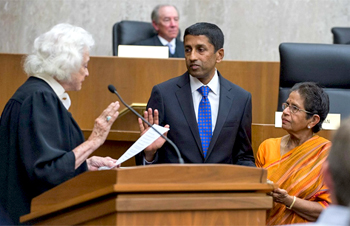
Judge Srinivasan becomes 1st Indian-American to lead federal circuit court

News Network
February 19, 2020

Washington, Feb 19: Sri Srinivasan, a prominent Indian-American judge, has created history by becoming the first person of South Asian descent to lead a powerful federal circuit court considered next only to the US Supreme Court.

Srinivasan, 52, became the Chief Judge of the United States Court of Appeals for the DC Circuit.

An Obama appointee who has already been considered for a Supreme Court seat twice, donned the mantle of the chief judge of the DC federal court circuit on February 12.

Srinivasan succeeded Judge Merrick Garland, who has been a member of the DC Circuit since 1997 and Chief Judge since 2013. He will remain on the bench, a press release said.

Notably, Garland's nomination to the Supreme Court by the then president Barack Obama was blocked by Senate Republicans in 2016.

Srinivasan, was appointed to the US Court of Appeals for the District of Columbia Circuit in May 2013.

He was the first ever Indian-American to be appointed to the second most powerful court of the US.

Neomi Rao, nominated by President Donald Trump, is the second Indian American on this powerful judiciary bench.

History being made on the DC Court of Appeals. Congratulations, Judge Srinivasan! Senator Mark Warner said.

Congratulations to Judge Sri Srinivasan on becoming the Chief Judge of the U.S. Court of Appeals for the D.C. Circuit! A milestone for the Indian-American/Kansan community (and yet another piece of evidence my family can use that I'm underachieving), US Federal Communications Commission Chair Ajit Pai said.

According to The Washington Post, Srinivasan spoke recently about his path to the bench at an event celebrating women in the law, a field where men still dominate leadership positions.

"Everybody doubts their belonging and worthiness in some measure. I definitely did and still do. This is just going to be a part of the thing when you're looking out in the world in which everyone isn't like you. It's natural to doubt whether you belong and whether you're worthy, he said, "but you do belong and you are worthy.

Born in Chandigarh, and raised in Lawrence, Kansas, he received a B.A. from Stanford University, a J.D. from Stanford Law School, and an M.B.A. from the Stanford Graduate School of Business.

Following graduation, he served as a law clerk to Judge J. Harvie Wilkinson III of the US Court of Appeals for the Fourth Circuit, as a Bristow Fellow in the Office of the US Solicitor General, and as a law clerk to US Supreme Court Justice Sandra Day O'Connor.

From 2011 until his appointment to the US Court of Appeals, Judge Srinivasan served as the Principal Deputy Solicitor General of the United States.

He has argued 25 cases before the US Supreme Court. He has also taught appellate advocacy at Harvard Law School as well as a seminar on civil rights statutes and the Supreme Court at Georgetown University Law Center.

Comments

Add new comment

  • Coastaldigest.com reserves the right to delete or block any comments.
  • Coastaldigset.com is not responsible for its readers’ comments.
  • Comments that are abusive, incendiary or irrelevant are strictly prohibited.
  • Please use a genuine email ID and provide your name to avoid reject.
News Network
December 6,2025

pilot.jpg

New Delhi: IndiGo, India’s largest airline, faced major operational turbulence this week after failing to prepare for new pilot-fatigue regulations issued by the Directorate General of Civil Aviation (DGCA). The stricter rules—designed to improve flight safety—took effect in phases through 2024, with the latest implementation on November 1. IndiGo has acknowledged that inadequate roster planning led to widespread cancellations and delays.

Below are the key DGCA rules that affected IndiGo’s operations:

1. Longer Mandatory Weekly Rest

Weekly rest for pilots has been increased from 36 hours to 48 hours.

The government says the extended break is essential to curb cumulative fatigue. This rule remains in force despite the current crisis.

2. Cap on Night Landings

Pilots can now perform only two night landings per week—a steep reduction from the earlier limit of six.

Night hours, defined as midnight to early morning, are considered the least alert period for pilots.

Given the disruptions, this rule has been temporarily relaxed for IndiGo until February 10.

3. Reduced Maximum Night Flight Duty

Flight duty that stretches into the night is now capped at 10 hours.

This measure has also been kept on hold for IndiGo until February 10 to stabilize operations.

4. Weekly Rest Cannot Be Replaced With Personal Leave

Airlines can no longer count a pilot’s personal leave as part of the mandatory 48-hour rest.

Pilots say this closes a loophole that previously reduced actual rest time.

Currently, all airlines are exempt from this rule to normalise travel.

5. Mandatory Fatigue Monitoring

Airlines must submit quarterly fatigue reports along with corrective actions to DGCA.

This system aims to create a transparent fatigue-tracking framework across the industry.

The DGCA has stressed that these rules were crafted to strengthen flight safety and align India with global fatigue-management standards. The temporary relaxations are expected to remain until February 2025, giving IndiGo time to stabilise its schedules and restore normal air travel.

Comments

Add new comment

  • Coastaldigest.com reserves the right to delete or block any comments.
  • Coastaldigset.com is not responsible for its readers’ comments.
  • Comments that are abusive, incendiary or irrelevant are strictly prohibited.
  • Please use a genuine email ID and provide your name to avoid reject.
News Network
December 4,2025

indigocrisis.jpg

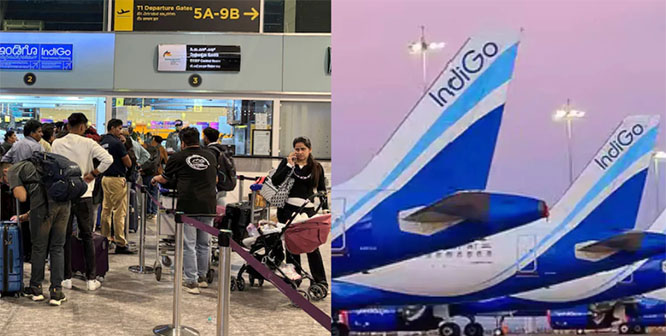
Angry outbursts, long queues, and desperate appeals filled airports across India today as IndiGo grappled with a severe operational breakdown. Hundreds of flights have been cancelled or delayed, leaving thousands of passengers stranded through the night and forcing many to spend long hours at helpdesks.

Social media was flooded with videos of fliers pleading for assistance, accusing the airline of misleading updates, and demanding accommodation after being stuck for 10 to 12 hours at airports such as Hyderabad and Bengaluru.

What Triggered the Meltdown?

IndiGo has attributed the widespread disruption to “a multitude of unforeseen operational challenges.” These include:

•    Minor technology glitches
•    Winter-season schedule adjustments
•    Bad weather
•    Congestion in the aviation network
•    New crew rostering rules (Flight Duty Time Limitations or FDTL)

Among these, the most disruptive has been the implementation of the updated FDTL norms introduced by the Directorate General of Civil Aviation (DGCA) in January 2024.

These rules were designed to reduce pilot fatigue and improve passenger safety. Key changes include:

•    Longer weekly rest periods for flight crew
•    A revised definition of “night,” extending it by an extra hour
•    Tighter caps on flight duty timing and night landings
•    Cutting night shifts for pilots and crew from six per roster cycle to just two

Once these norms became fully enforceable, airlines were required to overhaul rosters well in advance. For IndiGo, this triggered a sudden shortage of crew available for duty, leading to cascading delays and cancellations.

Why IndiGo Was Hit the Hardest

IndiGo is India’s largest airline by a wide margin, operating over 2,200 flights daily. That’s roughly double the number operated by Air India.

When an airline of this size experiences even a 10–20% disruption, it translates to 200–400 flights being delayed or grounded — producing massive spillover effects across the country.

IndiGo also relies heavily on high-frequency overnight operations, a model typical of low-cost carriers that aim to maximise aircraft utilisation and reduce downtime. The stricter FDTL norms clash with these overnight-heavy schedules, forcing the airline to pull back services.

Aviation bodies have also criticised IndiGo’s preparedness. The Airline Pilots' Association of India (ALPA) said airlines were given a two-year window to plan for the new rules but “started preparing rather late.” IndiGo, it said, failed to rebuild crew rosters 15 days in advance as required.

The Federation of Indian Pilots (FIP) went further, calling the crisis the result of IndiGo’s “prolonged and unorthodox lean manpower strategy,” and alleging that the airline adopted a hiring freeze even as it knew the new rules would require more careful staffing.

How Many Flights Are Affected?

In the past 48 hours, over 300 flights have been cancelled. At least 100 more are expected to be cancelled today.

City-wise impact:

•    Hyderabad: 33 expected cancellations; several fliers stranded overnight
•    Bengaluru: over 70 expected cancellations
•    Delhi, Mumbai, Chennai, Kolkata: widespread delays and missed connections

Passengers shared distressing accounts online.

One customer at Hyderabad airport said they waited from 6 PM to 9 AM with “no action taken” regarding their delayed Pune flight. Another said IndiGo repeatedly told them the crew was “arriving soon,” only for the delay to stretch over 12 hours.

IndiGo has apologised for the disruption and promised that operations will stabilise within 48 hours, adding that “calibrated adjustments” are being made to contain the chaos.

What Should Passengers Do Now?

For those flying in the next few days, especially with IndiGo, here are key precautions:

1. Keep Checking Flight Status
Monitor your flight closely before leaving for the airport, as delays may be announced last-minute.

2. Arrive Early
Expect long queues at counters and security due to crowding and rescheduling.

3. Carry Essentials
Pack snacks, water, basic medicines, chargers, and items for children or senior citizens. Extended waiting times should be anticipated.

4. Use Flexible Booking Options
If you booked tickets with a free-date-change or cancellation option, consider using them.
If you haven’t booked yet, prefer refundable or flexible fares, or even consider alternate airlines.

5. Follow IndiGo’s Updates
Keep an eye on IndiGo’s official social media channels and contact customer support for rebooking and refund queries.

What Needs to Change?

Pilot groups have raised concerns not just about staffing but also the planning practices behind it.
The Federation of Indian Pilots accused IndiGo of:

•    Imposing an unexplained hiring freeze despite knowing the FDTL changes were coming
•    Entering non-poaching agreements that limited talent movement
•    Keeping pilot pay frozen
•    Underestimating the need to restructure operations in advance

They have urged DGCA to approve seasonal schedules only after airlines prove they have adequate pilot strength under the new norms.

ALPA also warned that some airlines might be using the delays as an “immature pressure tactic” to push DGCA for relaxations in the new rules — which, if granted, could compromise the very safety standards the norms were meant to protect.

Both pilot bodies stressed that no exemption should dilute safety, and any deviations should be based solely on scientific risk assessment.

Is a Solution in Sight?

While IndiGo says normalcy will return within two days, aviation experts believe that fully stabilising operations could take longer, depending on how quickly the airline can:
•    Re-align rosters
•    Mobilise rested crew
•    Boost staffing
•    Adjust its winter schedule to match regulatory requirements
Passengers are advised to remain prepared for continued delays over the next few days as the airline works through its backlog. 

Comments

Add new comment

  • Coastaldigest.com reserves the right to delete or block any comments.
  • Coastaldigset.com is not responsible for its readers’ comments.
  • Comments that are abusive, incendiary or irrelevant are strictly prohibited.
  • Please use a genuine email ID and provide your name to avoid reject.
News Network
December 5,2025

Mangaluru: In a significant step to curb online hate and intimidation, Mangaluru City Police have registered a suo motu case against multiple Instagram accounts accused of circulating alleged provocative and threatening content.

While monitoring social media activity on Tuesday, Kankanady Town PSI Anitha Nikkam identified the Instagram handle ‘team_targetttt_900’ for posting a hate message alongside images of lethal weapons. Another account, ‘team_nagara_900’, allegedly shared a threatening post targeting activist Bharath Kumdelu, tagging additional pages such as KARAVALI-OFFICIAL.

Several other accounts — including ‘immu_bhai.fan’, ‘target_boy_900’, ‘kings_of_manglore’, ‘team_target_boys.900’, ‘arshad_mangalore’, ‘target_ka19_ullal’, ‘team_target__’, ‘troll_tigersz_900’, ‘tr_group_900’, and ‘team_target_900’ — are also under scrutiny for spreading similar inflammatory material, police said.

Authorities have urged citizens, especially young social media users, to report suspicious pages and avoid engaging with groups that glorify violence or threaten individuals. Online hate can quickly escalate into real-world harm, and police stress that sharing or promoting such content can attract legal consequences.

Comments

Add new comment

  • Coastaldigest.com reserves the right to delete or block any comments.
  • Coastaldigset.com is not responsible for its readers’ comments.
  • Comments that are abusive, incendiary or irrelevant are strictly prohibited.
  • Please use a genuine email ID and provide your name to avoid reject.