Lies and propaganda galore after abrogation of Article 370

Ram Puniyani
November 16, 2019

It is over three months that the Article 370 has been abrogated. The procedure laid down by the law has been given a go bye and through a majority in Lok Sabha, bypassing the people of Kashmir the act has been done. While many a falsehood has been promoted, lately two such surfaced yet again. Paying tribute to Sardar Patel on 31st October, Sardar’s anniversary, Narendra Modi, dedicated the abolition of this article to him. Interestingly it was Sardar who was crucial part of the Committee which had drafted the said article. Also it was Sardar Patel who had moved the resolution of Article 370 in Constituent Assembly as Pundit Jawaharlal Nehru, one dealing with the issue as External Affairs minister, was away to US at that time.

With lapse of time not only the ancient and medieval history is being doctored to suit the communal politics, even the recent history is also under mutilation by likes of Modi who are currently ruling the roost. The other point which the Prime Minster and the other top officials are harping strongly is that it was this article due to which terrorism was getting a boost! The point they want to make is that with the abrogation of this article terrorism will be controlled in the troubled state. As public memory is short it is necessary to recall that while hurling the disaster of demonetization on the country, similar claim was made that counterfeit currency is fuelling the terrorism and demonetization will wipe out the militancy in Kashmir. As the matters turned out along with other claims about merits of demonetization even this claim turned out to be totally hollow and false.

As a blockade has been put on Kashmir, normal life brought to standstill, local leaders arrested and national leaders not permitted to visit the valley, in a very clever manner a delegation of some European right wing MPs has been put together by some business person, in the name of an NGO. The invitation to the MP, Chris Davies, who said that he will like to meet the local people on his own; was withdrawn right away and the compliant MP’s did come for a the trip. Their job was to give the ‘All is well’ certificate to the Modi Governments move after the ‘conducted tour’, which they enjoyed.

During this period despite the presence of military in large numbers, despite the claims that the abolition of this article will curtail terrorism in the valley, already disturbing killings have been taking place. In one such tragic incident five migrant workers from West Bengal have been done to death, shot dead in Jammu Kashmir’s Kulgam. Prior to this there was attack on people related to fruit trade. In another shocking and painful incident one person died and fifteen injured in a grenade attack in Srinagar, in a vegetable market where vendors were targeted.

On one hand the people of J&K are feeling humiliated as their state has been demoted to a Union Territory and on the other there are boasts that this is what was the dream of Sardar Patel!

The false hood that India has eliminated one big reason behind terrorism is totally away from truth. This understanding negates the facts of history and builds the narrative to suit the politics being pursued by BJP. Why was militancy there in Kashmir? As such the story begins with Pakistan’s attack on Kashmir, in the form of Kabayalis (Tribal), who were backed by the Pakistan army. Since Kashmiri people did not want to succumb to the “Two Nation Theory” propagated by communal elements, since they were more for secular democracy, they did request Indian Government to quell the Pakistani aggression. The complex process leading the treaty of Accession and later article 370 through Indian Constituent Assembly has been dealt with extensively by serious commentators.

The efforts of likes Shyama Prasad Mukherjee to put pressure to forcibly merge Kashmir with India, the rise of communal politics in India sent the feeling of disenchantment to Sheikh Abdullah in particular, the one who as such was instrumental in accession of Kashmir to India. To cut the long story short, Sheikh’s apprehensions were answered by putting him in the prison and this is what sowed the seeds of alienation among people of Kashmir. This alienation of Kashmir people duly supported by Pakistan is what has been the root cause of terrorism in Kashmir. Article 370 was the protective cover which by giving the autonomy to the state of J&K was a big obstacle to the proliferation of terrorism as such. Of course the global situation where by America sowed the seeds of Al Qaeda to fight against Russian army added on to the problem as the Al Qaeda and its clones, after defeating the Russian army in alliance with anti Soviet Forces, made their entry into the troubled state, and communalized the militancy. Thirty years down the line now the picture is being presented in an obverse way.

What was needed was to instill more democracy in the state and involve the disgruntled elements into the process of dialogue. Of course the negative role of Pakistan, backed up thoroughly by America has been the major factor. The problems can be solved only when the correct diagnosis of the issue is made. The warped understanding of recent history by communalists, is dictating the current politics and so the blame of militancy is being put on article 370. Article 370 has also been blamed for lack of development in Kashmir.

The truth is that in social development indices Kashmir’s indices are better than many states and above the national averages. Time alone will tell how Pakistan behaves, how the cancerous Al Qaeda type elements will be tackled within the state. An all round process of dialogues on the issue is a must. Strengthening of democratic process seems to be the only way to restore peace and overcome the violence which is the tormenting the people of Kashmir!

Comments

Add new comment

  • Coastaldigest.com reserves the right to delete or block any comments.
  • Coastaldigset.com is not responsible for its readers’ comments.
  • Comments that are abusive, incendiary or irrelevant are strictly prohibited.
  • Please use a genuine email ID and provide your name to avoid reject.
News Network
January 23,2026

Karnataka Governor Thaawarchand Gehlot read only three lines from the 122-paragraph address prepared by the Congress-led state government while addressing the joint session of the Legislature on Thursday, effectively bypassing large sections critical of the BJP-led Union government.

The omitted portions of the customary Governor’s address outlined what the state government described as a “suppressive situation in economic and policy matters” under India’s federal framework. The speech also sharply criticised the Centre’s move to replace the Mahatma Gandhi National Rural Employment Guarantee Act (MGNREGA) with the Viksit Bharat–Guarantee for Rozgar and Ajeevika Mission (Gramin) Act, commonly referred to as the VB-GRAM (G) Act.

Governor Gehlot had earlier conveyed his objection to several paragraphs that were explicitly critical of the Union government. On Thursday, he confined himself to the opening lines — “I extend a warm welcome to all of you to the joint session of the State legislature. I am extremely pleased to address this august House” — before jumping directly to the concluding sentence of the final paragraph.

He ended the address by reading the last line of paragraph 122: “Overall, my government is firmly committed to doubling the pace of the State’s economic, social and physical development. Jai Hind — Jai Karnataka.”

According to the prepared speech, the Karnataka government demanded the scrapping of the VB-GRAM (G) Act, describing it as “contractor-centric” and detrimental to rural livelihoods, and called for the full restoration of MGNREGA. The state government argued that the new law undermines decentralisation, weakens labour protections, and centralises decision-making in violation of constitutional norms.

Key points from the unread sections of the speech:

•    Karnataka facing a “suppressive” economic and policy environment within the federal system

•    Repeal of MGNREGA described as a blow to rural livelihoods

•    VB-GRAM (G) Act accused of protecting corporate and contractor interests

•    New law alleged to weaken decentralised governance

•    Decision-making said to be imposed by the Centre without consulting states

•    Rights of Adivasis, women, backward classes and agrarian communities curtailed

•    Labourers allegedly placed under contractor control

•    States facing mounting fiscal stress due to central policies

•    VB-GRAM (G) Act accused of enabling large-scale corruption

Comments

Add new comment

  • Coastaldigest.com reserves the right to delete or block any comments.
  • Coastaldigset.com is not responsible for its readers’ comments.
  • Comments that are abusive, incendiary or irrelevant are strictly prohibited.
  • Please use a genuine email ID and provide your name to avoid reject.
News Network
January 20,2026

DGP.jpg

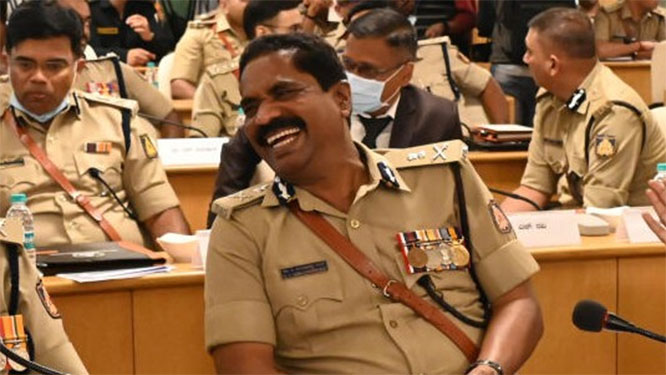
Karnataka DGP (Civil Rights Enforcement) K Ramachandra Rao was suspended with immediate effect, as per a state government order issued on Monday, 19 January. The order cited conduct unbecoming of a government servant and causing embarrassment to the state administration.

The Karnataka government suspended Rao after a purported video showed him in a compromising position with a woman inside his official chamber. The video went viral on social media. Rao rejected the videos outright, terming them "fabricated and false".

Who is K Ramachandra Rao?

Rao is a DGP-rank officer who was heading the Directorate of Civil Rights Enforcement until his suspension. He was promoted to DGP in September 2023 and assumed office in October 2023, the Sunday Guardian reported.

He also served as the Chairman and Managing Director of the Karnataka State Police Housing and Infrastructure Development Corporation Limited.

His stint as the Inspector General of Police (IGP) for the Southern Range was also marred by controversy. In 2014, during a cash seizure near Mysuru’s Yelwal, officials claimed the seized amount was ₹20 lakh, while the accused (Kerala-based merchants) claimed it was around ₹2.27 crore.

Rao, who was present during the seizure, denied all allegations. However, he was transferred soon after.

Allegations of collusion with a businessman surfaced, and a senior police officer was quoted by The Sunday Guardian as saying, “In Rao’s case, the CID has clearly mentioned that there was a great degree of lapse on the part of Rao and a deputy superintendent of police after it was brought to their notice that a few policemen, including a gunman attached to the IGP, were involved in the robbery.”

Rao had denied all wrongdoing in that incident. Despite past controversies, he rose to the state’s top police position, the Sunday Guardian reported.

Ranya Rao’s stepfather

Rao is the stepfather of Kannada actress Harshavardhini Ranya alias Ranya Rao, accused of orchestrating the illegal import of gold worth over ₹12.56 crore from Dubai to India along with two others — businessman Tarun Raju, and jewellery dealer Sahil Jain.

‘Obscene video’ controversy

A viral video showed Rao behaving inappropriately with a woman inside his office while in uniform.

The Karnataka government said in its Monday order that “vide videos and news reports widely broadcast on public news channels and media platforms, it is observed that Dr K Ramachandra Rao has acted in an obscene manner which is unbecoming of a Government Servant and also causing embarrassment to the Government.”

The order said the matter was examined by the state government, which found that the officer's conduct amounted to a violation of Rule 3 of the All India Services (Conduct) Rules, 1968.

The government said it is prima facie satisfied that "it is necessary to place Rao under suspension with immediate effect, pending inquiry".

During the suspension period, Rao will be entitled to subsistence allowance as per Rule 4 of the All India Services (Discipline and Appeal) Rules, 1969.

The order also places restrictions on his movement, stating that during the period of suspension, the officer must not leave headquarters under any circumstances without the written permission of the state government.

Comments

Add new comment

  • Coastaldigest.com reserves the right to delete or block any comments.
  • Coastaldigset.com is not responsible for its readers’ comments.
  • Comments that are abusive, incendiary or irrelevant are strictly prohibited.
  • Please use a genuine email ID and provide your name to avoid reject.
coastaldigest.com news network
January 19,2026

rizwanzameer.jpg

Bengaluru: As the dust settles on the recent legislative session, the corridors of Vidhana Soudha are buzzing with more than just policy talk. A high-stakes game of political musical chairs has begun, exposing a deepening rift within the Congress party’s Muslim leadership as a major Cabinet reshuffle looms.

With the party hierarchy signaling a "50% refresh" to gear up for the 2028 Assembly elections, the race to fill three projected Muslim ministerial berths has transformed from a strategic discussion into an all-out turf war.

The "Star Son" Spark

The internal friction turned public this week following provocative remarks by Zaid Khan, actor and son of Wakf Minister Zameer Ahmed Khan. Zaid’s claim—that his father "helped" secure a ticket for Shivajinagar MLA Rizwan Arshad in 2023—has acted as a lightning rod for resentment.

Rizwan’s camp was quick to fire back, dismissing the comment as a desperate attempt by Zameer to manufacture seniority. "Rizwan’s political pedigree was forged in the NSUI and Youth Congress long before Zameer even stepped into the party," a supporter noted, highlighting Rizwan’s tenure as an AICC secretary and his two-term presidency of the State Youth Congress.

A Tale of Two Loyalists

While both Zameer Ahmed Khan and Rizwan Arshad are staunch allies of Chief Minister Siddaramaiah and represent Bengaluru strongholds, their political DNA could not be more different:

•    Zameer Ahmed Khan: A four-time MLA who crossed over from JD(S) in 2018. Known for his "overzealous" and often polarizing outreach during communal flashpoints—from the DJ Halli riots to the recent Wakf land notice controversy—his style has frequently left the Congress high command in a state of "discomfort."

•    Rizwan Arshad: A homegrown organizational man. Seen as a "quiet performer," Arshad represents the sophisticated, moderate face of the party, preferred by those who find Zameer’s brand of politics too volatile.

The Outsiders Looking In

The bickering isn't limited to a duo. The "Beary" community, represented by leaders like N A Haris and Saleem Ahmed, is demanding its pound of flesh. Saleem Ahmed, the Chief Whip in the Legislative Council, has dropped the veil of diplomacy, openly declaring his ministerial aspirations.

"I was the only working president not included in the Cabinet last time," Saleem noted pointedly, signaling that the "loyalty quota" is no longer enough to keep the peace.

As Chief Minister Siddaramaiah prepares to finalize the list, he faces a delicate balancing act: rewarding the aggressive grassroots mobilization of Zameer’s camp without alienating the organizational stalwarts and minority sub-sects who feel increasingly sidelined by the "Chamarajpet-Shivajinagar" binary.

Comments

Add new comment

  • Coastaldigest.com reserves the right to delete or block any comments.
  • Coastaldigset.com is not responsible for its readers’ comments.
  • Comments that are abusive, incendiary or irrelevant are strictly prohibited.
  • Please use a genuine email ID and provide your name to avoid reject.