



Mangaluru: Mar 30: Stating that the Digital India Programme of the Union Government aims to transform India to a connected economy, Dr Vijay Kumar Saraswat, NITI Ayog member, said that it intends to connect 2.5 lakh villages across India through broadband highways, public internet access, universal access to mobile connectivity, e-governance, e-kranti and information to all. It aims to empower citizens – especially rural citizens – by making them digitally literate and by making available the digital resources in their native languages with a view to making their participation a reality.
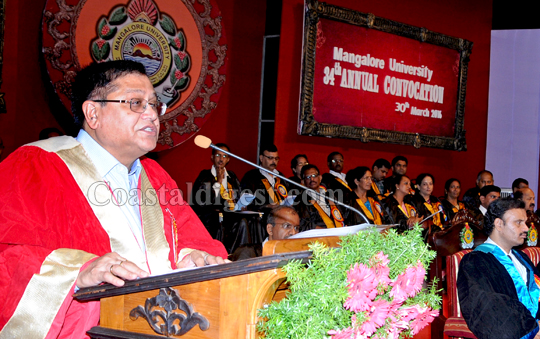
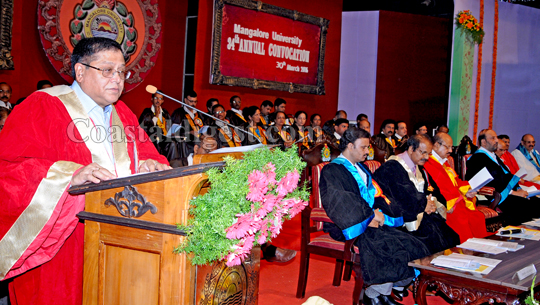
Delivering the 34th convocation address of Mangalore University on Wednesday, he said: “The Digital India Programme encompasses that by the end of 2018, India would emerge as advanced digital economy. With digitisation, 2.50 lakh gram panchayats will get broadband facility, covering entire rural India. Also, with the availability of pan-India network, emergency services will become mobile. By 2019, 2.50 lakh villages will have access to broadband, along with universal phone connectivity, 4 lakh public internet access points and wifi hotspots for schools, colleges, and citizens.”
He said that a predictable regulatory environment that protects the existing investments while creating room for new ones is important for inclusive digital society in the country. Attracting private investors to build internet infrastructure in remote places requires presence of favourable conditions like a stable regulatory environment. The stable regulatory policy should be an enabler and not an obstacle for investments, he explained.
“The selection of frequency bands and coverage obligations can affect the telecom operators' costs and investments. The use of low-frequency bands is one way of lowering the cost, while another way to reduce costs through spectrum assignment is to include rural coverage requirements in new spectrum licences, which might justify lower licence fee,” he added.
“Digitisation will bring in a paradigm shift in the focus of activities like improving productivity, transforming business process and creating knowledge and supporting human activities from being computer-centric to network-centric to human-centric. It is expected that Smart City Infrastructure world wide will grow by $ 16,000 billion by 2020,” the NITI Ayog member said.
On the hardware challenges for creating inclusive digital society, Dr Saraswat said that the use of low-power hardware with long battery life is crucial in an environment with erratic power supply. There is a need to strike a balance between low cost and solid reliable functional technology. The hardware products need to be designed with durability in mind, including resistance to water, humidity, dust, dirt and extreme heat, he said.










Comments
Please add photo of ALL GOLD MEDAL STUDENTS RECEIVING AWARD IN THE 34TH CONVOCATION GALLERY
Add new comment