



New Delhi, Oct 26: Perhaps not many people in India know much about the Edhi foundation of Pakistan. The return of deaf and mute Indian girl Geeta from Karachi has forced the Indian media to talk about this foundation and its noble deeds, which is a household name in Pakistan. Some say that after Pakistan’s founder Mohammed Ali Jinnah, India-born 87-year-old founder of the Edhi foundation Abdul Sattar Edhi is the second most revered personality in the history of Pakistan.
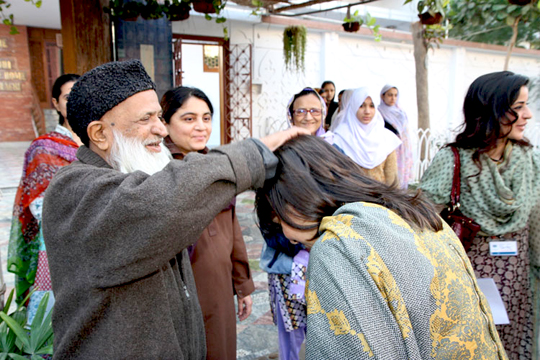
A partition refugee, Edhi started the foundation in 1951 in Karachi. Just 23-year-old then, he begged on the streets of Karachi to mobilise money for an ambulance. With the money he collected, he only managed to buy a battered van, which he converted into an ambulance. According to journalist Peter Oborne, who made a documentary on the Edhi foundation, the founder Abdul Sattar Edhi is a 'living saint'.
In an article for ‘The Telegraph’ in 2011, he writes, “In the course of my duties as a reporter, I have met presidents, prime ministers and reigning monarchs. Until meeting the Pakistani social worker Abdul Sattar Edhi, I had never met a saint. Within a few moments of shaking hands, I knew I was in the presence of moral and spiritual greatness. Edhi's life story is awesome, as I learnt when I spent two weeks working at one of his ambulance centres in Karachi. The 82-year-old lives in the austerity that has been his hallmark all his life. He wears blue overalls and sports a Jinnah cap, so named because it was the head gear of Muhammad Ali Jinnah, the founder of Pakistan. No Pakistani since Jinnah has commanded the same reverence, and our conversations were constantly interrupted as people came to pay their respects.”
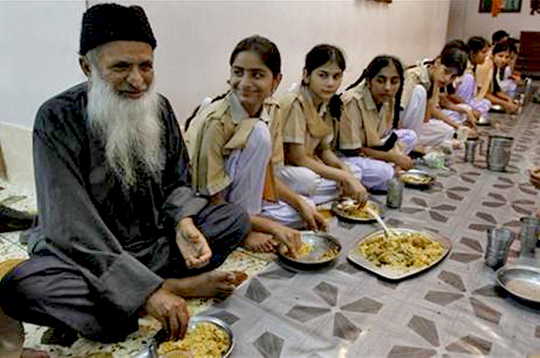
Highly motivated and selfless, Edhi has set up centres all over Pakistan in the last 60 odd years. He runs orphanages, homes for the mentally ill, drug rehabilitation centres, runs hundreds of ambulances and hostels for abandoned women. According to Oborne, Edhi has fed the poor and buried the dead. His compassion is boundless.
A Gujarati Muslim, Edhi was born at Bantva in Junagarh district of Gujarat in 1928. He fled to Pakistan during the 1947 partition riots and made Karachi his home. Finding himself penniless on the streets of Karachi, 20-year-old Edhi set out on his life's mission. He volunteered to join a charity run by the Memons, the Islamic religious community to which his family belonged. Edhi was happy with that volunteer job for some time.
Later he was shocked to discover that the Memon's foundation’s charity works were restricted only to Memons and they did not bother about other unfortunate people. The young and idealistic, Edhi took on his Memon foundation chiefs. He told them that "humanitarian work loses its significance when you discriminate between the needy".
According to Peter Oborne, he left the Memon foundation to set up a small medical centre of his own, sleeping on the cement bench outside his shop so that even those who came late at night could be served. But he also had to face the enmity of the Memons, and became convinced they were capable of having him killed. For his safety, and in search of knowledge, he set out on an overland journey to Europe, begging all the way. One morning, he awoke on a bench at Rome railway station to discover that his shoes had been stolen. He was not bothered, considering them inessential. Nevertheless, an elderly lady gave him a pair of gumboots the next day, two sizes too large, and Edhi wobbled about in them for the remainder of his journey. In London, he was a great admirer of the British welfare state, though he presciently noted its potential to encourage a culture of dependency. He was offered a job but refused, telling his benefactor: "I have to do something for the people in Pakistan."
On return from Europe, his destiny was set. There was no welfare state in Pakistan in 1950s, he would fill the gap. This was a difficult period in his life. Shabby, bearded and with no obvious prospects, seven women in rapid succession turned down his offers of marriage. He resigned himself to chastity and threw all of his energy into work.
He would hurtle round the province of Sindh in his poor man's ambulance, collecting dead bodies, taking them to the police station, waiting for the death certificate and, if the bodies were not claimed, burying them himself. Edhi's autobiography, published in 1996, records that he recovered these stinking cadavers "from rivers, from inside wells, from road sides, accident sites and hospitals. When families forsook them, and authorities threw them away, I picked them up… Then I bathed and cared for each and every victim of circumstance."
There is a photograph of Edhi from this formative time. It could be the face of a young revolutionary or poet: dark beard, piercing, passionate eyes. And it is indeed the case that parts of his profound and moving autobiography carry the same weight and integrity as great poetry or even scripture writes Oborne.
Edhi set up an orphanage for the new born who were being killed by their own unwed mothers to avoid social stigma. One newborn child was stoned to death outside a mosque on the orders of religious leaders. A furious Edhi responded, "Who can declare an infant guilty when there is no concept of punishing the innocent?" He placed a little cradle outside every Edhi centre, beneath a placard imploring, "Do not commit another sin: leave your baby in our care." Edhi has so far saved 35,000 babies and, in approximately half of these cases, found families to cherish them.
His bold, humanitarian efforts brought him into conflict with the fanatic religious leaders. They even declared him an infidel and even plotted to eliminate him. To this he said, "Beware of those who attribute petty instructions to God."
But Edhi’s vast moral authority forced even the Pakistan's most corrupt politicians accept him as a living saint. In 1982, General Zia announced the establishment of a shura (advisory council) to determine matters of state according to Islamic principles.
According to an article in ‘Telegraph’, Edhi was suspicious: "I represented the millions of downtrodden, and was aware that my presence gave the required credibility to an illegal rule." Travelling to Rawalpindi to speak at the national assembly, he delivered a passionate denunciation of political corruption, telling an audience of MPs, including Zia himself: "The people have been neglected long enough. "One day they shall rise like mad men and pull down these walls that keep their future captive. Mark my words and heed them before you find yourselves the prey instead of the predator." Edhi did not distinguish between politicians and criminals, asking: "Why should I condemn a declared dacoit [bandit] and not condemn the respectable villain who enjoys his spoils as if he achieved them by some noble means?", writes Oborne.
According to his close aides, although Edhi has a traditional Islamic background, he has an open and progressive mind on a number of sensitive social issues. He strongly supports the notion of working women. Of the 2,000 paid workers of the Edhi Foundation around 500 are women. They work in various capacities in-charges of Edhi centres, heads of maternity homes and dispensaries and office workers. Moreover, several women volunteers help Edhi Foundation in fund raising. Edhi encourages women to do all sorts of work without differentiation.
According to Edhi foundation website, Bilquis Bano Edhi, wife of Abdul Sattar Edhi, is a professional nurse and one of the most active philanthropists in Pakistan. She has been nicknamed, The Mother of Pakistan. She was born in 1947 in Karachi. She heads the Bilquis Edhi Foundation, and with her husband received the 1986 Ramon Magsaysay Award for Public Service. Her charity runs many services in Pakistan including a hospital and emergency service in Karachi. Together with her husband their charity has saved over 16,000 unwanted babies. It is true, as the saying goes: “There is a woman behind every man”. Bilquis Edhi is a woman of substance, for sure; and she has come a long way with Edhi for a cause that is simply great.
In an imploding nation like Pakistan, Edhi is like an oasis in a vast desert.


Comments
Add new comment