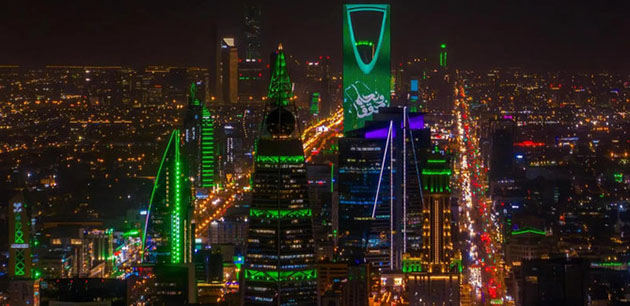
Celebration of ‘progress and unity’ marks Saudi Arabia’s 93rd National Day

Agencies
September 23, 2023

saudi.jpg

Riyadh, Sept 23: This day marks the 93rd National Day of Saudi Arabia, a day of pride and celebration for both its citizens and residents. Under the visionary leadership that prioritizes the well-being and prosperity of the people, this joyous occasion reflects upon the nation's remarkable journey toward a promising future.

As we commemorate this historic day, the Saudi Press Agency (SPA) takes us on a reflective journey through the life of a true statesman, King Abdulaziz bin Abdulrahman Al-Faisal Al Saud. On September 23, 1932, he achieved the monumental task of unifying the disparate tribes and scattered regions of the Arabian Peninsula, establishing the Kingdom of Saudi Arabia. This Islamic state, with Riyadh as its capital, adopted the Holy Qur'an and the Prophet's Sunnah as its constitution.

King Abdulaziz's remarkable journey began in Riyadh in 1293 Hijri. At the tender age of seven, he began learning to read and write, and at ten, his father, Imam Abdulrahman Al-Faisal, gathered scholars and tutors to instill in him the fundamentals of Islam and equestrian skills. His upbringing was greatly influenced by his courageous father and wise mother, Princess Sarah Al-Sudairi. King Abdulaziz shared a close bond with his siblings, including his sister, Princess Noura.

Throughout his life, King Abdulaziz encountered numerous challenges that shaped his character and instilled in him qualities of patience, strength, and statesmanship. One of the most trying moments was his forced departure from Riyadh in 1308 Hijri when he and his family settled in various locations, including the Yabrin oasis, Bahrain, and Kuwait. Despite these hardships, his determination to reclaim Riyadh, a city with deep historical significance for his family, remained unwavering.

In his twenties, King Abdulaziz embarked on a journey back to Riyadh, leading an army. His arrival in Al-Shaqib district marked the beginning of a pivotal chapter. Following a brief but intense battle, he restored order, ushering in a period of political stability that laid the foundation for Riyadh's growth and prosperity.

In 1320 Hijri, the people and notables of Riyadh pledged allegiance to him as Emir of Najd and Imam of its people. This victory brought much-needed stability after years of turmoil, setting the stage for Riyadh's transformation.

King Abdulaziz's tireless efforts to unite the nation, restore security, and combat the chaos of the Arabian Peninsula culminated in him becoming the revered leader of a newly constructed nation, securing a respected place for it on the world stage.

On September 23, 1932, King Abdulaziz issued a royal decree, renaming the state from the Kingdom of Hejaz and Najd and its annexes as the Kingdom of Saudi Arabia.

With the nation-building process well underway, King Abdulaziz turned his attention to expanding the Two Holy Mosques to serve pilgrims and establishing schools, hospitals, villages, and irrigation systems to support agriculture. These ambitious endeavors required substantial funding.

In the fall of 1933, oil exploration efforts began, initially yielding no results. However, persistence paid off when oil was discovered 5,000 feet underground in the "Ain Jet" area in 1939. This discovery marked a turning point, opening the doors to major state projects.

King Abdulaziz's interest extended beyond domestic affairs; he maintained diplomatic relations with countries worldwide, prioritizing the Kingdom's independence while fostering relations irrespective of religious, cultural, or civilizational differences. His approach garnered admiration from world leaders and media alike.

In Muharram 1373 Hijri, King Abdulaziz fell seriously ill in Taif, and he passed away on November 9, 1953. He was laid to rest in Al-Oud Cemetery, Riyadh.

As he built his nation, King Abdulaziz's commitment to education was unwavering. He avidly read Arabic books on various sciences, printing and distributing them freely. He sought the counsel of his citizens, guided by Islamic principles, fostering cooperation between the ruler and the governed.

King Abdulaziz's righteous approach, continued by his sons, laid the groundwork for the Kingdom's remarkable development, characterized by collaboration between the leadership and the people.

In a historic gathering on Muharram 25, 1355 Hijri, King Abdulaziz emphasized his desire for close ties with the people, stating, "My door is always open to anyone who wants to talk."

Under his leadership, Saudi Arabia forged strong relationships with Arab and Muslim nations and engaged the international community with transparency and pragmatism.

King Abdulaziz's legacy was the culmination of a rich history. The First Saudi State, founded by Imam Mohammed bin Saud in 1139 Hijri, laid the foundation for the nation's development. The Second Saudi State, initiated by Turki bin Abdullah bin Mohammed bin Saud, continued this legacy for approximately 68 years.

However, the true turning point came on the fifth day of Shawwal, 1319 Hijri, when King Abdulaziz reclaimed Riyadh with valor, establishing a state grounded in the principles of the Holy Qur'an and Prophet Mohammad's Sunnah.

Subsequent leaders, including King Saud, King Faisal, King Khalid, King Fahd, and King Abdullah, each contributed to the nation's progress and development, with a focus on education, healthcare, industry, and economic growth.

Today, under the wise leadership of Custodian of the Two Holy Mosques King Salman, Saudi Arabia continues its journey of growth, development, and global influence. The Kingdom boasts a strong economy that ranks among the world's top 20.

As we celebrate Saudi Arabia's National Day, we reflect on the nation's remarkable accomplishments, secure in the knowledge that its legacy of progress and unity will continue to thrive under the leadership of King Salman. Saudi Arabia stands as a testament to what can be achieved with vision, determination, and the unwavering commitment to the welfare of its people.


Comments

Add new comment

  • Coastaldigest.com reserves the right to delete or block any comments.
  • Coastaldigset.com is not responsible for its readers’ comments.
  • Comments that are abusive, incendiary or irrelevant are strictly prohibited.
  • Please use a genuine email ID and provide your name to avoid reject.
News Network
December 7,2025

SHRIMP.jpg

Mangaluru, Dec 7: A rare bamboo shrimp has been rediscovered on mainland India more than 70 years after it was last reported, confirming for the first time the presence of Atyopsis spinipes in the country. The find was made by researchers from the Centre for Climate Change Studies at Sathyabama Institute of Science and Technology, Chennai, during surveys in Karnataka and Odisha.

The team — shrimp expert Dr S Prakash, PhD scholar K Kunjulakshmi, and Mangaluru-based researcher Maclean Antony Santos — combined field surveys, ecological assessments and DNA analysis to identify the elusive species. Their findings, published in Zootaxa, resolve decades of taxonomic confusion stemming from a 1951 report that misidentified the species as Atyopsis moluccensis without strong evidence.

The shrimp has now been confirmed at two locations: the Mulki–Pavanje estuary near Mangaluru and the Kuakhai River in Bhubaneswar. Historical specimens from the Andaman Islands, previously labelled as A. moluccensis, were also found to be misidentified and actually belong to A. spinipes.

The rediscovery began after an aquarium hobbyist in Odisha spotted a shrimp in 2022, prompting systematic surveys across Udupi, Karwar and Mangaluru. Four female specimens were collected in Mulki and one in Odisha, all genetically matching.

Researchers warn the species may exist in very small, vulnerable populations as freshwater habitats face increasing pressure from pollution, sand mining and infrastructure development. All verified specimens have been deposited with the Zoological Survey of India for future reference.

Comments

Add new comment

  • Coastaldigest.com reserves the right to delete or block any comments.
  • Coastaldigset.com is not responsible for its readers’ comments.
  • Comments that are abusive, incendiary or irrelevant are strictly prohibited.
  • Please use a genuine email ID and provide your name to avoid reject.
News Network
December 3,2025

arrival.jpg

Mangaluru, Dec 3: A group of Congress workers gathered at the Mangaluru International Airport on Wednesday to welcome AICC general secretary K C Venugopal, but the reception quickly turned into a display of support for Deputy Chief Minister D K Shivakumar.

Venugopal arrived in the city to participate in the centenary commemoration of the historic dialogue between Mahatma Gandhi and Narayana Guru. The event, organised by the Sivagiri Mutt, Varkala, in association with the Mangalore University Sri Narayana Guru Study Chair, is being held on the university’s Konaje campus.

KPCC general secretary Mithun Rai and several party workers had assembled at the airport to receive Venugopal. However, the moment he stepped out, workers began raising slogans backing Shivakumar.

The university programme will be inaugurated by Chief Minister Siddaramaiah.

This show of support comes just a day after Siddaramaiah remarked that Shivakumar would lead the government “when the high command decides.” The chief minister made the comment after a breakfast meeting at Shivakumar’s residence—another public display of camaraderie between the two leaders amid ongoing attempts by the party high command to downplay their leadership rivalry.

Comments

Add new comment

  • Coastaldigest.com reserves the right to delete or block any comments.
  • Coastaldigset.com is not responsible for its readers’ comments.
  • Comments that are abusive, incendiary or irrelevant are strictly prohibited.
  • Please use a genuine email ID and provide your name to avoid reject.
News Network
December 2,2025

A major upgrade in safety and monitoring is planned for Haj 2026, with every Indian pilgrim set to receive a Haj Suvidha smart wristband linked to the official Haj Suvidha mobile app. The initiative aims to support pilgrims—especially senior citizens—who may struggle with smartphones during the 45-day journey.

What the Smart Wristband Will Do

Officials said the device will come with:
•    Location tracking
•    Pedometer
•    SOS emergency button
•    Qibla compass
•    Prayer timings
•    Basic health monitoring

SP Tiwari, secretary of the UP State Haj Committee, said the goal is to make the pilgrimage safer and more comfortable.

“Most Hajis are elderly and not comfortable with mobile apps,” he said. “The smartwatch will help locate pilgrims who forget their way or cannot communicate their location.”

The wristbands will be monitored by the Consulate General of India in Saudi Arabia, similar to mobile tracking via the Haj Suvidha App.

Free Distribution and Training

•    Smart wristbands will be given free of cost.
•    Training for pilgrims will be conducted between January and February 2026.
•    Sample units will reach state Haj committees soon.
•    Final devices will be distributed as pilgrims begin their journey.

New Rules for Accommodation

Two major decisions have also been finalised for Haj 2026:
1.    Separate rooms for men and women – including married couples. They may stay on the same floor but must occupy different rooms, following stricter Saudi guidelines.
2.    Cooking banned – gas cylinders will not be allowed; all meals will be provided through official catering services arranged by the Haj Committee of India.

These decisions were finalised during a meeting of the Haj Committee of India and state representatives in Mumbai.

Haj Suvidha App Launched Earlier

The government launched the Haj Suvidha App in 2024, offering:

•    Training modules
•    Accommodation and flight details
•    Baggage information
•    SOS and translation tools
•    Grievance redressal

Haj 2026 Quota and Key States

•    India’s total Haj quota for 2026: 1,75,025 pilgrims
•    70% (1,25,000) allotted to the Haj Committee of India
•    30% (around 50,000) reserved for Haj Group Organisers

Uttar Pradesh has the largest allocation (around 30,000 seats), though approximately 18,000 pilgrims are expected to go this year. States with high pilgrim numbers include Kerala, Maharashtra and Gujarat.

Dates of Haj 2026

The pilgrimage is scheduled to take place from 24 May to 29 May, 2026 (tentative).
Haj is one of the five pillars of Islam and is mandatory for Muslims who meet the required conditions.

Comments

Add new comment

  • Coastaldigest.com reserves the right to delete or block any comments.
  • Coastaldigset.com is not responsible for its readers’ comments.
  • Comments that are abusive, incendiary or irrelevant are strictly prohibited.
  • Please use a genuine email ID and provide your name to avoid reject.