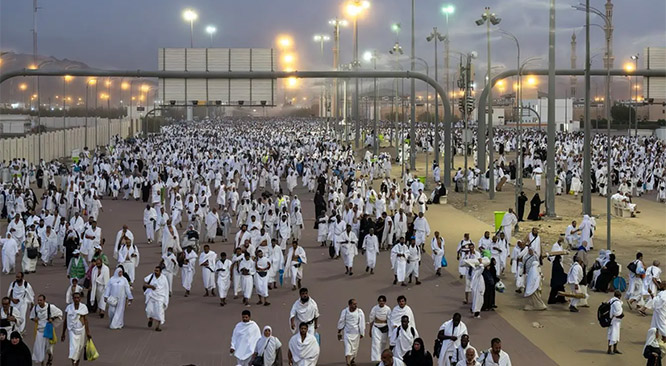
Pilgrims observe the final rites of Hajj as Muslims in Middle East celebrate Eid Al-Adha

Agencies
June 16, 2024

hajj.jpg

Masses of pilgrims on Sunday, May 16, embarked on a symbolic stoning of the devil in Saudi Arabia. The ritual marks the final days of Hajj pilgrimage and the start of the Eid Al-Adha celebrations for Muslims around the world.

The stoning is among the final rites of the Hajj, which is one of the Five Pillars of Islam. It came a day after more than 1.8 million pilgrims congregated on a sacred hill in Mount Ararat outside the holy city of Makkah, which Muslim pilgrims visit to perform the annual five-day rituals of Hajj.

The pilgrims left Mount Arafat on Saturday evening to spend their night in a nearby site known as Muzdalifa, where they collected pebbles they have used in the symbolic stoning of pillars representing the devil.

The pillars are in another sacred place in Makkah, called Mina, where Muslims believe Ibrahim’s faith was tested when God commanded him to sacrifice his only son Ismail. Ibrahim was prepared to submit to the command, but then God stayed his hand, sparing his son. In the Christian and Jewish version of the story, Abraham is ordered to kill his other son, Isaac.

Pilgrims will spend the next three days in Mina, where they walk long distances on pedestrian-only streets toward a multi-story complex housing large pillars. There, they cast seven pebbles each at three pillars in a ritual meant to symbolize the casting away of evil and sin.

While in Mina, they will visit Makkah to perform “tawaf,” circumambulation, which is circling the Kaaba in the Grand Mosque counterclockwise seven times. They will make another circumambulation, known as Farewell Tawaf, at the end of Hajj and as they prepare to leave the holy city.

The rites coincide with the four-day Eid Al-Adha, which means “Feast of Sacrifice,” when Muslims with the financial means commentate Ibrahim’s test of faith through slaughtering livestock and animals and distributing the meat to the poor.

Once the Hajj is over, men are expected to shave their heads and remove the shroud-like white garments worn during the pilgrimage, and women to snip a lock of hair in a sign of renewal and rebirth.

Most of the pilgrims then leave Makkah for the city of Madinah, about 340 kilometers away, to pray in Prophet Muhammad’s tomb, the Sacred Chamber. The tomb is part of the prophet’s mosque, which is one of the three holiest sites in Islam, along with the Grand Mosque in Makkah and the Al-Aqsa Mosque in Jerusalem.

All Muslims are required to make the Hajj once in their lives if they are physically and financially able to do so. Many wealthy Muslims make the pilgrimage more than once. The rituals largely commemorate the accounts of Prophet Ibrahim and his son Prophet Ismail, Ismail’s mother Hajjar and Prophet Muhammad, according to the Qur’an, Islam’s holy book.

More than 1.83 million Muslims performed Hajj in 2024, Saudi Hajj and Umrah Minister Tawfiq bin Fawzan Al-Rabiah said in a briefing, slightly less than last year’s figures when 1.84 million made the rituals.

Most of the Hajj rituals are held outdoors with little if any shade. It is set for the second week of Dhu Al-Hijjah, the last month in the Islamic lunar calendar, so its time of the year varies. And this year the pilgrimage fell in the burning summer of Saudi Arabia. The heat soared to 47 degrees Celsius (116.6 F) at Mount Arafat on Saturday.

This year’s Hajj came against the backdrop of the devastating Israel-Hamas war, which has pushed the Middle East to the brink of a regional conflict.


Comments

Add new comment

  • Coastaldigest.com reserves the right to delete or block any comments.
  • Coastaldigset.com is not responsible for its readers’ comments.
  • Comments that are abusive, incendiary or irrelevant are strictly prohibited.
  • Please use a genuine email ID and provide your name to avoid reject.
News Network
December 15,2025

Mangaluru, Dec 15: Air India Express has announced that it will resume direct flight services between Mangaluru and Muscat from March 2026, restoring an important international air link for passengers from the coastal region.

Airport authorities said the service will operate twice a week—on Sundays and Tuesdays—from March 1. The initial flights are scheduled on March 3, 8 and 10, followed by March 15 and 17, with the same operating pattern to continue thereafter. The flight duration is approximately three hours and 25 minutes.

The Mangaluru–Muscat route was earlier operated under the 2025 summer schedule, with services beginning on July 14. At that time, Air India Express had operated four flights a week before suspending the service.

Officials said the summer schedule will come into effect from March 29, after which changes in flight timings and departure schedules from Mangaluru are expected. Passengers have been advised to check the latest schedules while planning their travel.

The resumption of direct flights to Muscat is expected to significantly benefit expatriates, business travellers and others, further strengthening Mangaluru’s air connectivity with the Gulf region.

Comments

Add new comment

  • Coastaldigest.com reserves the right to delete or block any comments.
  • Coastaldigset.com is not responsible for its readers’ comments.
  • Comments that are abusive, incendiary or irrelevant are strictly prohibited.
  • Please use a genuine email ID and provide your name to avoid reject.
News Network
December 4,2025

Udupi: A 40-year-old NRI from Udupi has reportedly lost more than Rs 12.25 lakh in an online investment scam operated through Telegram.

According to a complaint filed at the CEN police station, Leo Jerome Mendonsa, who has been working in Dubai for the past 15 years in computer accessories sales, maintains NRI accounts in Karkala and Nitte.

On November 12, 2025, Mendonsa was added to a Telegram group called Instaflow Earnings by unknown individuals. Users identified as Priya and Dipannita persuaded him to invest in “Revenue Tasks.” Initially, Mendonsa transferred Rs 1,100 multiple times and received the promised returns, encouraging him to continue.

On November 14, another user, Nishmitha Shetty, directed him to register on a website, digitvisionuoce.cc, and invest Rs 4 lakh in various shares. Over the next few days, he made multiple transfers totaling Rs 12,25,000, including Rs 50,000 via Google Pay, believing the scheme was legitimate.

After receiving the money, the alleged handlers stopped responding, and neither the invested amount nor the promised profits were returned.

The CEN police have registered a case under Sections 66(C) and 66(D) of the IT Act and Section 318(4) of the Bharatiya Nyaya Sanhita (BNS), and investigations are ongoing.

Comments

Add new comment

  • Coastaldigest.com reserves the right to delete or block any comments.
  • Coastaldigset.com is not responsible for its readers’ comments.
  • Comments that are abusive, incendiary or irrelevant are strictly prohibited.
  • Please use a genuine email ID and provide your name to avoid reject.
News Network
December 13,2025

New Delhi: School-going children are picking up drug and smoking habits and engaging in consumption of alcohol, with the average age of introduction to such harmful substances found to be around 13 years, suggesting a need for earlier interventions as early as primary school, a multi-city survey by AIIMS-Delhi said.

The findings also showed substance use increased in higher grades, with grade XI/XII students two times more likely to report use of substances when compared with grade VIII students. This emphasised the importance of continued prevention and intervention through middle and high school.

The study led by Dr Anju Dhawan of AIIMS's National Drug Dependence Treatment Centre, published in the National Medical Journal of India this month, looks at adolescent substance use across diverse regions.

The survey included 5,920 students from classes 8, 9, 11 and 12 in urban government, private and rural schools across 10 cities -- Bengaluru, Chandigarh, Delhi, Dibrugarh, Hyderabad, Imphal, Jammu, Lucknow, Mumbai, and Ranchi. The data were collected between May 2018 and June 2019.

The average age of initiation for any substance was 12.9 (2.8) years. It was lowest for inhalants (11.3 years) followed by heroin (12.3 years) and opioid pharmaceuticals (without prescription; 12.5 years).

Overall, 15.1 per cent of participants reported lifetime use, 10.3 per cent reported past year use, and 7.2 per cent reported use in the past month of any substance, the study found.

The most common substances used in the past year, after tobacco (4 per cent) and alcohol (3.8 per cent), were opioids (2.8 per cent), followed by cannabis (2 per cent) and inhalants (1.9 per cent). Use of non-prescribed pharmaceutical opioids was most common among opioid users (90.2 per cent).

On being asked, 'Do you think this substance is easily available for a person of your age' separately for each substance category, nearly half the students (46.3 per cent) endorsed that tobacco products and more than one-third of the students (36.5 per cent) agreed that a person of their age can easily procure alcohol products.

Similarly, for Bhang (21.9 per cent), ganja/charas (16.1 per cent), inhalants (15.2 per cent), sedatives (13.7 per cent), opium and heroin (10 per cent each), the students endorsed that these can be easily procured.

About 95 per cent of the children, irrespective of their grade, agreed with the statement that 'drug use is harmful'.

The rates of substance use (any) among boys were significantly higher than those of girls for substance use (ever), use in the past year and use in the past 30 days. Compared to grade VIII students, grade IX students were more likely, and grade XI/XII students were twice as likely to have used any substance (ever).

The likelihood of past-year use of any substance was also higher for grade IX students and for grade XI/XII students as compared to grade VIII students.

About 40 per cent of students mentioned that they had a family member who used tobacco or alcohol each. The use of cannabis (any product) and opioid (any product) by a family member was reported by 8.2 per cent and 3.9 per cent of students, respectively, while the use of other substances, such as inhalants/sedatives by family was 2-3 per cent, the study found.

A relatively smaller percentage of students reported use of tobacco or alcohol among peers as compared to among family members, while a higher percentage reported inhalants, sedatives, cannabis or opioid use among peers.

Children using substances (past year) compared to non-users reported significantly higher any substance use by their family members and peers.

There were 25.7 per cent students who replied 'yes' to the question 'conflicts/fights often occur in your family'. Most students also replied affirmatively to 'family members are aware of how their time is being spent' and 'damily members are aware of with whom they spend their time'.

Comments

Add new comment

  • Coastaldigest.com reserves the right to delete or block any comments.
  • Coastaldigset.com is not responsible for its readers’ comments.
  • Comments that are abusive, incendiary or irrelevant are strictly prohibited.
  • Please use a genuine email ID and provide your name to avoid reject.