



Modi govt freezes ads in 3 Indian newspaper groups

Agencies
June 30, 2019

New Delhi, Jun 30: India's government has cut off advertisements to at least three major newspaper groups in a move that executives and an opposition leader said was likely retaliation for unfavourable reports.
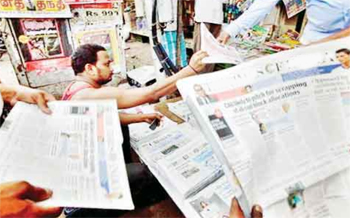
Critics have said that freedom of the press has been under attack since Prime Minister Narendra Modi's government first took office in 2014 and journalists have complained of intimidation for writing critical stories.

Now the big newspaper groups, which have a combined monthly readership of more than 26 million, say they are being starved of government ads worth millions of rupees that began even before Modi was elected to power last month with a landslide mandate.

"There is a freeze," an executive at Bennett, Coleman & Co that controls the Times of India and The Economic Times, among the country's biggest English-language newspapers, said. "Could be (because of) some reports they were unhappy with," the executive said, seeking anonymity because he was not authorised to speak to the press.

Around 15 per cent of the Times Group's advertising comes from the government, the executive said. The ads are mostly government tenders for contracts as well as publicising government schemes.

The ABP Group, which publishes The Telegraph that has run reports questioning Modi's record on everything from national security to unemployment, has seen a similar 15 per cent drop in government advertisements for around six months, two company officials said.

"Once you don't toe the government line in your editorial coverage and you write anything against the government, then obviously the only way they can penalise you (is) to choke your advertising supply," the first ABP official said.

The second ABP official said that there had been no communication from the government, and the company was looking to other sources to plug the gap.

"Press freedom must be maintained and it will be maintained despite these things," the official said. Both also sought anonymity.

Satyendra Prakash, director general of the Bureau of Outreach and Communication, the agency responsible for advertisements from the federal government, did not reply to Reuters emails or phone calls seeking comment.

But a spokesman for Modi's ruling Hindu nationalist Bharatiya Janata Party said the press in India remained fully free.

Nalin Kohli said there was ample criticism against the ruling party in newspapers and on TV news channels. "That's testimony of freedom of speech," he said, "The suggestion that the BJP is throttling free press is ridiculous."

India ranked 140th out of 180 in the 2019 World Press Freedom Index, lower than countries like Afghanistan, Myanmar and the Philippines. It ranked 80th out of 139 countries surveyed when the index was started in 2002.

The Hindu newspaper group also saw government advertising plunge after publishing investigative stories on a multi-billion dollar deal to buy combat planes from France's Dassault that strengthened an opposition campaign alleging government wrongdoing, a company official said.

The government rejected the accusation.

A leader of the main opposition Congress told parliament this week the government was trying to bring the three newspaper groups to heel.

"The undemocratic and megalomaniac style of stopping government advertisement is a message to media from this government to toe its line," Adhir Ranjan Chowdhury said.

Chief executive officers of all three newspaper groups did not respond to Reuters emails.

Comments

Add new comment

  • Coastaldigest.com reserves the right to delete or block any comments.
  • Coastaldigset.com is not responsible for its readers’ comments.
  • Comments that are abusive, incendiary or irrelevant are strictly prohibited.
  • Please use a genuine email ID and provide your name to avoid reject.
News Network
December 16,2025

Mangaluru, Dec 16: The Mangaluru City police have significantly escalated their campaign against drug trafficking, arresting 25 individuals and booking 12 cases under the Narcotic Drugs and Psychotropic Substances (NDPS) Act between November 30 and December 13. The crackdown resulted in the seizure of a substantial quantity of illicit substances, including 685.6 grams of MDMA and 1.5 kg of ganja.

The success of this recent drive has been significantly boosted by the city’s innovative, QR code-based anonymous reporting system.

"The anonymous reporting system has received an encouraging response. Several recent arrests were made based on inputs received through this system, helping police tighten the noose around drug peddlers," said the City Police Commissioner.

The latest arrests contribute to a robust year-to-date record, underscoring the police's relentless commitment to combating the drug menace.

Up to December 14 this year, the police have registered a total of 107 cases of drug peddling, leading to the arrest of 219 peddlers. Furthermore, they have booked 562 cases of drug consumption, resulting in the arrest of 671 individuals.

The scale of the seizure for the year reflects the magnitude of the problem being tackled: police have seized 320.6 kg of ganja worth ₹88.7 lakh and 1.4 kg of MDMA valued at ₹1.2 crore. Other significant seizures include hydro-weed ganja worth ₹94.7 lakh and cocaine worth ₹1.9 lakh, among others.

The Commissioner emphasized a policy of rigorous enforcement: "We ensure that peddlers are caught red-handed so that they cannot later dispute the case or claim innocence."

To counter the rising trend of substance abuse among youth, the Mangaluru City police have rolled out uniform guidelines for random drug testing across educational institutions.

As part of the drive, tests were conducted in approximately 100 institutions, screening an estimated 5,500 to 6,000 students in the first phase. 20 students tested positive for drug consumption during the initial screening.

Students who tested positive have been provided counselling and are scheduled for re-testing in the second quarter. The testing will also be expanded to students not covered in the first phase. In a move to ensure strict implementation, police personnel were deployed in mufti in some institutions. Reiterating a zero-tolerance stance, the Commissioner confirmed that random testing will continue, and colleges have also been instructed to conduct drug tests at the time of admission to deter substance abuse from an early stage.

Comments

Add new comment

  • Coastaldigest.com reserves the right to delete or block any comments.
  • Coastaldigset.com is not responsible for its readers’ comments.
  • Comments that are abusive, incendiary or irrelevant are strictly prohibited.
  • Please use a genuine email ID and provide your name to avoid reject.
News Network
December 5,2025

Mangaluru: In a significant step to curb online hate and intimidation, Mangaluru City Police have registered a suo motu case against multiple Instagram accounts accused of circulating alleged provocative and threatening content.

While monitoring social media activity on Tuesday, Kankanady Town PSI Anitha Nikkam identified the Instagram handle ‘team_targetttt_900’ for posting a hate message alongside images of lethal weapons. Another account, ‘team_nagara_900’, allegedly shared a threatening post targeting activist Bharath Kumdelu, tagging additional pages such as KARAVALI-OFFICIAL.

Several other accounts — including ‘immu_bhai.fan’, ‘target_boy_900’, ‘kings_of_manglore’, ‘team_target_boys.900’, ‘arshad_mangalore’, ‘target_ka19_ullal’, ‘team_target__’, ‘troll_tigersz_900’, ‘tr_group_900’, and ‘team_target_900’ — are also under scrutiny for spreading similar inflammatory material, police said.

Authorities have urged citizens, especially young social media users, to report suspicious pages and avoid engaging with groups that glorify violence or threaten individuals. Online hate can quickly escalate into real-world harm, and police stress that sharing or promoting such content can attract legal consequences.

Comments

Add new comment

  • Coastaldigest.com reserves the right to delete or block any comments.
  • Coastaldigset.com is not responsible for its readers’ comments.
  • Comments that are abusive, incendiary or irrelevant are strictly prohibited.
  • Please use a genuine email ID and provide your name to avoid reject.
News Network
December 6,2025

pilot.jpg

New Delhi: IndiGo, India’s largest airline, faced major operational turbulence this week after failing to prepare for new pilot-fatigue regulations issued by the Directorate General of Civil Aviation (DGCA). The stricter rules—designed to improve flight safety—took effect in phases through 2024, with the latest implementation on November 1. IndiGo has acknowledged that inadequate roster planning led to widespread cancellations and delays.

Below are the key DGCA rules that affected IndiGo’s operations:

1. Longer Mandatory Weekly Rest

Weekly rest for pilots has been increased from 36 hours to 48 hours.

The government says the extended break is essential to curb cumulative fatigue. This rule remains in force despite the current crisis.

2. Cap on Night Landings

Pilots can now perform only two night landings per week—a steep reduction from the earlier limit of six.

Night hours, defined as midnight to early morning, are considered the least alert period for pilots.

Given the disruptions, this rule has been temporarily relaxed for IndiGo until February 10.

3. Reduced Maximum Night Flight Duty

Flight duty that stretches into the night is now capped at 10 hours.

This measure has also been kept on hold for IndiGo until February 10 to stabilize operations.

4. Weekly Rest Cannot Be Replaced With Personal Leave

Airlines can no longer count a pilot’s personal leave as part of the mandatory 48-hour rest.

Pilots say this closes a loophole that previously reduced actual rest time.

Currently, all airlines are exempt from this rule to normalise travel.

5. Mandatory Fatigue Monitoring

Airlines must submit quarterly fatigue reports along with corrective actions to DGCA.

This system aims to create a transparent fatigue-tracking framework across the industry.

The DGCA has stressed that these rules were crafted to strengthen flight safety and align India with global fatigue-management standards. The temporary relaxations are expected to remain until February 2025, giving IndiGo time to stabilise its schedules and restore normal air travel.

Comments

Add new comment

  • Coastaldigest.com reserves the right to delete or block any comments.
  • Coastaldigset.com is not responsible for its readers’ comments.
  • Comments that are abusive, incendiary or irrelevant are strictly prohibited.
  • Please use a genuine email ID and provide your name to avoid reject.
