



Modi reaches out to farmers in poll-bound Gujarat

August 30, 2016

Sanosara (Guj), Aug 30: Holding his first public rally in poll-bound Gujarat after taking office in 2014, Prime Minister Narendra Modi today reached out to farmers from the heartland of the restive Patel community after launching an irrigation project.
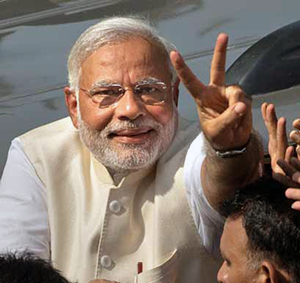
modi

Modi also launched a veiled attack on the Congress after inaugurating the first phase of the ambitious Saurashtra Narmada Avtaran Irrigation (Sauni) project here, saying that polls can be won by dangling baits and "throwing pieces" but a country can't be run by doing so.

Targeting the Congress which had questioned the timing of his visit to poll-bound Gujarat, Modi said his government does not believe in "throwing pieces" to attract voters.

"You can win polls by throwing pieces, but you cannot run a country by doing so. We do not believe in throwing pieces. We worked hard for almost 15 years for this project to bring transformation and development," Modi told a huge gathering at Sanosara village in Jamnagar district in the patidar(or patel)-dominated Saurashtra region.

Water is a politically sensitive issue in Gujarat, which the BJP plans to cash in before the 2017 Assembly polls to revive its fortunes, specially at the time when it is facing challenges like Patel quota agitation and Dalit uprising.

The Congress has termed the inauguration of Sauni scheme at this juncture by the Prime Minister as an attempt to give a message to voters ahead of the polls.

In his address, Modi stressed on conserving water and remembered his days as Gujarat Chief Minister when people did not understood his vision to bring transformation in agriculture sector.

"After I became Gujarat's CM for the first time (in 2001), I used to tell farmers that instead of fighting against government to get more electricity for irrigation, they should focus more on water management. However, I failed to make them understand for almost 2-3 years" said Modi.

"At that time, I faced lot of protests by farmers. They used to burn my effigies. But, I remained firm on my vision. Today, I want to thank farmers of Gujarat for accepting my vision of conserving water through sprinklers, drip irrigation and micro irrigation tools, which significantly brought up ground water levels," said Modi.

He added that water of Narmada river has now reached till the extreme end of parched Kutch region and helped farmers to a great extent.

"Narmada waters have reached till Khavda in Kutch. There was a time when camels were used to transport water to our BSF jawans posted there. They used to get small quantity of water for drinking. But now, they use Narmada water for even bathing," said Modi.

"We worked on the motto of Jai Jawan and Jai Kisan. Water from Narmada has transformed the lives of farmers too. This season, farmers of Kutch exported 70,000 tonnes of Kesar mangoes" added Modi.

Remembering the day when Modi first coined the idea of Sauni scheme, the PM said that people had apprehensions about the success of this project initially.

"On September 25, 2012, I made a presentation about SAUNI project in Rajkot during a program organised to celebrate the birth anniversary of Pandit Deen Dayal Upadhyay. All the representatives of Saurashtra region present in the hall were surprised to know about this scheme and felt that it can ever be accomplished," said Modi.

"The work started in February 2014, after which, I left Gujarat (to become PM). Then, (former CM) Anandiben Patel took over the task of completing the project and finally (current CM) Vijay Rupani and (Deputy CM) Nitin Patel's team sped up the task. And today, the project has become a reality," said Modi. He added that a total of 115 dams will be filled up under this project. Modi stated that agriculture production in Saurashtra region was growing at a rapid pace due to the Narmada canal network.

"In Saurashtra alone, cotton production has grown by 370 per cent, groundnut production registered a growth of 600 per cent and wheat production by 300 per cent. I wonder what will happen when farmers will get some more water under this project. This water is no less than gold for them," said Modi. Under the SAUNI scheme, the Gujarat government plans to fill 115 dams of Saurashtra region with excess overflowing water of Sardar Sarovar dam across river Narmada, by web of pipeline networks.

The Rs 12,000 crore scheme aims to take excess water of Sardar Sarovar Dam on river Narmada all the way to 115 dams of parched Saurashtra region. During monsoon, on an average, around three MAFt (million acre feet) water overflows from the dam is wasted, as it goes to sea. The project is divided in four phases. In the first phase, which was inaugurated by Modi today, ten dams including Aji-3, will get excess water of Narmada. Modi termed the entire project as an "engineering milestone", for which, the entire nation can take pride.

"Saurashtra's landscape is like an inverted saucer, which forces us to lift water. In such adverse scenario, it is not a small achievement to complete such large network. People of India should understand and appreciate this engineering wonder," said Modi. Modi also listed the Central government's pro-farmers schemes like Pradhan Mantri Fasal Vima Yojana, turnaround of urea production and Pradhan Mantri Sichai Yojana for the benefits of the farmers.


Comments

Add new comment

  • Coastaldigest.com reserves the right to delete or block any comments.
  • Coastaldigset.com is not responsible for its readers’ comments.
  • Comments that are abusive, incendiary or irrelevant are strictly prohibited.
  • Please use a genuine email ID and provide your name to avoid reject.
News Network
December 16,2025

bengal.jpg

The deletion of over 58 lakh names from West Bengal’s draft electoral rolls following a Special Intensive Revision (SIR) has sparked widespread concern and is likely to deepen political tensions in the poll-bound state.

According to the Election Commission, the revision exercise has identified 24 lakh voters as deceased, 19 lakh as relocated, 12 lakh as missing, and 1.3 lakh as duplicate entries. The draft list, published after the completion of the first phase of SIR, aims to remove errors and duplication from the electoral rolls.

However, the scale of deletions has raised fears that a large number of eligible voters may have been wrongly excluded. The Election Commission has said that individuals whose names are missing can file objections and seek corrections. The final voter list is scheduled to be published in February next year, after which the Assembly election announcement is expected. Notably, the last Special Intensive Revision in Bengal was conducted in 2002.

The development has intensified the political row over the SIR process. Chief Minister Mamata Banerjee and her Trinamool Congress have strongly opposed the exercise, accusing the Centre and the Election Commission of attempting to disenfranchise lakhs of voters ahead of the elections.

Addressing a rally in Krishnanagar earlier this month, Banerjee urged people to protest if their names were removed from the voter list, alleging intimidation during elections and warning of serious consequences if voting rights were taken away.

The BJP, meanwhile, has defended the revision and accused the Trinamool Congress of politicising the issue to protect what it claims is an illegal voter base. Leader of the Opposition Suvendu Adhikari alleged that the ruling party fears losing power due to the removal of deceased, fake, and illegal voters.

The controversy comes amid earlier allegations by the Trinamool Congress that excessive work pressure during the SIR led to the deaths by suicide of some Booth Level Officers (BLOs), for which the party blamed the Election Commission. With the draft list now out, another round of political confrontation appears imminent.

As objections begin to be filed, the focus will be on whether the correction mechanism is accessible, transparent, and timely—critical factors in ensuring that no eligible voter is denied their democratic right ahead of a crucial election.

Comments

Add new comment

  • Coastaldigest.com reserves the right to delete or block any comments.
  • Coastaldigset.com is not responsible for its readers’ comments.
  • Comments that are abusive, incendiary or irrelevant are strictly prohibited.
  • Please use a genuine email ID and provide your name to avoid reject.
News Network
December 13,2025

New Delhi: School-going children are picking up drug and smoking habits and engaging in consumption of alcohol, with the average age of introduction to such harmful substances found to be around 13 years, suggesting a need for earlier interventions as early as primary school, a multi-city survey by AIIMS-Delhi said.

The findings also showed substance use increased in higher grades, with grade XI/XII students two times more likely to report use of substances when compared with grade VIII students. This emphasised the importance of continued prevention and intervention through middle and high school.

The study led by Dr Anju Dhawan of AIIMS's National Drug Dependence Treatment Centre, published in the National Medical Journal of India this month, looks at adolescent substance use across diverse regions.

The survey included 5,920 students from classes 8, 9, 11 and 12 in urban government, private and rural schools across 10 cities -- Bengaluru, Chandigarh, Delhi, Dibrugarh, Hyderabad, Imphal, Jammu, Lucknow, Mumbai, and Ranchi. The data were collected between May 2018 and June 2019.

The average age of initiation for any substance was 12.9 (2.8) years. It was lowest for inhalants (11.3 years) followed by heroin (12.3 years) and opioid pharmaceuticals (without prescription; 12.5 years).

Overall, 15.1 per cent of participants reported lifetime use, 10.3 per cent reported past year use, and 7.2 per cent reported use in the past month of any substance, the study found.

The most common substances used in the past year, after tobacco (4 per cent) and alcohol (3.8 per cent), were opioids (2.8 per cent), followed by cannabis (2 per cent) and inhalants (1.9 per cent). Use of non-prescribed pharmaceutical opioids was most common among opioid users (90.2 per cent).

On being asked, 'Do you think this substance is easily available for a person of your age' separately for each substance category, nearly half the students (46.3 per cent) endorsed that tobacco products and more than one-third of the students (36.5 per cent) agreed that a person of their age can easily procure alcohol products.

Similarly, for Bhang (21.9 per cent), ganja/charas (16.1 per cent), inhalants (15.2 per cent), sedatives (13.7 per cent), opium and heroin (10 per cent each), the students endorsed that these can be easily procured.

About 95 per cent of the children, irrespective of their grade, agreed with the statement that 'drug use is harmful'.

The rates of substance use (any) among boys were significantly higher than those of girls for substance use (ever), use in the past year and use in the past 30 days. Compared to grade VIII students, grade IX students were more likely, and grade XI/XII students were twice as likely to have used any substance (ever).

The likelihood of past-year use of any substance was also higher for grade IX students and for grade XI/XII students as compared to grade VIII students.

About 40 per cent of students mentioned that they had a family member who used tobacco or alcohol each. The use of cannabis (any product) and opioid (any product) by a family member was reported by 8.2 per cent and 3.9 per cent of students, respectively, while the use of other substances, such as inhalants/sedatives by family was 2-3 per cent, the study found.

A relatively smaller percentage of students reported use of tobacco or alcohol among peers as compared to among family members, while a higher percentage reported inhalants, sedatives, cannabis or opioid use among peers.

Children using substances (past year) compared to non-users reported significantly higher any substance use by their family members and peers.

There were 25.7 per cent students who replied 'yes' to the question 'conflicts/fights often occur in your family'. Most students also replied affirmatively to 'family members are aware of how their time is being spent' and 'damily members are aware of with whom they spend their time'.

Comments

Add new comment

  • Coastaldigest.com reserves the right to delete or block any comments.
  • Coastaldigset.com is not responsible for its readers’ comments.
  • Comments that are abusive, incendiary or irrelevant are strictly prohibited.
  • Please use a genuine email ID and provide your name to avoid reject.
News Network
December 4,2025

indigoflight.jpg

Domestic carrier IndiGo has cancelled over 180 flights from three major airports — Mumbai, Delhi and Bengaluru — on Thursday, December 4, as the airline struggles to secure the required crew to operate its flights in the wake of new flight-duty and rest-period norms for pilots.

While the number of cancellations at Mumbai airport stands at 86 (41 arrivals and 45 departures) for the day, at Bengaluru, 73 flights have been cancelled, including 41 arrivals, according to a PTI report that quoted sources.

"IndiGo cancelled over 180 flights on Thursday at three airports-Mumbai, Delhi and Bengaluru," the source told the news agency.

Besides, it had cancelled as many as 33 flights at Delhi airport for Thursday, the source said, adding, "The number of cancellations is expected to be higher by the end of the day."

The Gurugram-based airline's On-Time Performance (OTP) nosedived to 19.7 per cent at six key airports — Delhi, Mumbai, Chennai, Kolkata, Bengaluru and Hyderabad — on December 3, as it struggled to get the required crew to operate its services, down from almost half of December 2, when it was 35 per cent.

"IndiGo has been facing acute crew shortage since the implementation of the second phase of the FDTL (Flight Duty Time Limitations) norms, leading to cancellations and huge delays in its operations across the airports," a source had told PTI on Wednesday.

Chaos continued at several major airports for the third day on Thursday because of the cancellations.

A spokesperson for the Kempegowda International Airport (KIA) in Bengaluru said that 73 IndiGo flights had been cancelled on Thursday.

At least 150 flights were cancelled and dozens of others delayed on Wednesday, airport sources said, leaving thousands of travellers stranded, according to news agency Reuters.

The Directorate General of Civil Aviation (DGCA) has said it is investigating IndiGo flight disruptions and has asked the airline to submit the reasons for the current situation, as well as its plans to reduce flight cancellations and delays.

It may be mentioned here that the pilots' body, Federation of Indian Pilots (FIP), has alleged that IndiGo, despite getting a two-year preparatory window before the full implementation of new flight duty and rest period norms for cockpit crew, "inexplicably" adopted a "hiring freeze".

The FIP said it has urged the safety regulator, the DGCA, not to approve airlines' seasonal flight schedules unless they have adequate staff to operate their services "safely and reliably" in accordance with the New Flight Duty Time Limitations (FDTL) norms.

In a letter to the DGCA late on Wednesday, the FIP urged the DGCA to consider re-evaluating and reallocating slots to other airlines, which have the capacity to operate them without disruption during the peak holiday and fog season if IndiGo continues to "fail in delivering on its commitments to passengers due to its own avoidable staffing shortages."

Comments

Add new comment

  • Coastaldigest.com reserves the right to delete or block any comments.
  • Coastaldigset.com is not responsible for its readers’ comments.
  • Comments that are abusive, incendiary or irrelevant are strictly prohibited.
  • Please use a genuine email ID and provide your name to avoid reject.