



Modi's 5 years 'most traumatic, devastating', he should be shown exit door: Manmohan Singh

Agencies
May 5, 2019

New Delhi, May 5: Prime Minister Narendra Modi should be shown the exit door as his five-year rule has been "most traumatic and devastating" for India's youths, farmers, traders and every democratic institution, his predecessor Manmohan Singh said on Sunday.
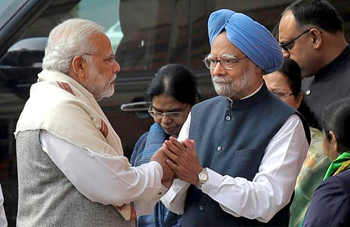
Singh, in an exclusive interview to PTI, dismissed the notion that there was a wave in favour of Modi and asserted that the people have made up their minds to vote out the government that "does not believe in inclusive growth and is only worried about its political existence at the altar of disharmony".

In one of his most fierce attacks on the Modi dispensation, Singh alleged that the past five years only witnessed "stench" of corruption peaking to "unimaginable proportions", adding demonetisation was perhaps the "biggest scam" of independent India.

Incidentally, the BJP campaign in the run-up to the 2014 elections had centred on various alleged scams, including in the allocations of 2G spectrum and coal blocks, during the 10-year tenure of the Manmohan-led UPA government.

The former Prime Minister also called Modi's Pakistan policy "slipshod", which he said was marred by a series of "flip-flops" - from going to Pakistan uninvited to inviting "rogue" ISI to the Pathankot air base in connection with the probe into a terrorist attack.

Singh, known as the architect of India's economic reforms in 1990s, felt the country is headed for a slowdown and accused the Modi regime of leaving the country's economy in "dire straits".

He said people are "fed up" with the daily rhetoric and cosmetic change by the current dispensation and there is an undercurrent against this "illusion and boastful self aggrandizement".

In a bid to counter the BJP's focus on the issues of nationalism and terrorism in this election, the former Prime Minister sought to question Modi's commitment.

He said it was "distressing" to note that Modi was "filming movies" in the Jim Corbett National Park instead of chairing any meeting of the Cabinet Committee on Security (CCS) in the immediate aftermath of the Pulwama terror attack in which 40 CRPF personnel were martyred.

He claimed the "gross intelligence failure" in Pulwama speaks volumes about this government's preparedness to tackle terror.

"Let's not forget that Narendra Modi's slipshod policy on Pakistan has been marred by a series of flip-flops - from going to Pakistan uninvited to inviting the rogue ISI to investigate the Pathankot Air Base terror attack. Does it not speak volumes about the strategic failures of Modi Government on national security front," he asked.

Singh said the Modi government's record on national security is "dismal" as incidents of terrorism have seen a quantum jump.

"A lie spoken a hundred times does not become the truth," he said on Modi's plank of nationalism, adding that terror attacks in Jammu and Kashmir alone have gone up by 176 per cent and ceasefire violations at the border with Pakistan up 1,000 per cent in the past five years.

He said that division and hate have become synonymous with the BJP and it thrives on societal fissures.

"A government which does not believe in inclusive growth and is only worried about its political existence at the altar of disharmony should be immediately shown the exit door," he noted.

He alleged that in the past five years, the stench of corruption has peaked to "unimaginable proportions" and "there is a definite collusion of people holding political positions and scamsters who fled the country after defrauding banks".

Singh said the BJP's "political distress" emanates from its "failed track record" and claimed the party is searching for new narratives every day. "This reflects the bankruptcy of a national security vision for the country."

"Five years of Modi government is a sad story of governance and accountability failure. In the year 2014, Modiji came to power on the promise of 'acche din'. His five-year rule has ended up being the most traumatic and devastating for India's youth, farmers, traders, businesses and every democratic institution," he said.

"Our socio-political ambience has lost cohesiveness. People are fed up with the daily loud rhetoric of cosmetic change. There is a sense of deep despair and disillusionment amongst the masses. People have made up their minds to reject the Modi Government and the BJP so that the future of India is safe and secure," Singh said.

The former Prime Minister said one man would not do any justice to the aspirations and hopes of the people by imposing the thought process and will of 'one person' on a diverse country like India.

"Representation in India is very important. A single man can neither represent all the desires of 130 crore people of India and can also not solve the variety of problems faced by them. The idea of 'one man as the monolith of knowledge' cannot be applied to India," he said on whether a presidential form of election is good for democracy.

On foreign policy, he said India has always been guided by national interests and not for "image building of any individual".

Foreign policy entails "gravitas", a sense of diplomacy and restraint, sensitivity towards the concerns of the host nation and ultimately furthering the interests of India, but "regrettably, this government's foreign policy is founded upon anything but a mature comprehension of diplomacy", he said.

Comments

Add new comment

  • Coastaldigest.com reserves the right to delete or block any comments.
  • Coastaldigset.com is not responsible for its readers’ comments.
  • Comments that are abusive, incendiary or irrelevant are strictly prohibited.
  • Please use a genuine email ID and provide your name to avoid reject.
News Network
December 13,2025

New Delhi: School-going children are picking up drug and smoking habits and engaging in consumption of alcohol, with the average age of introduction to such harmful substances found to be around 13 years, suggesting a need for earlier interventions as early as primary school, a multi-city survey by AIIMS-Delhi said.

The findings also showed substance use increased in higher grades, with grade XI/XII students two times more likely to report use of substances when compared with grade VIII students. This emphasised the importance of continued prevention and intervention through middle and high school.

The study led by Dr Anju Dhawan of AIIMS's National Drug Dependence Treatment Centre, published in the National Medical Journal of India this month, looks at adolescent substance use across diverse regions.

The survey included 5,920 students from classes 8, 9, 11 and 12 in urban government, private and rural schools across 10 cities -- Bengaluru, Chandigarh, Delhi, Dibrugarh, Hyderabad, Imphal, Jammu, Lucknow, Mumbai, and Ranchi. The data were collected between May 2018 and June 2019.

The average age of initiation for any substance was 12.9 (2.8) years. It was lowest for inhalants (11.3 years) followed by heroin (12.3 years) and opioid pharmaceuticals (without prescription; 12.5 years).

Overall, 15.1 per cent of participants reported lifetime use, 10.3 per cent reported past year use, and 7.2 per cent reported use in the past month of any substance, the study found.

The most common substances used in the past year, after tobacco (4 per cent) and alcohol (3.8 per cent), were opioids (2.8 per cent), followed by cannabis (2 per cent) and inhalants (1.9 per cent). Use of non-prescribed pharmaceutical opioids was most common among opioid users (90.2 per cent).

On being asked, 'Do you think this substance is easily available for a person of your age' separately for each substance category, nearly half the students (46.3 per cent) endorsed that tobacco products and more than one-third of the students (36.5 per cent) agreed that a person of their age can easily procure alcohol products.

Similarly, for Bhang (21.9 per cent), ganja/charas (16.1 per cent), inhalants (15.2 per cent), sedatives (13.7 per cent), opium and heroin (10 per cent each), the students endorsed that these can be easily procured.

About 95 per cent of the children, irrespective of their grade, agreed with the statement that 'drug use is harmful'.

The rates of substance use (any) among boys were significantly higher than those of girls for substance use (ever), use in the past year and use in the past 30 days. Compared to grade VIII students, grade IX students were more likely, and grade XI/XII students were twice as likely to have used any substance (ever).

The likelihood of past-year use of any substance was also higher for grade IX students and for grade XI/XII students as compared to grade VIII students.

About 40 per cent of students mentioned that they had a family member who used tobacco or alcohol each. The use of cannabis (any product) and opioid (any product) by a family member was reported by 8.2 per cent and 3.9 per cent of students, respectively, while the use of other substances, such as inhalants/sedatives by family was 2-3 per cent, the study found.

A relatively smaller percentage of students reported use of tobacco or alcohol among peers as compared to among family members, while a higher percentage reported inhalants, sedatives, cannabis or opioid use among peers.

Children using substances (past year) compared to non-users reported significantly higher any substance use by their family members and peers.

There were 25.7 per cent students who replied 'yes' to the question 'conflicts/fights often occur in your family'. Most students also replied affirmatively to 'family members are aware of how their time is being spent' and 'damily members are aware of with whom they spend their time'.

Comments

Add new comment

  • Coastaldigest.com reserves the right to delete or block any comments.
  • Coastaldigset.com is not responsible for its readers’ comments.
  • Comments that are abusive, incendiary or irrelevant are strictly prohibited.
  • Please use a genuine email ID and provide your name to avoid reject.
News Network
December 16,2025

bengal.jpg

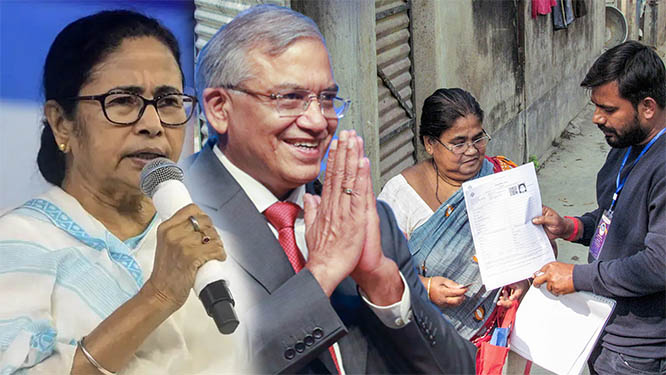
The deletion of over 58 lakh names from West Bengal’s draft electoral rolls following a Special Intensive Revision (SIR) has sparked widespread concern and is likely to deepen political tensions in the poll-bound state.

According to the Election Commission, the revision exercise has identified 24 lakh voters as deceased, 19 lakh as relocated, 12 lakh as missing, and 1.3 lakh as duplicate entries. The draft list, published after the completion of the first phase of SIR, aims to remove errors and duplication from the electoral rolls.

However, the scale of deletions has raised fears that a large number of eligible voters may have been wrongly excluded. The Election Commission has said that individuals whose names are missing can file objections and seek corrections. The final voter list is scheduled to be published in February next year, after which the Assembly election announcement is expected. Notably, the last Special Intensive Revision in Bengal was conducted in 2002.

The development has intensified the political row over the SIR process. Chief Minister Mamata Banerjee and her Trinamool Congress have strongly opposed the exercise, accusing the Centre and the Election Commission of attempting to disenfranchise lakhs of voters ahead of the elections.

Addressing a rally in Krishnanagar earlier this month, Banerjee urged people to protest if their names were removed from the voter list, alleging intimidation during elections and warning of serious consequences if voting rights were taken away.

The BJP, meanwhile, has defended the revision and accused the Trinamool Congress of politicising the issue to protect what it claims is an illegal voter base. Leader of the Opposition Suvendu Adhikari alleged that the ruling party fears losing power due to the removal of deceased, fake, and illegal voters.

The controversy comes amid earlier allegations by the Trinamool Congress that excessive work pressure during the SIR led to the deaths by suicide of some Booth Level Officers (BLOs), for which the party blamed the Election Commission. With the draft list now out, another round of political confrontation appears imminent.

As objections begin to be filed, the focus will be on whether the correction mechanism is accessible, transparent, and timely—critical factors in ensuring that no eligible voter is denied their democratic right ahead of a crucial election.

Comments

Add new comment

  • Coastaldigest.com reserves the right to delete or block any comments.
  • Coastaldigset.com is not responsible for its readers’ comments.
  • Comments that are abusive, incendiary or irrelevant are strictly prohibited.
  • Please use a genuine email ID and provide your name to avoid reject.