



New Delhi, Apr 30: India embarks on space diplomacy like never before. For the first time, New Delhi is flexing its prowess of space technology by embarking on an unprecedented and un- chartered 'stratospheric diplomacy' through a special Rs 450 crore gift for south Asians. India is carving a very unique place in the universe, this week New Delhi will 'gift' a heavyweight bird in the sky to its neighbours through the 'South Asia Satellite'.
India is opening its heart out to its neighbours, explains External Affairs Ministry spokesperson Gopal Baglay, adding "neighbourhood first is now being extended beyond the stratosphere". It seems this 'gift' of a communications satellite for use by neighbours at no cost has no parallels in the space- faring world, all other current regional consortia are commercial for-profit enterprises.
So it seems Prime Minister Narendra Modi, who is a known visionary space buff, is placing the Indian Space Research Organisation (ISRO) in a new orbit by providing this space- based platform that would cost the participating nations almost USD 1,500 million over the 12-year life of the satellite.
Prashant Agarwal, an IIT Kanpur-trained engineer and the point-person in the Ministry of External Affairs piloting the project, says, "Prime Minister Modi has actually extended his slogan 'Sab Ka Saath Sab Ka Vikas' to India's neighbourhood essentially to service the needs of the poor in South Asia."
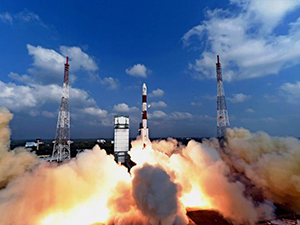
On May 5, the skies above the island of Sriharikota on the coast of the Bay of Bengal will be lit up as the Geo- synchronous Satellite Launch Vehicle (GSLV) also called the 'naughty boy of ISRO' on its 11th mission will carry a message of peace like never before.
The nearly 50-m-tall rocket that weighs about 412 tons will carry what is now dubbed as the 'South Asia Satellite' or what the Indian Space Research Organisation (ISRO) still prefers to call GSAT-9. The 2230-kg satellite has been fabricated in three years and is purely a communications satellite costing Rs 235 crore.
The uniqueness of this satellite is that it will have a footprint that extends all over South Asia and India is gifting this heavenly messenger to its neighbours who according to India's assessment could be helped in better utilising these space based technologies. The South Asia Satellite has 12 Ku band transponders which India's neighbours can utilise to increase communications. Each country will get access to at least one transponder through which they could beam their own programming and there could be common 'south Asian programing' as well.
Each country has to develop its own ground infrastructure though India is willing to extend assistance and know-how. According to the government. the satellite will "enable a full range of applications and services to our neighbours in the areas of telecommunication and broadcasting applications viz. television, direct-to-home (DTH), very small aperture terminals (VSATs), tele-education, telemedicine and disaster management support".
The satellite also has the capability to provide secure hot lines among the participating nations in addition since the region is highly prone to earthquakes, cyclones, floods, tsunamis, it may help in providing critical communication links in times of disasters. In this unusual message of peace, India's most hostile neighbour Pakistan has fully opted out. Rest of the seven nations part of the South Asian Association for Regional Co- operation (SAARC) are already on-board with Afghanistan still to ink the deal with some minor technical details still to be fixed in Kabul.
Nepal, Bhutan, Maldives, Bangladesh and Sri Lanka have agreed to be part of this mission, confirms Baglay. When Prime Minister Modi was just a fresher and just four weeks into his new position on June 30, 2014, he surprised the world while speaking to the scientists at ISRO in Sriharikota as he asked "the space community to take up the challenge of developing a SAARC satellite that we can dedicate to our neighbourhood as a gift from India".
The proposal emerged directly from Modi and the leadership at ISRO was stunned into silence not knowing what this space animal will look like. A highly-impassioned Modi, who had just witnessed a successful launch, said "I believe that the fight against the poverty of the countries of SAARC is the fight against illiteracy, the fight against superstitions, the challenge of moving forward in the scientific field is the possibility of providing opportunities to young people of SAARC countries.
"Our dream of this SAARC Satellite will work in the welfare of all our neighbouring countries. And that's why I have proposed in front of you today that we offer a valuable gift to our SAARC countries through a SAARC Satellite launch so that we also become partners in their welfare." Modi reinforced this idea five months later when speaking in Kathmandu at the SAARC Summit on November 26, 2014. He said, "India's gift of a satellite for the SAARC region will benefit us all in areas like education, telemedicine, disaster response, resource management, weather forecasting and communication.
"We will also host a conference in India for all South Asian partners next year, to strengthen our collective ability to apply space technology in economic development and governance. And, we plan to launch our satellite by the SAARC Day in 2016." Modi's sincere efforts got a jolt when even after participating in the planning meeting on June 22, 2015, Pakistan decided to 'opt out' from the proposed SAARC satellite suggesting that 'Pakistan has its own space program'.
So the project was renamed to 'South Asia Satellite' but sources say Pakistan was not allowed to veto the development project. Meanwhile frequency co-ordination activities took longer than expected and the launch got postponed by almost six months. Among India's neighbours, three nations already possess full-fledged communication satellites with Pakistan and Sri Lanka having been helped by China; Afghanistan also has a communication satellite actually an old India-made satellite acquired from Europe.
Bangladesh is likely to have its first bird in the sky later this year made with help from Thales. Essentially, it is the tiny nations of Bhutan and Maldives that may benefit in the long run. Incidentally, Nepal has already floated a tender to acquire two communications satellites. Experts say "Pakistan has missed an opportunity" since its own space program is currently in a primitive stage as compared to India's. This is despite the fact that Pakistan actually launched its first rocket five years ahead of India and its space agency Pakistan Space and Upper Atmosphere Research Commission (SUPARCO) is older than ISRO.
Pakistan has had five satellites in space but today lacks heavy duty launchers and satellite fabrication facilities. But will India's strident regional space diplomacy yield results? There is no doubt that through the South Asia Satellite India is actively trying to counter China's growing influence on its neighbours. But in the 21st-century Asian space race, China already has the first mover advantage.
Better late than never is prevailing mood and for this unique space diplomacy it is almost certain that India is likely to get applauded by the world's powers for this one of a kind friendly confidence building measure. Hopefully friendly skies can result in reduced hostilities on Earth.

Comments
Add new comment