



Muslim population growth slows in India, still faster than others

August 26, 2015

New Delhi, Aug 26: India’s Muslim population is growing slower than it had in the previous decades, and its growth rate has slowed more sharply than that of the Hindu population, the census on religious groups released by the Central government has revealed. However, the Muslim share in India’s population has grown faster than that of other religions between 2001 and 2011.

humanity

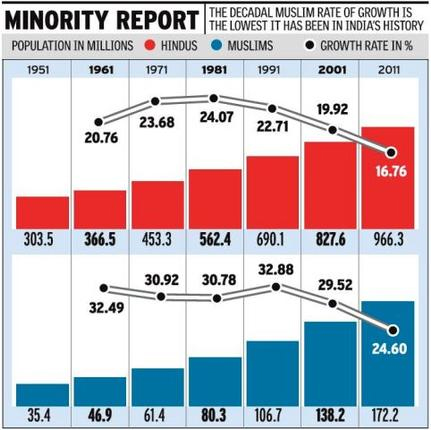
The decadal Muslim rate of growth is the lowest it has ever been in India’s history, as it is for all religions.

The Muslim population still grows at a faster rate than the Hindu population, but the gap between the two growth rates is narrowing fast.
census1

India in numbers

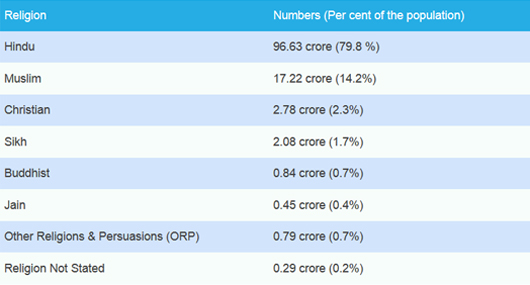
India now has 966.3 million Hindus, who make up 79.8 per cent of its population, and 172.2 million Muslims, who make up 14.23 per cent. Among the other minorities, Christians make up 2.3 per cent of the population and Sikhs 2.16 per cent.

The Registrar-General and Census Commissioner released the data on Population by Religious Communities of Census 2011 on Tuesday evening.

The distribution of data is of the total population by six major religious communities — Hindu, Muslim, Christian, Sikh, Buddhist and Jain — besides “Other religions and persuasions” and “Religion not stated”.

The data are released by sex and residence up to the levels of sub-districts and towns.

As has been the case since Independence, the rate of increase of the Muslim population is higher than that of the Hindu population as a result of higher Muslim fertility, higher child mortality among Hindus and a greater life expectancy among Muslims, demographers say. However, Muslim fertility rates in India are falling faster than among Hindus, Pew Research’s Future of World Religions report showed recently, and the Muslim community is expected to reach replacement levels of fertility by 2050.

Muslim sex ratio improves further
census2

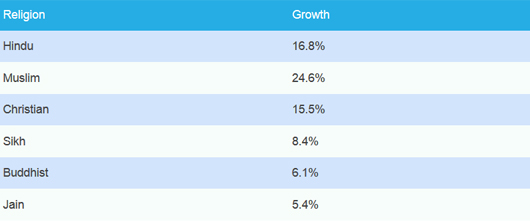
The data on Population by Religious Communities of Census 2011 show that between 2001 and 2011, Hindu population grew by 16.76 per cent, while that of Muslims by 24.6 per cent. The population of both communities grew faster during the previous decade, at 19.92 per cent and 29.52 per cent, respectively. As a long-term trend, say demographers, the communities’ growth rates are converging.

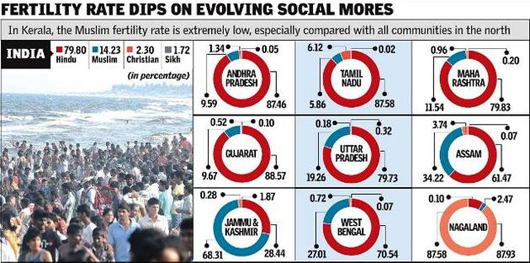
“This is completely along expected lines, and has been an ongoing process,” P. Arokiasamy, demographer and Professor at the International Institute of Population Sciences, Mumbai, told The Hindu. “With rising education and changing family expectations, declining fertility is an expected demographic phenomenon. It begins among better educated groups with better access to health care — as in India’s southern States — and then other groups catch up and converge,” Dr. Arokiasamy explained. In Kerala, for instance, the Muslim fertility rate (while higher than among the Hindus) is extremely low, especially compared with all communities in the northern States, he said.

The numbers show that the sex ratio among Muslims, already better than among Hindus, has further improved.

The sex ratio among Muslims now stands at 951 females for every 1,000 males, substantially better than 936 in 2001, while among Hindus, it is 939 females for every 1,000 males, a slight improvement over the 2001 value of 931. Assam remains the State with the largest Muslim population as a proportion (34.22 per cent) and saw the largest increase in the Muslim proportion between 2001 and 2011, followed by Uttarakhand and Kerala.
census3

Growth rate

The growth rate of population in the decade 2001-2011 was 17.7%. The growth rate of population of the different religious communities in the same period was:
census4

The Census data on religion comes after a significant delay; the 2001 Census data on religion was released in 2004 and the 2011 round results were expected in 2014. However, the numbers remained unreleased, even as a draft of the key data was selectively leaked earlier. The data comes in the backdrop of much fear-mongering over Muslims and their population, and RSS thinkers were quick to term the new data as proof of the end of Hindus, even while the numbers belie their claim.

Also Read: Hindu population declined; Muslims increased in India, reveals 2011 census

Comments

Add new comment

  • Coastaldigest.com reserves the right to delete or block any comments.
  • Coastaldigset.com is not responsible for its readers’ comments.
  • Comments that are abusive, incendiary or irrelevant are strictly prohibited.
  • Please use a genuine email ID and provide your name to avoid reject.
News Network
December 2,2025

DKSsiddu.jpg

Bengaluru: 'Nati koli saaru' (country chicken curry) considered one of Chief Minister Siddaramaiah’s favourites along with steaming hot idlis was on the breakfast menu at Deputy CM D K Shivakumar’s residence on Tuesday, according to official sources.

The spread also included 'nati koli' fry, vada and pongal, among other items, they said.

In an apparent show of unity, Siddaramaiah visited Shivakumar’s residence for breakfast, just days after the two leaders shared a meal amid a simmering power tussle in the state Congress.

Siddaramaiah drove to the Deputy CM’s residence in Sadashivanagar, where he was received by Shivakumar and his brother D K Suresh, who is a former Congress MP.

Suresh and Kunigal MLA H D Ranganath, a relative of Shivakumar, joined them for breakfast, which featured a mix of vegetarian and non-vegetarian dishes.

Speaking to reporters later, Siddaramaiah said Shivakumar had invited him during his visit to the CM’s residence for breakfast on Saturday.

Asked about the difference between the two meals, the chief minister said, "At his (Shivakumar’s) house it was non-veg, while at my house it was veg. He is a vegetarian, I am a non-vegetarian. I had not prepared non-veg. I told DK to get chicken from the village as you won’t get the original in Bengaluru."

Shivakumar said he had initially invited Siddaramaiah to his residence, but the CM had suggested visiting his place first and reciprocating later. "It was a vegetarian breakfast at the CM’s house on Saturday," he noted.

"Today, I invited him (the CM) to my house. He enjoyed the breakfast, which had his Mysuru taste," Shivakumar added. At this point, Siddaramaiah remarked that Shivakumar’s wife is also from Mysuru.

Saturday’s breakfast at Siddaramaiah’s official residence, held as part of efforts by the Congress high command to ease tensions in the leadership dispute between the two, reportedly included idlis and sambar, according to official sources.

Comments

Add new comment

  • Coastaldigest.com reserves the right to delete or block any comments.
  • Coastaldigset.com is not responsible for its readers’ comments.
  • Comments that are abusive, incendiary or irrelevant are strictly prohibited.
  • Please use a genuine email ID and provide your name to avoid reject.
News Network
December 7,2025

Mangaluru, Dec 7: A 34-year-old fruit and vegetable trader in Mangaluru has reportedly lost ₹33.1 lakh after falling victim to an online investment scam run through a fake mobile app.

Police said the scam began in September, when the victim received a link on Facebook. Clicking it connected him to a WhatsApp number, where an unidentified person introduced a high-return investment scheme and instructed him to download an app.

To build trust, the fraudster asked him to invest ₹30,000 on September 24. The trader soon received ₹34,000 as “profit,” convincing him the scheme was genuine. Over the next two months, he transferred money in multiple instalments via Google Pay and IMPS to different scanner codes and bank accounts shared by the scammers. Between September 24 and December 3, he ended up sending a total of ₹33.1 lakh.

When he later requested a refund of his investment and promised returns, the scammers demanded additional payments, claiming he needed to pay a “service tax” first. Even after he paid a small amount, no money was returned, and the scammers continued pressuring him for more.

A case has been registered at the CEN Crime Police Station.

Comments

Add new comment

  • Coastaldigest.com reserves the right to delete or block any comments.
  • Coastaldigset.com is not responsible for its readers’ comments.
  • Comments that are abusive, incendiary or irrelevant are strictly prohibited.
  • Please use a genuine email ID and provide your name to avoid reject.
News Network
November 30,2025

airportmetro.jpg

Udupi: The pontiffs of Sri Paryaya Puttige Mutt, the sacred seat of Jagadguru Shrimad Madhvacharya Moola Samsthanam, have submitted a proposal to the Prime Minister seeking comprehensive development for Udupi district. 

Proposal for International Airport

A key request is the establishment of an international airport. Highlighting that around 1,000 acres of land are available and suitable, the pontiffs noted that the existing Mangalore Airport provides limited international connectivity. They suggested the airport be developed under a Public-Private Partnership (PPP) or as a Greenfield Airport to boost trade, education, healthcare, and spiritual tourism.

Metro and Rapid Transit Connectivity

The proposal also calls for Metro Rail or Rapid Transit between Mangaluru and Udupi. The 55 km coastal stretch experiences heavy daily commuter traffic, causing congestion. The district administration is ready to prepare an initial project report for a Mass Rapid Transit corridor and requested inclusion under national urban mobility programmes to ensure safe, green, and time-efficient regional transport.

Port and Coastal Development

The pontiffs urged the development of an international-standard port with a cruise terminal along Udupi’s coast. They also requested fast-tracking of pending coastal tourism projects and revising Coastal Regulation Zone (CRZ) norms to encourage sustainable infrastructure and hospitality investment.

IT, AI and Technological Infrastructure

Support was sought for an IT and AI Innovation Park with incubation facilities under Digital India and Startup India initiatives. The proposal also emphasized the need for strengthened data security and cloud computing infrastructure to boost India’s technological independence.

Sports and Education Initiatives

The pontiffs requested national sports status for Kambala, along with financial and infrastructure support. They also sought the establishment of an AIIMS in Udupi, a new IIT campus, and approval for an IIM to promote higher education in the district.

Representation to the Prime Minister

Sri Sugunendra Tirtha Pontiff and Sri Sushrendra Tirtha Swamiji represented the pontiffs in submitting the comprehensive development proposal to the Prime Minister during his recent visit.

Comments

Add new comment

  • Coastaldigest.com reserves the right to delete or block any comments.
  • Coastaldigset.com is not responsible for its readers’ comments.
  • Comments that are abusive, incendiary or irrelevant are strictly prohibited.
  • Please use a genuine email ID and provide your name to avoid reject.