



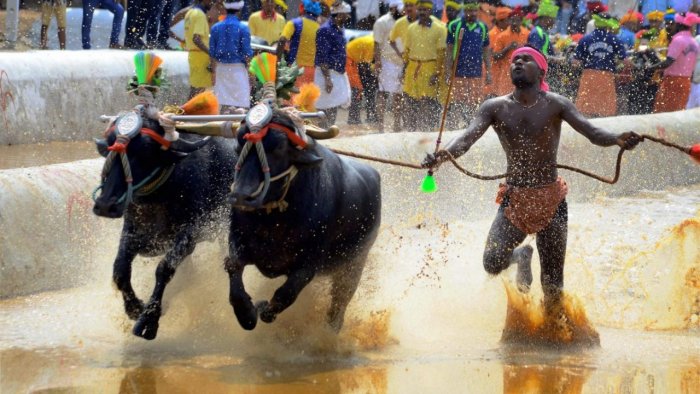
Kambala season begins to enthuse local folks in coastal Karnataka

News Network
December 17, 2022

kambala.jpg

Kambala, the traditional buffalo race event popular in the coastal Karnataka districts of Dakshina Kannada, Udupi and Kasaragod of Kerala, has embarked on a new season, entertaining tourists and the rural population in the region known as Tulu Nadu.

The first kambala (buffalo race in slushy paddy fields) of the season was set in motion at Kakkepadavu in Bantwal taluk of DK district on November 26.

Priest Raghavendra Bhat performed the rituals and temple pujari Yogindra Bhat inaugurated the ‘Sathya Dharma Kambala’ at the venue, which entered its decennial year. A total of 22 competitive kambalas have been tentatively scheduled for the 2022-23 season till April 8 next year, according to district Kambala committee president Rohit Hegde Yermal.

The last Kambala has been scheduled at Panapila in Moodbidri on April 8, 2023.

The events to be held at Bolangala near Mudipu and Panapila are the two new Kambalas which have been added to the season’s calendar. The kambala track at Bolangala is getting ready while the track at Panapila has already been prepared, sources said. Kambalas are usually held at 18 to 20 places in the region on behalf of the committee every year.

The number rose to 22 this season due to the apparent enthusiasm among the youth who are more attracted to the event in recent years. The sixth edition of Mangaluru Kambala under the aegis of Capt Brijesh Chowta will be held on January 22 at the Goldfinch city ground. Former MLC Capt Ganesh Karnik said Kambala sport needs to be preserved for future generations and youth need to be actively taking part in it.

The rich culture of the coastal belt through Kambala should be maintained, he said, seeking the support of all for the sixth Mangaluru kambala.

Two Kambalas at Katapadi (Beedu kambala) to be held on February 11, 2023, and Aikala (Bava Kambala) on January 28 are more than 100 years old and were once traditional events which later turned into competitive ones.

The competitive kambala events are held on two parallel race tracks filled with slushy fields. Buffalo owners and farmers in the region take good care of their buffalos and the best of them are well fed, oiled and nurtured for a race in kambala. Buffaloes are usually raced in pairs during a kambala event, held together with ploughs and ropes. The best of Kambala buffaloes can cover a 140-meter race track in around 12 seconds. The jockey or kambala runner is the man commanding the buffaloes and races along with them and only the most athletic youth can handle the animals.

The runner stands on a wooden plank (known as halage) supported to the setup that holds two buffaloes together (called Negilu). The Kambala runner controls the buffaloes with a whip or ropes.

The runner also entertains spectators by splashing water as high as possible during the race. Two teams of buffaloes along with their jockeys race towards the finish line on the two parallel race tracks. Race goes on all day and winners qualify for the next rounds. Kambala events usually begin in November after the October paddy harvest is done. More than 45 villages in coastal Karnataka celebrate the traditional, non-competitive kambala race every year. Major Kambala events are held at Aikala, Katapadi, Pilikula, Mangaluru, Moodbidri, Puttur, Paivalike, Kakkepadavu, Kulur, Surathkal, Uppinangadi, Vamanjoor and Venur.

Kambala has become an organised rural sport, with elaborate planning and scheduling to accommodate competitions at different places. While traditional Kambala was non-competitive with pairs running one by one, in the modern event, the contest generally takes place between two pairs of buffaloes. The winning pair of buffaloes were usually rewarded with coconuts and bananas. At present, winning owners earn gold and silver coins and in many competitions, cash prizes are also awarded. The length of the kambala tracks varies from 133.5 metre to 150 metre and has width from 15 feet to 17 feet.

The competitions are held in six categories of Kane halage, adda halage, hagga senior, hagga junior, naegilu hiriya and naegilu kiriya. More pairs of buffalos are expected this year for the hagga junior competitions as many youngsters are showing more interest in taking part in the events, a Kambala committee member said. The kambalas for the 2021-22 season, which began on November 27 last year, had to be temporarily cancelled due to the weekend curfew and other Covid-19 restrictions, after holding only six of the 19 scheduled events.

The events resumed on February 5, 2022 after the lifting of the curfew with a renewed calendar, listing 11 kambalas between February 5 and April 16. The kambala committee counts at least 100 jockeys taking part in the events in the region. Of them, 8 to 10 are top performers while around 20 have already displayed their brilliance in the sport. One of the jockeys, Srinivas Gowda, a construction worker, had shot into the limelight in 2020, when he covered 142.5 metres in 13.62 seconds, which when back-calculated, equates to 100-metre run in around 9.55 seconds. It was 0.03 seconds faster than Usain Bolt’s record time of 9.58 seconds. Many compared his feat to that of Bolt and Gowda was termed as the ‘Usain Bolt of Kambala.’

Later, he himself said putting him on the same plane as Usain Bolt would be a bit of a stretch. The race involves the athlete maintaining momentum with some help from his racing buffaloes.

Kambala had also stirred controversy in the past with the charge of ill-treatment of animals. In 2016, the event was banned for the first time by the High Court, based on a petition by animal rights activists group PETA. Just like the row over jallikattu in Tamil Nadu, a heated debate followed with arguments of people supporting the event and those against the rural sport. The state government later brought an ordinance in 2017 to pave the way for the continuance of kambala. The Prevention of Cruelty to Animals (Karnataka second amendment) Act, 2017, permits kambala to be organised with restrictions to protect the animals from mistreatment. The Supreme Court has also issued several guidelines to ensure that kambala buffaloes are not harmed, tortured or ill-treated during the races. 

Comments

Add new comment

  • Coastaldigest.com reserves the right to delete or block any comments.
  • Coastaldigset.com is not responsible for its readers’ comments.
  • Comments that are abusive, incendiary or irrelevant are strictly prohibited.
  • Please use a genuine email ID and provide your name to avoid reject.
News Network
December 15,2025

Mangaluru, Dec 15: Educational institutions in Mangaluru that rely on the popular Mangala Stadium for their annual sports events are bracing for an inconvenience as the city's key sporting venue is set to close its gates for a significant upgrade. The stadium is expected to be unavailable for approximately two months starting from January 15, 2026.

The closure is necessitated by a proposed overhaul of the stadium's facilities, with a special focus on upgrading the synthetic track. Pradeep Dsouza, Assistant Director of the District of Youth Empowerment and Sports (DYES), Dakshina Kannada, confirmed the development.

"Experts have visited the stadium, conducted a thorough inspection, and have given the go-ahead for a complete makeover," Dsouza stated. "Funds have been allocated for the project, and we are currently awaiting the final green signal from state officials to commence the work. We anticipate that the work will likely begin in the second week of January. Consequently, we have stopped renting out the stadium to colleges and other organizations in preparation for the upgrade."

The timing presents a logistical challenge for colleges, as many schools have already concluded their sports meets.

"Colleges will now be organizing their events and will need to find alternative locations to host their sports meets," Dsouza added. He suggested a few potential venues, including the Dakshina Kannada police ground, University College grounds, Panambur grounds, Swaraj Maidan in Moodbidri, and the Mangalore University sports grounds in Konaje.

However, many institutions note that finding a comparable venue will be difficult. While the DK police ground and University College grounds are closer to the city center, they do not possess the extensive facilities and infrastructure offered by Mangala Stadium.

Dr. P Dayananda Pai - P Satisha Govt First Grade College, Carstreet, is one such institution dependent on the stadium. Principal Jayakar Bhandary expressed hope for a swift completion of the work. "We expect the work to be completed at the earliest. If not, we will be forced to look for other venues to host the sports day for our students," Bhandary said, highlighting the pressing need for the city's main sporting facility.

Comments

Add new comment

  • Coastaldigest.com reserves the right to delete or block any comments.
  • Coastaldigset.com is not responsible for its readers’ comments.
  • Comments that are abusive, incendiary or irrelevant are strictly prohibited.
  • Please use a genuine email ID and provide your name to avoid reject.
News Network
December 19,2025

Saudi Arabia has abolished fees on expatriate workers employed in licensed industrial establishments, signaling a strong push to empower national factories and enhance the Kingdom’s global industrial competitiveness. The move reflects the leadership’s commitment to building a sustainable and resilient industrial economy under Saudi Vision 2030.

The decision was approved by the Council of Ministers, chaired by Crown Prince and Prime Minister Mohammed bin Salman, following a recommendation from the Council of Economic and Development Affairs (CEDA). It forms part of a broader strategy to support, modernize, and strengthen the industrial sector.

By removing fees on foreign workers, industrial establishments gain greater operational flexibility and relief from financial pressures. This is expected to help factories expand production, improve efficiency, and compete more effectively in international markets, while reinforcing long-term sustainability.

The initiative aligns closely with Saudi Vision 2030, which identifies industry as a key pillar of economic diversification. A competitive and resilient industrial base is viewed as essential for driving innovation, attracting investment, and sustaining long-term economic growth.

Overall, the fee exemption underscores the Kingdom’s commitment to creating a supportive environment for industrial development and ensuring that Saudi factories remain globally competitive and capable of leading the nation’s economic transformation.

Comments

Add new comment

  • Coastaldigest.com reserves the right to delete or block any comments.
  • Coastaldigset.com is not responsible for its readers’ comments.
  • Comments that are abusive, incendiary or irrelevant are strictly prohibited.
  • Please use a genuine email ID and provide your name to avoid reject.
News Network
December 13,2025

New Delhi: School-going children are picking up drug and smoking habits and engaging in consumption of alcohol, with the average age of introduction to such harmful substances found to be around 13 years, suggesting a need for earlier interventions as early as primary school, a multi-city survey by AIIMS-Delhi said.

The findings also showed substance use increased in higher grades, with grade XI/XII students two times more likely to report use of substances when compared with grade VIII students. This emphasised the importance of continued prevention and intervention through middle and high school.

The study led by Dr Anju Dhawan of AIIMS's National Drug Dependence Treatment Centre, published in the National Medical Journal of India this month, looks at adolescent substance use across diverse regions.

The survey included 5,920 students from classes 8, 9, 11 and 12 in urban government, private and rural schools across 10 cities -- Bengaluru, Chandigarh, Delhi, Dibrugarh, Hyderabad, Imphal, Jammu, Lucknow, Mumbai, and Ranchi. The data were collected between May 2018 and June 2019.

The average age of initiation for any substance was 12.9 (2.8) years. It was lowest for inhalants (11.3 years) followed by heroin (12.3 years) and opioid pharmaceuticals (without prescription; 12.5 years).

Overall, 15.1 per cent of participants reported lifetime use, 10.3 per cent reported past year use, and 7.2 per cent reported use in the past month of any substance, the study found.

The most common substances used in the past year, after tobacco (4 per cent) and alcohol (3.8 per cent), were opioids (2.8 per cent), followed by cannabis (2 per cent) and inhalants (1.9 per cent). Use of non-prescribed pharmaceutical opioids was most common among opioid users (90.2 per cent).

On being asked, 'Do you think this substance is easily available for a person of your age' separately for each substance category, nearly half the students (46.3 per cent) endorsed that tobacco products and more than one-third of the students (36.5 per cent) agreed that a person of their age can easily procure alcohol products.

Similarly, for Bhang (21.9 per cent), ganja/charas (16.1 per cent), inhalants (15.2 per cent), sedatives (13.7 per cent), opium and heroin (10 per cent each), the students endorsed that these can be easily procured.

About 95 per cent of the children, irrespective of their grade, agreed with the statement that 'drug use is harmful'.

The rates of substance use (any) among boys were significantly higher than those of girls for substance use (ever), use in the past year and use in the past 30 days. Compared to grade VIII students, grade IX students were more likely, and grade XI/XII students were twice as likely to have used any substance (ever).

The likelihood of past-year use of any substance was also higher for grade IX students and for grade XI/XII students as compared to grade VIII students.

About 40 per cent of students mentioned that they had a family member who used tobacco or alcohol each. The use of cannabis (any product) and opioid (any product) by a family member was reported by 8.2 per cent and 3.9 per cent of students, respectively, while the use of other substances, such as inhalants/sedatives by family was 2-3 per cent, the study found.

A relatively smaller percentage of students reported use of tobacco or alcohol among peers as compared to among family members, while a higher percentage reported inhalants, sedatives, cannabis or opioid use among peers.

Children using substances (past year) compared to non-users reported significantly higher any substance use by their family members and peers.

There were 25.7 per cent students who replied 'yes' to the question 'conflicts/fights often occur in your family'. Most students also replied affirmatively to 'family members are aware of how their time is being spent' and 'damily members are aware of with whom they spend their time'.

Comments

Add new comment

  • Coastaldigest.com reserves the right to delete or block any comments.
  • Coastaldigset.com is not responsible for its readers’ comments.
  • Comments that are abusive, incendiary or irrelevant are strictly prohibited.
  • Please use a genuine email ID and provide your name to avoid reject.