



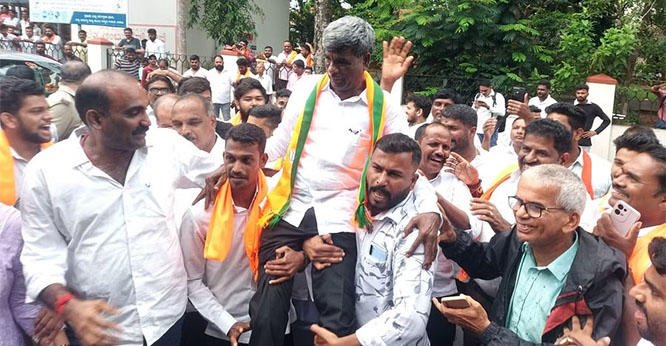
Replacing sitting MPs with new candidates helps BJP retain its coastal Karnataka bastions amid public discontent

News Network
June 5, 2024

kotasrinvas.jpg

Riding on the Hindutva wave and replacing sitting MPs with new candidates, the Bharatiya Janata Party (BJP) has succeeded in retaining its strongholds in coastal Karnataka — Uttara Kannada, Dakshina Kannada, and Udupi-Chikmagalur Lok Sabha constituencies.

Although the victory margins have decreased in all constituencies, a strong organizational network and the Hindutva factor seem to have helped the BJP overcome anti-incumbency sentiment. All three elected MPs will enter the Lok Sabha for the first time.

The Congress appears to have failed in mobilizing its grassroots volunteers and strengthening its organizational networks in these regions. Even the party's guarantee schemes did not seem to significantly influence the election outcomes.

Dakshina Kannada

In Dakshina Kannada, which faced a notable anti-incumbency sentiment, BJP’s Brijesh Chowta defeated Congress’ Padmaraj R. Poojary. Brijesh’s efforts to placate discontented BJP and RSS workers, his focus on the Hindutva factor, development, and local leaders’ efforts to unite various factions within the BJP contributed to his victory with a margin of 1,49,208 votes. In 2019, the BJP had won by a margin of 2,74,621.

Prime Minister Modi held a roadshow in Mangaluru to bolster support for the Dakshina Kannada and Udupi-Chikmagalur candidates, particularly after dissatisfaction with three-time MP Nalin Kumar Kateel’s unfulfilled promises became apparent.

Udupi-Chikmagalur

In Udupi-Chikmagalur, the BJP responded to the 'Go Back, Shobha' campaign by fielding former minister Kota Srinivas Poojary, who won with a margin of 2,59,175 votes against Congress candidate Jayaprakash Hegde. In 2019, the BJP’s margin was 3,49,599 votes. Poojary’s clean image, emphasis on Hindutva politics, the Modi wave, and support from majority communities were likely key factors in his victory.

The BJP appeared to be more effective than the Congress in strategizing to win over the Billavas and Bunts, two major communities in Dakshina Kannada and Udupi-Chikmagalur constituencies. Modi’s gesture of garlanding the statue of social reformer Narayana Guru, revered by the Billava community in Mangaluru, also resonated with voters.

Uttara Kannada

In Uttara Kannada, BJP’s Vishweshwar Hegde Kageri defeated Congress’ Anjali Nimbalkar by 3,37,428 votes. In 2019, the BJP’s victory margin was 4,79,649 votes. Despite local leaders’ demands to field a younger candidate, the party chose the six-time MLA and former state minister. The Modi appeal and Hindutva politics were significant factors, along with the outsider tag of the Congress candidate.

The Congress had won five out of eight Assembly segments in Uttara Kannada in last year’s elections, indicating potential for a competitive race. However, a rally by Modi in Sirsi shifted the momentum in favor of Kageri, who campaigned heavily on Modi's popularity rather than his own track record.

Public discontent

Udupi-based political analyst Rajaram Tallur noted that the reduced victory margins signal public discontent with the BJP. However, the Congress failed to capitalize on this sentiment due to a lack of charismatic leaders, insufficient organizational efforts, and a defeatist attitude regarding their chances in these seats.

Yellapur-based political analyst Sriranga Katti highlighted that Kageri’s reliance on Modi's appeal rather than his own achievements was a decisive factor in Uttara Kannada.

Overall, the BJP's combination of new candidates, a strong organizational framework, and leveraging the Hindutva narrative helped it retain its coastal Karnataka strongholds, while the Congress struggled to make significant inroads.

Comments

Add new comment

  • Coastaldigest.com reserves the right to delete or block any comments.
  • Coastaldigset.com is not responsible for its readers’ comments.
  • Comments that are abusive, incendiary or irrelevant are strictly prohibited.
  • Please use a genuine email ID and provide your name to avoid reject.
News Network
December 4,2025

Udupi: A 40-year-old NRI from Udupi has reportedly lost more than Rs 12.25 lakh in an online investment scam operated through Telegram.

According to a complaint filed at the CEN police station, Leo Jerome Mendonsa, who has been working in Dubai for the past 15 years in computer accessories sales, maintains NRI accounts in Karkala and Nitte.

On November 12, 2025, Mendonsa was added to a Telegram group called Instaflow Earnings by unknown individuals. Users identified as Priya and Dipannita persuaded him to invest in “Revenue Tasks.” Initially, Mendonsa transferred Rs 1,100 multiple times and received the promised returns, encouraging him to continue.

On November 14, another user, Nishmitha Shetty, directed him to register on a website, digitvisionuoce.cc, and invest Rs 4 lakh in various shares. Over the next few days, he made multiple transfers totaling Rs 12,25,000, including Rs 50,000 via Google Pay, believing the scheme was legitimate.

After receiving the money, the alleged handlers stopped responding, and neither the invested amount nor the promised profits were returned.

The CEN police have registered a case under Sections 66(C) and 66(D) of the IT Act and Section 318(4) of the Bharatiya Nyaya Sanhita (BNS), and investigations are ongoing.

Comments

Add new comment

  • Coastaldigest.com reserves the right to delete or block any comments.
  • Coastaldigset.com is not responsible for its readers’ comments.
  • Comments that are abusive, incendiary or irrelevant are strictly prohibited.
  • Please use a genuine email ID and provide your name to avoid reject.
News Network
December 13,2025

New Delhi: School-going children are picking up drug and smoking habits and engaging in consumption of alcohol, with the average age of introduction to such harmful substances found to be around 13 years, suggesting a need for earlier interventions as early as primary school, a multi-city survey by AIIMS-Delhi said.

The findings also showed substance use increased in higher grades, with grade XI/XII students two times more likely to report use of substances when compared with grade VIII students. This emphasised the importance of continued prevention and intervention through middle and high school.

The study led by Dr Anju Dhawan of AIIMS's National Drug Dependence Treatment Centre, published in the National Medical Journal of India this month, looks at adolescent substance use across diverse regions.

The survey included 5,920 students from classes 8, 9, 11 and 12 in urban government, private and rural schools across 10 cities -- Bengaluru, Chandigarh, Delhi, Dibrugarh, Hyderabad, Imphal, Jammu, Lucknow, Mumbai, and Ranchi. The data were collected between May 2018 and June 2019.

The average age of initiation for any substance was 12.9 (2.8) years. It was lowest for inhalants (11.3 years) followed by heroin (12.3 years) and opioid pharmaceuticals (without prescription; 12.5 years).

Overall, 15.1 per cent of participants reported lifetime use, 10.3 per cent reported past year use, and 7.2 per cent reported use in the past month of any substance, the study found.

The most common substances used in the past year, after tobacco (4 per cent) and alcohol (3.8 per cent), were opioids (2.8 per cent), followed by cannabis (2 per cent) and inhalants (1.9 per cent). Use of non-prescribed pharmaceutical opioids was most common among opioid users (90.2 per cent).

On being asked, 'Do you think this substance is easily available for a person of your age' separately for each substance category, nearly half the students (46.3 per cent) endorsed that tobacco products and more than one-third of the students (36.5 per cent) agreed that a person of their age can easily procure alcohol products.

Similarly, for Bhang (21.9 per cent), ganja/charas (16.1 per cent), inhalants (15.2 per cent), sedatives (13.7 per cent), opium and heroin (10 per cent each), the students endorsed that these can be easily procured.

About 95 per cent of the children, irrespective of their grade, agreed with the statement that 'drug use is harmful'.

The rates of substance use (any) among boys were significantly higher than those of girls for substance use (ever), use in the past year and use in the past 30 days. Compared to grade VIII students, grade IX students were more likely, and grade XI/XII students were twice as likely to have used any substance (ever).

The likelihood of past-year use of any substance was also higher for grade IX students and for grade XI/XII students as compared to grade VIII students.

About 40 per cent of students mentioned that they had a family member who used tobacco or alcohol each. The use of cannabis (any product) and opioid (any product) by a family member was reported by 8.2 per cent and 3.9 per cent of students, respectively, while the use of other substances, such as inhalants/sedatives by family was 2-3 per cent, the study found.

A relatively smaller percentage of students reported use of tobacco or alcohol among peers as compared to among family members, while a higher percentage reported inhalants, sedatives, cannabis or opioid use among peers.

Children using substances (past year) compared to non-users reported significantly higher any substance use by their family members and peers.

There were 25.7 per cent students who replied 'yes' to the question 'conflicts/fights often occur in your family'. Most students also replied affirmatively to 'family members are aware of how their time is being spent' and 'damily members are aware of with whom they spend their time'.

Comments

Add new comment

  • Coastaldigest.com reserves the right to delete or block any comments.
  • Coastaldigset.com is not responsible for its readers’ comments.
  • Comments that are abusive, incendiary or irrelevant are strictly prohibited.
  • Please use a genuine email ID and provide your name to avoid reject.
News Network
December 15,2025

Mangaluru, Dec 15: Air India Express has announced that it will resume direct flight services between Mangaluru and Muscat from March 2026, restoring an important international air link for passengers from the coastal region.

Airport authorities said the service will operate twice a week—on Sundays and Tuesdays—from March 1. The initial flights are scheduled on March 3, 8 and 10, followed by March 15 and 17, with the same operating pattern to continue thereafter. The flight duration is approximately three hours and 25 minutes.

The Mangaluru–Muscat route was earlier operated under the 2025 summer schedule, with services beginning on July 14. At that time, Air India Express had operated four flights a week before suspending the service.

Officials said the summer schedule will come into effect from March 29, after which changes in flight timings and departure schedules from Mangaluru are expected. Passengers have been advised to check the latest schedules while planning their travel.

The resumption of direct flights to Muscat is expected to significantly benefit expatriates, business travellers and others, further strengthening Mangaluru’s air connectivity with the Gulf region.

Comments

Add new comment

  • Coastaldigest.com reserves the right to delete or block any comments.
  • Coastaldigset.com is not responsible for its readers’ comments.
  • Comments that are abusive, incendiary or irrelevant are strictly prohibited.
  • Please use a genuine email ID and provide your name to avoid reject.