



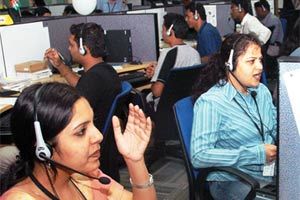
India lost 10% of BPO business in 5 years

February 27, 2013

BPO

New Delhi, Feb 27: India has lost about 10 per cent share of the global BPO market in the last five years to destinations like China, the Philippines and Brazil, raising concerns for the USD 20-billion Indian BPO industry.

The pre-budget Economic Survey 2012-13, which was tabled in Parliament today, said India faces stiff competition from several emerging countries in the BPO sector.

It called for information campaigns by the industry to dispel the myths and fears about outsourcing in the developed economies.

Countries like Malaysia, China and the Philippines in Asia; Egypt and Morocco in North Africa; Brazil, Mexico, Chile and Columbia in Latin America; and Poland and Ireland in Europe are emerging as attractive destinations for voice contracts, posing a significant threat to Indian firms, it said.

"According to Nasscom, in the last five years, India has lost about 10 per cent market share to the rest of the world in the world BPO space, most of which is in the voice contract segment," it said.

According to industry body Nasscom, in FY13, IT services would account for USD 50 billion, while Business Process Management (BPM or BPO) and Engineering services would contribute USD 20 billion and USD 10 billion, respectively.

In terms of competition, though China faces challenges like language proficiency, it is making large investments in the mission mode to increase English proficiency.

"Thus, (China) may eventually emerge as a threat to India," it added.

The Philippines, which is the second largest destination for outsourcing, is also a serious competitor having developed both the hardware and software segments of IT.

Outsourcing has become a national issue in many developed countries like the US and the UK, who are supporting the local BPO industry through various means.

"In such a situation, the Indian BPO industry needs to gear up to address the challenges. Information campaigns to dispel the myths and fears about outsourcing needs to be undertaken by the industry in the developed economies," it said.

In the overall IT and IT-enabled services space, new competitors like China, Israel and the Philippines have emerged in recent years.

Between 2005 and 2011, the annual average growth of IT-ITeS services was 69 per cent in the Philippines, 28 per cent in Sri Lanka, 59 per cent in Ukraine, 27 per cent in the Russian Federation, 37 per cent in Argentina and 35 per cent in Costa Rica.

"Even if in some cases the export values are relatively low, the average annual growth of computer services in these economies is well above the average of the top exporters," it said.

Comments

Add new comment

  • Coastaldigest.com reserves the right to delete or block any comments.
  • Coastaldigset.com is not responsible for its readers’ comments.
  • Comments that are abusive, incendiary or irrelevant are strictly prohibited.
  • Please use a genuine email ID and provide your name to avoid reject.
News Network
December 4,2025

indigoflight.jpg

Domestic carrier IndiGo has cancelled over 180 flights from three major airports — Mumbai, Delhi and Bengaluru — on Thursday, December 4, as the airline struggles to secure the required crew to operate its flights in the wake of new flight-duty and rest-period norms for pilots.

While the number of cancellations at Mumbai airport stands at 86 (41 arrivals and 45 departures) for the day, at Bengaluru, 73 flights have been cancelled, including 41 arrivals, according to a PTI report that quoted sources.

"IndiGo cancelled over 180 flights on Thursday at three airports-Mumbai, Delhi and Bengaluru," the source told the news agency.

Besides, it had cancelled as many as 33 flights at Delhi airport for Thursday, the source said, adding, "The number of cancellations is expected to be higher by the end of the day."

The Gurugram-based airline's On-Time Performance (OTP) nosedived to 19.7 per cent at six key airports — Delhi, Mumbai, Chennai, Kolkata, Bengaluru and Hyderabad — on December 3, as it struggled to get the required crew to operate its services, down from almost half of December 2, when it was 35 per cent.

"IndiGo has been facing acute crew shortage since the implementation of the second phase of the FDTL (Flight Duty Time Limitations) norms, leading to cancellations and huge delays in its operations across the airports," a source had told PTI on Wednesday.

Chaos continued at several major airports for the third day on Thursday because of the cancellations.

A spokesperson for the Kempegowda International Airport (KIA) in Bengaluru said that 73 IndiGo flights had been cancelled on Thursday.

At least 150 flights were cancelled and dozens of others delayed on Wednesday, airport sources said, leaving thousands of travellers stranded, according to news agency Reuters.

The Directorate General of Civil Aviation (DGCA) has said it is investigating IndiGo flight disruptions and has asked the airline to submit the reasons for the current situation, as well as its plans to reduce flight cancellations and delays.

It may be mentioned here that the pilots' body, Federation of Indian Pilots (FIP), has alleged that IndiGo, despite getting a two-year preparatory window before the full implementation of new flight duty and rest period norms for cockpit crew, "inexplicably" adopted a "hiring freeze".

The FIP said it has urged the safety regulator, the DGCA, not to approve airlines' seasonal flight schedules unless they have adequate staff to operate their services "safely and reliably" in accordance with the New Flight Duty Time Limitations (FDTL) norms.

In a letter to the DGCA late on Wednesday, the FIP urged the DGCA to consider re-evaluating and reallocating slots to other airlines, which have the capacity to operate them without disruption during the peak holiday and fog season if IndiGo continues to "fail in delivering on its commitments to passengers due to its own avoidable staffing shortages."

Comments

Add new comment

  • Coastaldigest.com reserves the right to delete or block any comments.
  • Coastaldigset.com is not responsible for its readers’ comments.
  • Comments that are abusive, incendiary or irrelevant are strictly prohibited.
  • Please use a genuine email ID and provide your name to avoid reject.