No internal democracy in Cong; BJP chiefs are picked on merit: Amit Shah

Agencies
July 31, 2017

Lucknow, Jul 31: BJP chief Amit Shah targeted the Congress over dynasty politics on Sunday and said that the lack of internal democracy in a political party results in it being dominated by caste or family.

Addressing a meeting of intellectuals in Lucknow, Shah drew parallel between the BJP and the Congress over who will be the next chief of the two parties. Shah asked the audience that who will succeed Sonia Gandhi in the Congress, to which the people responded saying Rahul Gandhi. He then posed the same question about the BJP.

"Can anyone tell me who will be the next president of BJP?, No one knows. A person with nirmal charitra (pious character) will head the BJP. The president of BJP is not elected on the basis of dynasty, caste or religion, but on the basis of merit," Shah said.

"Internal democracy provides an opportunity for talent to develop naturally. In the absence of internal democracy in any political party, it ends up being run by gharanas (families). Among the 1,650 political parties in India, very few have internal democracy, and BJP is one of them," he said.

He said in the absence of internal democracy, a party cannot serve the purpose of democracy and incompetent heirs are chosen to head them.

"...Then these political parties become family-based or caste-based. Talent is not given any importance there, and talented people are sidelined. Parties like the SP and the BSP decide their waaris (heir). Sometimes there is a mistake in deciding the heir as well," the BJP chief said, apparently hinting at the falling out of SP patriarch Mulayam Singh Yadav and his son and former Uttar Pradesh chief minister Akhilesh Yadav.

Shah said principles and development should also be two vital characteristics of a political party. "In absence of principles in a political party, casteism and family politics take over," Shah said.

He said the BJP is a party which follows "cultural nationalism", both in letter and spirit, and also believes in Antyodaya — a model which touches all sections of the society, and aims to disseminating the benefits of development to the last strata of the society.

"Since 1950 to 2017, in the journey from Jan Sangh to the BJP, the basic principle has been Antyodaya, integral humanism and cultural nationalism," Shah said.

Shah claimed states without a BJP government have been "taken over by scams, corruption and dynasty politics.

Talking about Uttar Pradesh, he said the BJP will script history in terms of development.

"Owing to financial indiscipline, a term Bimaru (laggard) states was coined in the 1980s for Madhya Pradesh, Bihar, Rajasthan and Uttar Pradesh. Madhya Pradesh and Rajasthan have come out of the Bimaru bracket. Bihar had shed the tag, when we were in government. There were some roadblocks, but day before yesterday things have moved in the right direction.

"We want to promise that UP will be out of the Bimaru bracket in the next five years. I assure you that under the leadership of Yogi Adityanath, we will script a new story of development of UP and make it the best state," Shah said.

He also claimed that the country's growth came down to 4.4 percent under the previous Congress-led UPA government. However, under the leadership of Prime Minister Narendra Modi, it went up to seven percent.

Taking a jibe at former prime minister Manmohan Singh, the BJP chief said his government suffered from "policy paralysis".

"Every minister assumed himself to be the prime minister and no one considered him as the prime minister. Today under Narendra Modi, the BJP has completed three years in government, but even the rivals could not level allegations of corruption against us," Shah said.

"Wherever the BJP forms the government, it works for the welfare of the people, is transparent and decisive," he said. Chief Minister Yogi Adityanath and his deputy Keshav Prasad Maurya also addressed the meeting.

 

Comments

Add new comment

  • Coastaldigest.com reserves the right to delete or block any comments.
  • Coastaldigset.com is not responsible for its readers’ comments.
  • Comments that are abusive, incendiary or irrelevant are strictly prohibited.
  • Please use a genuine email ID and provide your name to avoid reject.
News Network
December 7,2025

envoy.jpg

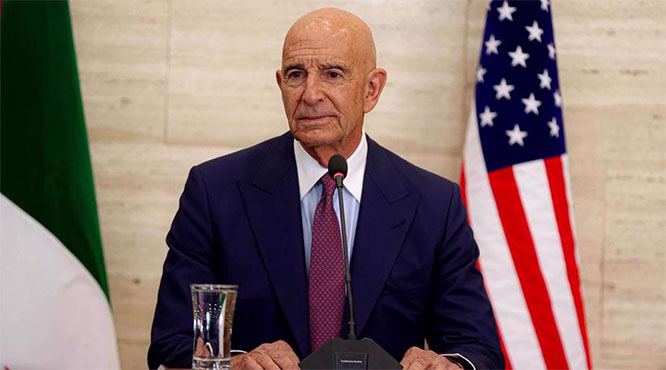
Since 1946, the United States has attempted 93 coups or “regime change” operations across the world — including two in Iran, US Special Envoy for Syria Tom Barrack has admitted.

Speaking to the UAE-based IMI Media Group, in remarks published by The National, Barrack said Washington tried twice to overthrow the Iranian government but failed both times. 

“For (Trump) then to be imputed with regime change — we had two regime changes in Iran already. Neither one worked. So I think wisely leave it to the region to solve,” said Barrack, who also serves as the US ambassador to Turkey.

His comments come six months after the US joined Israel in airstrikes against Iran during ongoing indirect nuclear negotiations between Tehran and Washington.

On June 13, Israel launched an attack on Iran that killed at least 1,064 people and hit civilian infrastructure. Days later, the United States targeted three nuclear facilities — Fordow, Natanz and Isfahan — in what Iran called a clear violation of international law. Iranian retaliation eventually forced a halt to the assault on June 24.

Barrack further claimed that US President Donald Trump and Foreign Secretary Marco Rubio are “not into regime change” and prefer a regional approach driven by Middle Eastern countries themselves. According to him, regional dialogue and non-interference by outside powers offer a more durable path forward.

He added that Washington is still open to an agreement with Tehran if Iranian authorities show “seriousness” and willingness to engage constructively.

However, Iran maintains the US has not shown readiness for meaningful talks. In an interview with Japan’s Kyodo News, Iranian Foreign Minister Abbas Araghchi said negotiations could advance only if Washington acknowledges Iran’s right to peaceful nuclear energy and lifts unilateral sanctions.

Comments

Add new comment

  • Coastaldigest.com reserves the right to delete or block any comments.
  • Coastaldigset.com is not responsible for its readers’ comments.
  • Comments that are abusive, incendiary or irrelevant are strictly prohibited.
  • Please use a genuine email ID and provide your name to avoid reject.
News Network
December 5,2025

indigoCEO.jpg

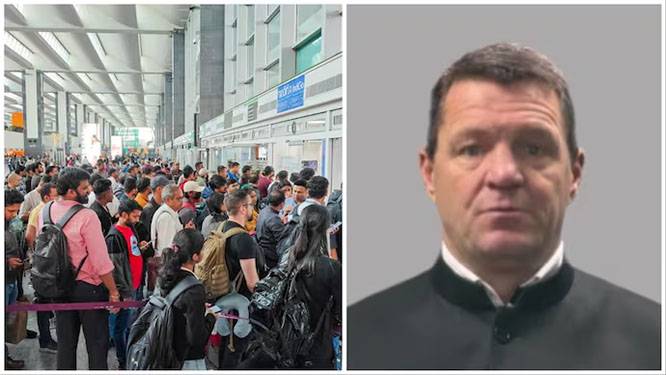
New Delhi, Dec 5: IndiGo CEO Pieter Elbers issued a public apology this evening after more than a thousand flights were cancelled today, making it the "most severely impacted day" in terms of cancellations. The biggest airline of the country cancelled "more than half" of its daily number of flights on Friday, said Elbers. He also said that even though the crisis will persist on Saturday, the airline anticipates fewer than 1,000 flight cancellations.

"Full normalisation is expected between December 10 and 15, though IndiGo cautions that recovery will take time due to the scale of operations," the IndiGo CEO said. 

IndiGo operates around 2,300 domestic and international flights daily.

Pieter Elbers, while apologising for the major inconvenience due to delays and cancellations, said the situation is a result of various causes.

The crisis at IndiGo stems from new regulations that boost pilots' weekly rest requirements by 12 hours to 48 and allow only two night-time landings per week, down from six. IndiGo has attributed the mass cancellations to "misjudgment and planning gaps".

Elbers also listed three lines of action that the airline will adopt to address the issue.

"Firstly, customer communication and addressing your needs, for this, messages have been sent on social media. And just now, a more detailed communication with information, refunds, cancellations and other customer support measures was sent," he said.

The airline has also stepped up its call centre capacity.

"Secondly, due to yesterday's situation, we had customers stranded mostly at the nation's largest airports. Our focus was for all of them to be able to travel today itself, which will be achieved. For this, we also ask customers whose flights are cancelled not to come to the airports as notifications are sent," the CEO said.

"Thirdly, cancellations were made for today to align our crew and planes to be where they need to start tomorrow morning afresh. Earlier measures of the last few days, regrettable, have proven not to be enough, but we have decided today to reboot all our systems and schedules, resulting in the highest numbers of cancellations so far, but imperative for progressive improvements starting from tomorrow," he added.

As airports witnessed chaotic scenes, the Directorate General of Civil Aviation (DGCA) stepped in to grant IndiGo a temporary exemption from stricter night duty rules for pilots. It also allowed substitution of leaves with a weekly rest period. 

Civil Aviation Minister Ram Mohan Naidu has said a high-level inquiry will be ordered and accountability will be fixed.

Comments

Add new comment

  • Coastaldigest.com reserves the right to delete or block any comments.
  • Coastaldigset.com is not responsible for its readers’ comments.
  • Comments that are abusive, incendiary or irrelevant are strictly prohibited.
  • Please use a genuine email ID and provide your name to avoid reject.
News Network
December 6,2025

pilot.jpg

New Delhi: IndiGo, India’s largest airline, faced major operational turbulence this week after failing to prepare for new pilot-fatigue regulations issued by the Directorate General of Civil Aviation (DGCA). The stricter rules—designed to improve flight safety—took effect in phases through 2024, with the latest implementation on November 1. IndiGo has acknowledged that inadequate roster planning led to widespread cancellations and delays.

Below are the key DGCA rules that affected IndiGo’s operations:

1. Longer Mandatory Weekly Rest

Weekly rest for pilots has been increased from 36 hours to 48 hours.

The government says the extended break is essential to curb cumulative fatigue. This rule remains in force despite the current crisis.

2. Cap on Night Landings

Pilots can now perform only two night landings per week—a steep reduction from the earlier limit of six.

Night hours, defined as midnight to early morning, are considered the least alert period for pilots.

Given the disruptions, this rule has been temporarily relaxed for IndiGo until February 10.

3. Reduced Maximum Night Flight Duty

Flight duty that stretches into the night is now capped at 10 hours.

This measure has also been kept on hold for IndiGo until February 10 to stabilize operations.

4. Weekly Rest Cannot Be Replaced With Personal Leave

Airlines can no longer count a pilot’s personal leave as part of the mandatory 48-hour rest.

Pilots say this closes a loophole that previously reduced actual rest time.

Currently, all airlines are exempt from this rule to normalise travel.

5. Mandatory Fatigue Monitoring

Airlines must submit quarterly fatigue reports along with corrective actions to DGCA.

This system aims to create a transparent fatigue-tracking framework across the industry.

The DGCA has stressed that these rules were crafted to strengthen flight safety and align India with global fatigue-management standards. The temporary relaxations are expected to remain until February 2025, giving IndiGo time to stabilise its schedules and restore normal air travel.

Comments

Add new comment

  • Coastaldigest.com reserves the right to delete or block any comments.
  • Coastaldigset.com is not responsible for its readers’ comments.
  • Comments that are abusive, incendiary or irrelevant are strictly prohibited.
  • Please use a genuine email ID and provide your name to avoid reject.