



Pak boat intercepted mid-sea, 26/11 like terror averted?

January 2, 2015

New Delhi, Jan 2: In a mid-sea operation that probably averted a 26/11-like terror attack, a suspected Pakistani fishing boat carrying explosives was intercepted by the Coast Guards in the Arabian Sea but the four occupants on board set the vessel afire and exploded it before it sank with them.
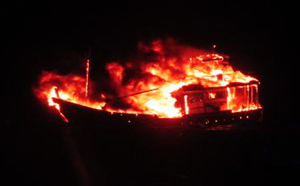
pak boat

The incident, which resembled the operation undertaken by terrorists from Karachi who had come in a boat before they launched their dreaded attack in Mumbai in Novermber, 2008, took place during the midnight of Dec 31 and Jan 1 when the Coast Guard spotted the vessel about 8 km inside the Indian waters on the maritime boundary with Pakistan.

An intelligence-based midnight operation was conducted by the Coast Guard ships and aircraft to intercept the suspect fishing boat, approximately 365 km off Porbander in Gujarat, on the intervening night of December 31 and January 1 after a hot pursuit.

There was information that the fishing boat from Keti Bunder near Karachi was planning some illicit transaction in Arabian Sea, a statement by the Defence Ministry said today.

Based on the information, a Coast Guard Dornier aircraft undertook sea-air coordinated search and located the suspect fishing boat.

Thereafter, the Coast Guard ship on patrol in the area was diverted and intercepted the unlit boat at about midnight of December 31 in a position 365 km west-south west off Porbandar.

The Coast Guard ship warned the fishing boat to stop for further investigation of the crew and cargo. However, the boat raised its speed and tried to escape from the Indian side of the maritime boundary.

The hot pursuit continued for nearly one hour and the Coast Guard ship managed to stop the fishing boat after firing warning shots.

Four persons were seen on the boat who disregarded all warnings by the Coast Guard ship to stop and cooperate with investigation, the statement said.

Soon thereafter, the crew hid themselves in the deck compartment below and set the boat on fire, which resulted in an explosion and major fire on the boat, it said.

Due to darkness, bad weather and strong winds, the boat and persons on board could not be saved or recovered. The boat burnt and sank in the same position, in the early hours of January one.

Ten terrorists involved in the 2008 Mumbai terror attack had reached Mumbai in a boat from Karachi in Pakistan. The attack had left 166 people dead.

Coast Guard ships and aircraft are continuing operations in the area to search for any possible survivor, the statement said.

The Coast Guard and other security agencies were maintaining high vigil in the maritime and coastal areas in the last couple of months due to several inputs on threat from the sea.


Comments

Add new comment

  • Coastaldigest.com reserves the right to delete or block any comments.
  • Coastaldigset.com is not responsible for its readers’ comments.
  • Comments that are abusive, incendiary or irrelevant are strictly prohibited.
  • Please use a genuine email ID and provide your name to avoid reject.
News Network
December 6,2025

pilot.jpg

New Delhi: IndiGo, India’s largest airline, faced major operational turbulence this week after failing to prepare for new pilot-fatigue regulations issued by the Directorate General of Civil Aviation (DGCA). The stricter rules—designed to improve flight safety—took effect in phases through 2024, with the latest implementation on November 1. IndiGo has acknowledged that inadequate roster planning led to widespread cancellations and delays.

Below are the key DGCA rules that affected IndiGo’s operations:

1. Longer Mandatory Weekly Rest

Weekly rest for pilots has been increased from 36 hours to 48 hours.

The government says the extended break is essential to curb cumulative fatigue. This rule remains in force despite the current crisis.

2. Cap on Night Landings

Pilots can now perform only two night landings per week—a steep reduction from the earlier limit of six.

Night hours, defined as midnight to early morning, are considered the least alert period for pilots.

Given the disruptions, this rule has been temporarily relaxed for IndiGo until February 10.

3. Reduced Maximum Night Flight Duty

Flight duty that stretches into the night is now capped at 10 hours.

This measure has also been kept on hold for IndiGo until February 10 to stabilize operations.

4. Weekly Rest Cannot Be Replaced With Personal Leave

Airlines can no longer count a pilot’s personal leave as part of the mandatory 48-hour rest.

Pilots say this closes a loophole that previously reduced actual rest time.

Currently, all airlines are exempt from this rule to normalise travel.

5. Mandatory Fatigue Monitoring

Airlines must submit quarterly fatigue reports along with corrective actions to DGCA.

This system aims to create a transparent fatigue-tracking framework across the industry.

The DGCA has stressed that these rules were crafted to strengthen flight safety and align India with global fatigue-management standards. The temporary relaxations are expected to remain until February 2025, giving IndiGo time to stabilise its schedules and restore normal air travel.

Comments

Add new comment

  • Coastaldigest.com reserves the right to delete or block any comments.
  • Coastaldigset.com is not responsible for its readers’ comments.
  • Comments that are abusive, incendiary or irrelevant are strictly prohibited.
  • Please use a genuine email ID and provide your name to avoid reject.