Pak violated Vienna Convention in Jadhav's case: ICJ

News Network
October 31, 2019

United Nations, Oct 31: Pakistan violated its obligations under the Vienna Convention in the arrest and detention of Indian national Kulbhushan Jadhav, International Court of Justice (ICJ) President Judge Abduylqawi Yusuf told the UN General Assembly here.

Jadhav, 49, a retired Indian Navy officer, was sentenced to death by a Pakistani military court on charges of "espionage and terrorism" after a closed trial in April 2017. India has maintained that Jadhav was kidnapped from Iran where he had business interests after retiring from the Navy.

Presenting the report of the International Court of Justice to the 193-member General Assembly on Wednesday, Yusuf said in its judgement of July 17 the principal judicial organ of the United Nations “found that Pakistan had violated its obligations under Article 36 of the Vienna Convention and that appropriate remedies were due in this case.”

In a major victory for India, the ICJ had ruled that Pakistan must review the death sentence given to Jadhav. India had argued that consular access was being denied to its national in violation of the 1963 Vienna Convention on Consular Relations.

The bench led by Yusuf had ordered an "effective review and reconsideration of the conviction and sentence of Kulbhushan Sudhir Jadhav.”

Yusuf elaborated on several aspects of the Court's ruling in Jadhav's case while presenting his report to the General Assembly.

He said one of the issues that the Court had to examine was the question of whether the rights relating to consular access, set out in Article 36 of the Vienna Convention, were in any manner to be excluded in a situation where the individual concerned was suspected of carrying out acts of espionage.

“The Court noted in that regard that there is no provision in the Vienna Convention containing a reference to cases of espionage; nor does the Article concerning consular access, Article 36, exclude from its scope certain categories of persons, such as those suspected of espionage. Therefore, the Court concluded that Article 36 of the Vienna Convention was applicable in full to the case at hand,” he said.

The Court was also called upon to interpret the meaning of the expression “without delay” in the notification requirements of Article 36 of the Vienna Convention. The Court noted that in its case, the question of how to determine what was meant by the term “without delay” depended on the given circumstances of a case.

“Taking into account the particular circumstances of the Jadhav case, the Court noted that Pakistan's making of the notification some three weeks after Jadhav's arrest constituted a breach of its obligation to inform India's consular post “without delay”, as required by the provisions of the Vienna Convention,” he noted.

He further said that “another interesting legal question” that the Court had to address was whether a bilateral agreement on consular access concluded between the two Parties - India and Pakistan - in 2008 could be read as excluding the applicability of the Vienna Convention.

“The Court considered that this was not the case,” he said.

“More precisely, the Court noted that under the Vienna Convention, parties were able to conclude only bilateral agreements that confirm, supplement, extend or amplify the provisions of that instrument. Having examined the 2008 Agreement, the Court came to the conclusion that it could not be read as denying consular access in the case of an arrest, detention or sentence made on political or security grounds, and that it did not displace obligations under Article 36 of the Vienna Convention.”

Coming to the “crux” of the Court's ruling, he said the Court considered the reparation and remedies to be granted, after it had found that the rights to consular access had been violated.

"In line with its earlier jurisprudence in other cases dealing with breaches of the Vienna Convention, the Court found that the appropriate remedy was effective review and reconsideration of the conviction and sentence of Mr. Jadhav.”

Yusuf told the General Assembly that the Court moreover clarified what it considered to be the requirements of effective review and reconsideration.

It stressed that “Pakistan must ensure that full weight is given to the effect of the violation of the rights set forth in the Vienna Convention and guarantee that the violation and the possible prejudice caused by the violation are fully examined.”

“While the Court left the choice of means to provide effective review and reconsideration to Pakistan, it noted that effective review and reconsideration presupposes the existence of a procedure that is suitable for this purpose and observed that it is normally the judicial process that is suited to this task.”

Yusuf said that following its ruling, the Court received a communication dated August 1, 2019 from Pakistan confirming its commitment to implementing the July 17 judgment in full.

“In particular, Pakistan stated that Jadhav had been immediately informed of his rights under the Vienna Convention and that the consular post of the High Commission of India in Islamabad had been invited to visit him on August 2, 2019,” Yusuf said.

However, the meeting, which was scheduled on August 2, did not materialise amid differences between India and Pakistan on the terms of the consular access to Jadhav.

Jadhav was finally granted the consular access on September 2.

India had welcomed the verdict of the International Court of Justice, saying that the ruling of the court by a vote of 15-1 upheld India's position in the case.


Comments

Add new comment

  • Coastaldigest.com reserves the right to delete or block any comments.
  • Coastaldigset.com is not responsible for its readers’ comments.
  • Comments that are abusive, incendiary or irrelevant are strictly prohibited.
  • Please use a genuine email ID and provide your name to avoid reject.
News Network
December 16,2025

jordan.jpg

Prime Minister Narendra Modi on Monday held talks with Jordan’s King Abdullah II in Amman, during which the two leaders discussed ways to further strengthen bilateral relations, with the Prime Minister outlining an eight-point vision covering key areas of cooperation.

Describing the meeting as “productive”, PM Modi said he shared a roadmap focused on trade and economy, fertilisers and agriculture, information technology, healthcare, infrastructure, critical and strategic minerals, civil nuclear cooperation, and people-to-people ties.

In a post on social media platform X, the Prime Minister praised King Abdullah II’s personal commitment to advancing India–Jordan relations, particularly as both countries mark the 75th anniversary of the establishment of diplomatic ties this year.

“Held productive discussions with His Majesty King Abdullah II in Amman. His personal commitment towards vibrant India-Jordan relations is noteworthy. This year, we are celebrating the 75th anniversary of our bilateral diplomatic relations,” PM Modi said.

The meeting took place at the Al Husseiniya Palace, where the two leaders also exchanged views on regional and global issues of mutual interest. According to the Ministry of External Affairs (MEA), both sides agreed to further deepen cooperation in areas including trade and investment, defence and security, counter-terrorism and de-radicalisation, fertilisers and agriculture, infrastructure, renewable energy, tourism, and heritage.

The MEA said both leaders reaffirmed their united stand against terrorism.

PM Modi arrived in Amman earlier on Monday and was received by Jordanian Prime Minister Jafar Hassan, who accorded him a formal welcome. Following the talks, King Abdullah II hosted a banquet dinner in honour of the Prime Minister, reflecting the warmth of bilateral ties.

Jordan is the first leg of PM Modi’s three-nation tour. From Amman, the Prime Minister will travel to Ethiopia at the invitation of Prime Minister Abiy Ahmed Ali, marking his first official visit to the African nation. The tour will conclude with a visit to Oman.

Comments

Add new comment

  • Coastaldigest.com reserves the right to delete or block any comments.
  • Coastaldigset.com is not responsible for its readers’ comments.
  • Comments that are abusive, incendiary or irrelevant are strictly prohibited.
  • Please use a genuine email ID and provide your name to avoid reject.
News Network
December 16,2025

Mangaluru, Dec 16: The Mangaluru City police have significantly escalated their campaign against drug trafficking, arresting 25 individuals and booking 12 cases under the Narcotic Drugs and Psychotropic Substances (NDPS) Act between November 30 and December 13. The crackdown resulted in the seizure of a substantial quantity of illicit substances, including 685.6 grams of MDMA and 1.5 kg of ganja.

The success of this recent drive has been significantly boosted by the city’s innovative, QR code-based anonymous reporting system.

"The anonymous reporting system has received an encouraging response. Several recent arrests were made based on inputs received through this system, helping police tighten the noose around drug peddlers," said the City Police Commissioner.

The latest arrests contribute to a robust year-to-date record, underscoring the police's relentless commitment to combating the drug menace.

Up to December 14 this year, the police have registered a total of 107 cases of drug peddling, leading to the arrest of 219 peddlers. Furthermore, they have booked 562 cases of drug consumption, resulting in the arrest of 671 individuals.

The scale of the seizure for the year reflects the magnitude of the problem being tackled: police have seized 320.6 kg of ganja worth ₹88.7 lakh and 1.4 kg of MDMA valued at ₹1.2 crore. Other significant seizures include hydro-weed ganja worth ₹94.7 lakh and cocaine worth ₹1.9 lakh, among others.

The Commissioner emphasized a policy of rigorous enforcement: "We ensure that peddlers are caught red-handed so that they cannot later dispute the case or claim innocence."

To counter the rising trend of substance abuse among youth, the Mangaluru City police have rolled out uniform guidelines for random drug testing across educational institutions.

As part of the drive, tests were conducted in approximately 100 institutions, screening an estimated 5,500 to 6,000 students in the first phase. 20 students tested positive for drug consumption during the initial screening.

Students who tested positive have been provided counselling and are scheduled for re-testing in the second quarter. The testing will also be expanded to students not covered in the first phase. In a move to ensure strict implementation, police personnel were deployed in mufti in some institutions. Reiterating a zero-tolerance stance, the Commissioner confirmed that random testing will continue, and colleges have also been instructed to conduct drug tests at the time of admission to deter substance abuse from an early stage.

Comments

Add new comment

  • Coastaldigest.com reserves the right to delete or block any comments.
  • Coastaldigset.com is not responsible for its readers’ comments.
  • Comments that are abusive, incendiary or irrelevant are strictly prohibited.
  • Please use a genuine email ID and provide your name to avoid reject.
News Network
December 22,2025

saudisnow.jpg

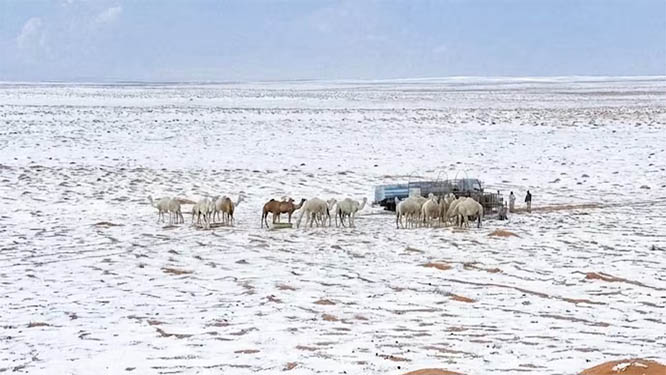
Saudi Arabia has witnessed rare snowfall in several parts of the country, including the northern regions, where such an event has been reported for the first time in 30 years, leaving residents in awe. 

The white blanket of snow covered vast desert areas, from the Tuwaiq mountain range in the west to regions near Riyadh. The rare event has sparked excitement and disbelief among residents, who have shared videos and photos of the Gulf nation blanketed in white.

A video shared on X captured an unusual scene: a group of camels standing in a desert area covered in snow, with dark clouds looming overhead.

Snowfall transformed parts of the country into an unexpected winter playground. Another video showed adults enjoying the snow by skiing, celebrating, and capturing a scene rarely seen in the Kingdom.

Local TV channels have described the snowfall as historic, while many residents have expressed concerns over the cold conditions and icy roads. The National Meteorology Center (NCM) had earlier warned of a sharp drop in temperatures and urged the public to take safety precautions.

Additionally, the Trojena Highlands and parts of the Tabuk region experienced unusually low temperatures due to snow last week. Jabal Al-Lawz in Tabuk reported heavy snowfall on Wednesday, accompanied by thick fog and strong winds, according to the Saudi Gazette.

The NCM has forecast a high chance of snow in the Qassim region and northern parts of Riyadh on Thursday, as an intense weather system continues to affect large areas of the kingdom. Authorities have cautioned the public to exercise extreme care during the severe weather.

While snow in Saudi Arabia is rare, it is not unprecedented. Last February, the Trojena Mountains saw snowfall and sub-zero temperatures, and parts of Al-Jawf reportedly experienced snow for the first time.

Comments

Add new comment

  • Coastaldigest.com reserves the right to delete or block any comments.
  • Coastaldigset.com is not responsible for its readers’ comments.
  • Comments that are abusive, incendiary or irrelevant are strictly prohibited.
  • Please use a genuine email ID and provide your name to avoid reject.