



Plastic ban in Maharashtra from today

Agencies
June 23, 2018

Mumbai, Jun 23: As the Maharashtragovernment is set to enforce the ban on a variety of plastic items -- announced in March -- from Saturday, environment minister Ramdas Kadam said errant manufacturers will face a strong action, but common people and small traders will not be harassed.

He was speaking to reporters after a review meeting with the Maharashtra Pollution Control Board officials.

On March 23, the state government imposed a ban on manufacturing, use, sale, distribution and storage of plastic materials such as one-time-use bags, spoons, plates, PET and PETE bottles and thermocol items. The government gave three months for the disposal of existing stocks.

An extensive awareness campaign will be carried out in the next eight days to inform about banned items, Kadam said.

"We will ensure that common people and small traders are not harassed. But strict action will be taken again plastic manufacturers (if they break the law)," the senior Shiv Sena minister said. There will be no relaxation in fine, he said.

The fine for the first-time and second-time offenders will be Rs 5,000 and Rs 10,000, respectively. A third violation will attract a fine of Rs 25,000 and a jail term for three months.

Kadam reiterated that 80 per cent of banned plastic items are manufactured in Gujarat and smuggled to Maharashtra.

"Anybody caught bringing in banned plastic goods will be imprisoned for three months," he said.

The ban will mostly hit jobs in the plastic sector in Gujarat, he said, adding "we will find alternative jobs for those who are affected in Maharashtra."

On the demand to exempt thermocol used for decorations during Ganesh Festival, Kadam said, "Some Maharashtrian youths met me and requested that they be allowed to use thermocol items in the festival this year as they had already purchased these items."

The empowered committee of the government, dealing with the ban, will discuss this issue and an exemption might be given if Ganesh Mandals give an undertaking that these items will be later handed over to the municipal corporation for disposal, he said.

Retail packaging companies have been given an extension of three months to submit an undertaking over recycling of plastic materials, he said.

"Once they give the affidavit, their proposals will be forwarded to the empowered committee which will consider exempting them from the ban," the minister said.

Yuva Sena (Shiv Sena youth wing) chief Aaditya Thackeray, who called on Kadam, took a jibe at the ruling alliance partner BJP while speaking to reporters.

The plastic ban was not announced overnight, unlike demonetisation. The decision was in discussion for nine months, Thackeray said.

"There has been a lot of awareness about the ban. Only wilful offenders would be worried about fines," he added.

Kadam said that 1,200 tonnes of plastic waste is generated in Maharashtra everyday.

"Fish and other marine life is threatened by plastic. Plastic is found in nullahs. The city was flooded in the past due to plastic (which chokes nullahs). Plastic is also responsible for emission of sulphur gas, which is carcinogenic."

"If the next generation is to be saved, plastic has to be banned. Seventeen states have already banned it and we are the 18th," the minister said.

Comments

Add new comment

  • Coastaldigest.com reserves the right to delete or block any comments.
  • Coastaldigset.com is not responsible for its readers’ comments.
  • Comments that are abusive, incendiary or irrelevant are strictly prohibited.
  • Please use a genuine email ID and provide your name to avoid reject.
News Network
December 13,2025

New Delhi: School-going children are picking up drug and smoking habits and engaging in consumption of alcohol, with the average age of introduction to such harmful substances found to be around 13 years, suggesting a need for earlier interventions as early as primary school, a multi-city survey by AIIMS-Delhi said.

The findings also showed substance use increased in higher grades, with grade XI/XII students two times more likely to report use of substances when compared with grade VIII students. This emphasised the importance of continued prevention and intervention through middle and high school.

The study led by Dr Anju Dhawan of AIIMS's National Drug Dependence Treatment Centre, published in the National Medical Journal of India this month, looks at adolescent substance use across diverse regions.

The survey included 5,920 students from classes 8, 9, 11 and 12 in urban government, private and rural schools across 10 cities -- Bengaluru, Chandigarh, Delhi, Dibrugarh, Hyderabad, Imphal, Jammu, Lucknow, Mumbai, and Ranchi. The data were collected between May 2018 and June 2019.

The average age of initiation for any substance was 12.9 (2.8) years. It was lowest for inhalants (11.3 years) followed by heroin (12.3 years) and opioid pharmaceuticals (without prescription; 12.5 years).

Overall, 15.1 per cent of participants reported lifetime use, 10.3 per cent reported past year use, and 7.2 per cent reported use in the past month of any substance, the study found.

The most common substances used in the past year, after tobacco (4 per cent) and alcohol (3.8 per cent), were opioids (2.8 per cent), followed by cannabis (2 per cent) and inhalants (1.9 per cent). Use of non-prescribed pharmaceutical opioids was most common among opioid users (90.2 per cent).

On being asked, 'Do you think this substance is easily available for a person of your age' separately for each substance category, nearly half the students (46.3 per cent) endorsed that tobacco products and more than one-third of the students (36.5 per cent) agreed that a person of their age can easily procure alcohol products.

Similarly, for Bhang (21.9 per cent), ganja/charas (16.1 per cent), inhalants (15.2 per cent), sedatives (13.7 per cent), opium and heroin (10 per cent each), the students endorsed that these can be easily procured.

About 95 per cent of the children, irrespective of their grade, agreed with the statement that 'drug use is harmful'.

The rates of substance use (any) among boys were significantly higher than those of girls for substance use (ever), use in the past year and use in the past 30 days. Compared to grade VIII students, grade IX students were more likely, and grade XI/XII students were twice as likely to have used any substance (ever).

The likelihood of past-year use of any substance was also higher for grade IX students and for grade XI/XII students as compared to grade VIII students.

About 40 per cent of students mentioned that they had a family member who used tobacco or alcohol each. The use of cannabis (any product) and opioid (any product) by a family member was reported by 8.2 per cent and 3.9 per cent of students, respectively, while the use of other substances, such as inhalants/sedatives by family was 2-3 per cent, the study found.

A relatively smaller percentage of students reported use of tobacco or alcohol among peers as compared to among family members, while a higher percentage reported inhalants, sedatives, cannabis or opioid use among peers.

Children using substances (past year) compared to non-users reported significantly higher any substance use by their family members and peers.

There were 25.7 per cent students who replied 'yes' to the question 'conflicts/fights often occur in your family'. Most students also replied affirmatively to 'family members are aware of how their time is being spent' and 'damily members are aware of with whom they spend their time'.

Comments

Add new comment

  • Coastaldigest.com reserves the right to delete or block any comments.
  • Coastaldigset.com is not responsible for its readers’ comments.
  • Comments that are abusive, incendiary or irrelevant are strictly prohibited.
  • Please use a genuine email ID and provide your name to avoid reject.
News Network
December 16,2025

bengal.jpg

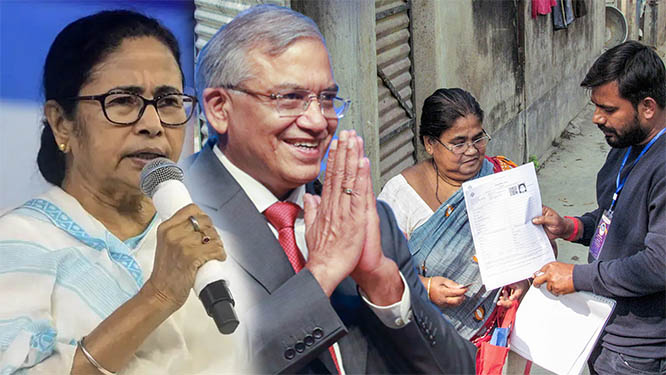
The deletion of over 58 lakh names from West Bengal’s draft electoral rolls following a Special Intensive Revision (SIR) has sparked widespread concern and is likely to deepen political tensions in the poll-bound state.

According to the Election Commission, the revision exercise has identified 24 lakh voters as deceased, 19 lakh as relocated, 12 lakh as missing, and 1.3 lakh as duplicate entries. The draft list, published after the completion of the first phase of SIR, aims to remove errors and duplication from the electoral rolls.

However, the scale of deletions has raised fears that a large number of eligible voters may have been wrongly excluded. The Election Commission has said that individuals whose names are missing can file objections and seek corrections. The final voter list is scheduled to be published in February next year, after which the Assembly election announcement is expected. Notably, the last Special Intensive Revision in Bengal was conducted in 2002.

The development has intensified the political row over the SIR process. Chief Minister Mamata Banerjee and her Trinamool Congress have strongly opposed the exercise, accusing the Centre and the Election Commission of attempting to disenfranchise lakhs of voters ahead of the elections.

Addressing a rally in Krishnanagar earlier this month, Banerjee urged people to protest if their names were removed from the voter list, alleging intimidation during elections and warning of serious consequences if voting rights were taken away.

The BJP, meanwhile, has defended the revision and accused the Trinamool Congress of politicising the issue to protect what it claims is an illegal voter base. Leader of the Opposition Suvendu Adhikari alleged that the ruling party fears losing power due to the removal of deceased, fake, and illegal voters.

The controversy comes amid earlier allegations by the Trinamool Congress that excessive work pressure during the SIR led to the deaths by suicide of some Booth Level Officers (BLOs), for which the party blamed the Election Commission. With the draft list now out, another round of political confrontation appears imminent.

As objections begin to be filed, the focus will be on whether the correction mechanism is accessible, transparent, and timely—critical factors in ensuring that no eligible voter is denied their democratic right ahead of a crucial election.

Comments

Add new comment

  • Coastaldigest.com reserves the right to delete or block any comments.
  • Coastaldigset.com is not responsible for its readers’ comments.
  • Comments that are abusive, incendiary or irrelevant are strictly prohibited.
  • Please use a genuine email ID and provide your name to avoid reject.
News Network
December 19,2025

Mangaluru: The Mangaluru CEN police have arrested a 23-year-old man for allegedly posting provocative and misleading content on an Instagram page named “mr_a_titude”, targeting the Bajpe police.

Mangaluru Commissioner of Police Sudheer Kumar Reddy C H identified the arrested as Abhishek M, a resident of Katipalla in Mangaluru.

A case has been registered at the Bajpe Police Station under Sections 353(1)(c), 353(2), 56, and 57 read with Section 189 of the Bharatiya Nyaya Sanhita (BNS) in connection with the post.

According to police, the accused uploaded a photograph of a hotel on the Instagram page and alleged that accused persons in a murder case under the Bajpe police jurisdiction were being given “royal treatment” by the police, including being served beef meals daily from the hotel.

The post further accused the police of supporting criminals, misusing their authority, and betraying public trust. Police said the content was provocative in nature and aimed at inciting public outrage against the police.

Following the post, a case was registered at the Bajpe police station, and further investigation was transferred to the CEN police station.

Police records indicate that the accused has a criminal history, with multiple cases registered against him, including murder, attempt to murder, assault, and robbery at the Surathkal Police Station, and one case at the Kaup Police Station.

The Commissioner said the accused was traced and arrested using technical evidence.

Comments

Add new comment

  • Coastaldigest.com reserves the right to delete or block any comments.
  • Coastaldigset.com is not responsible for its readers’ comments.
  • Comments that are abusive, incendiary or irrelevant are strictly prohibited.
  • Please use a genuine email ID and provide your name to avoid reject.