PM Modi unveils word's tallest Statue of Unity in honour of Patel, flays 'political prism'

Agencies
October 31, 2018

Kevadiya, Oct 31: Prime Minister Narendra Modi on Wednesday dedicated to the nation the much- awaited 182-metre high Statue of Unity in honour of coutry's first Home Minister Sardar Vallabhbhai Patel.

Mr Modi urged critics not to dismiss his government's efforts to pay tributes to icons like Patel with 'political prism'. 

Paying rich tributes to Sardar Patel, the Prime Minister said the towering statue will serve as a reminder about the courage and firm political commitment of a man who brought in unity among all princely states in 1947 and later and thwarted efforts to disintegrate India.

Built on Sadhu Bet Island on Narmada river, the imposing statue is twice as high as the 93-metre Statue of Liberty in New York and surpasses the China's Spring Temple Buddha by about 29 metres. 

He lashed out at those skeptics and political detractors who try to see his government's efforts to show due respect to great sons of India such as Sardar Vallabhbhai Patel with 'political prism'.

"At times, they give an impression as if by remembering the contributions of great sons of India like Sardar Patel is an offence. Is it an offence?," Mr Modi said. 

The remarks from the Prime Minister came even as critics and a section of citizens on social network and micro blogging site Twitter have tried to suggest that showing tributes to the legacy of Patel was akin to election gimmick.

Three Indian Air Force planes flew past the Patel figure and created the tricolour in the sky on the occasion graced among others by Gujarat Governor O P Kohli, Chief Minister Vijay Rupani, BJP chief Amit Shah, Madhya Pradesh Governor Anandiben Patel and Karnataka Governor Vajubhai Vala.

The grand ceremony coincided with Patel's 143rd birth anniversary. Originally, the concept of such a grand statue was conceptualised by Mr Modi in 2010 during his stint as the Gujarat Chief Minister.

"It is in fitness of things that Sardar Patel's birthday today is being celebrated as Ekta Diwas in the country," Mr Modi said.

He said it goes to the visionary statesmanship of Sardar Patel that the fundamental right is today inherent part of India's democracy.

Approximately 70,000 tonnes of cement in addition to 18,500 tonnes of reinforcement steel and 6000 tonnes of structural steel have been used to build the statue - also billed as an architectural wonder.

"Had Sardar Patel not united the country, we would need visas to see lions in Gujarat or pay homage at Somnath or view the Charminar in Hyderabad," Mr Modi said, lauding the stellar role played by Sardar Patel in integrating the princely states after the partition of 1947.

PM Modi described the Statue of Unity as a symbol of the country's engineering and technical capabilities. He also took part in a 'pooja' on the occasion.

He also recorded appreciation of the erstwhile rulers of the princely states and said their 'sacrifice' and decision to merge with Indian union was no less.

A viewing gallery has been created at a height of 135 metres at the venue to enable tourists to have a view of the dam and nearby mountain ranges.

This Statue will boost tourism and help local tribals get a regular source of income, Mr Modi said.

The world's largest statue is also a symbol of 'New India' as being envisioned by his government, Mr Modi said.

"This statue is recognition of contribution of tribals and farmers who contributed iron pieces and their sincerity for the unique statue," the Prime Minister said.

"When I proposed this Statue on October 31, 2010, I wanted that the man deserves his due place in Indian history," the Prime Minister said. 

"There were skeptics who thought India's diversity will be a weakness. Sardar Patel proved the prophets of doom wrong. During the time of such skepticism, it was Sardar Patel who stood as a symbol of unity," the Prime Minister said.

Sardar Patel had the unique synthesis of 'Kautiyla's diplomacy and Shivaji's bravery', Mr Modi said.


Comments

Anti-modi
 - 
Thursday, 1 Nov 2018

when you vote for a man who always lie then your futur will be in danger, the day will come to india that they will be all poor people and all political people are rich and dont think thast they will develop hindu people, you are the most effected people in india not muslim or cristian.


softman
 - 
Wednesday, 31 Oct 2018

Use this money for poor in the name Sardar Patel.


Foolish decision to spend for statue

Add new comment

  • Coastaldigest.com reserves the right to delete or block any comments.
  • Coastaldigset.com is not responsible for its readers’ comments.
  • Comments that are abusive, incendiary or irrelevant are strictly prohibited.
  • Please use a genuine email ID and provide your name to avoid reject.
News Network
December 6,2025

pilot.jpg

New Delhi: IndiGo, India’s largest airline, faced major operational turbulence this week after failing to prepare for new pilot-fatigue regulations issued by the Directorate General of Civil Aviation (DGCA). The stricter rules—designed to improve flight safety—took effect in phases through 2024, with the latest implementation on November 1. IndiGo has acknowledged that inadequate roster planning led to widespread cancellations and delays.

Below are the key DGCA rules that affected IndiGo’s operations:

1. Longer Mandatory Weekly Rest

Weekly rest for pilots has been increased from 36 hours to 48 hours.

The government says the extended break is essential to curb cumulative fatigue. This rule remains in force despite the current crisis.

2. Cap on Night Landings

Pilots can now perform only two night landings per week—a steep reduction from the earlier limit of six.

Night hours, defined as midnight to early morning, are considered the least alert period for pilots.

Given the disruptions, this rule has been temporarily relaxed for IndiGo until February 10.

3. Reduced Maximum Night Flight Duty

Flight duty that stretches into the night is now capped at 10 hours.

This measure has also been kept on hold for IndiGo until February 10 to stabilize operations.

4. Weekly Rest Cannot Be Replaced With Personal Leave

Airlines can no longer count a pilot’s personal leave as part of the mandatory 48-hour rest.

Pilots say this closes a loophole that previously reduced actual rest time.

Currently, all airlines are exempt from this rule to normalise travel.

5. Mandatory Fatigue Monitoring

Airlines must submit quarterly fatigue reports along with corrective actions to DGCA.

This system aims to create a transparent fatigue-tracking framework across the industry.

The DGCA has stressed that these rules were crafted to strengthen flight safety and align India with global fatigue-management standards. The temporary relaxations are expected to remain until February 2025, giving IndiGo time to stabilise its schedules and restore normal air travel.

Comments

Add new comment

  • Coastaldigest.com reserves the right to delete or block any comments.
  • Coastaldigset.com is not responsible for its readers’ comments.
  • Comments that are abusive, incendiary or irrelevant are strictly prohibited.
  • Please use a genuine email ID and provide your name to avoid reject.
News Network
December 5,2025

indigoCEO.jpg

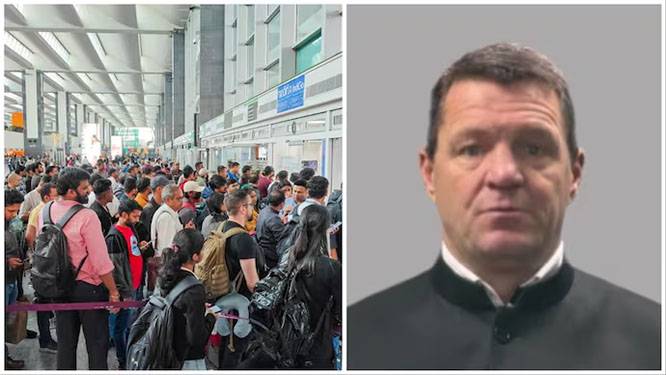
New Delhi, Dec 5: IndiGo CEO Pieter Elbers issued a public apology this evening after more than a thousand flights were cancelled today, making it the "most severely impacted day" in terms of cancellations. The biggest airline of the country cancelled "more than half" of its daily number of flights on Friday, said Elbers. He also said that even though the crisis will persist on Saturday, the airline anticipates fewer than 1,000 flight cancellations.

"Full normalisation is expected between December 10 and 15, though IndiGo cautions that recovery will take time due to the scale of operations," the IndiGo CEO said. 

IndiGo operates around 2,300 domestic and international flights daily.

Pieter Elbers, while apologising for the major inconvenience due to delays and cancellations, said the situation is a result of various causes.

The crisis at IndiGo stems from new regulations that boost pilots' weekly rest requirements by 12 hours to 48 and allow only two night-time landings per week, down from six. IndiGo has attributed the mass cancellations to "misjudgment and planning gaps".

Elbers also listed three lines of action that the airline will adopt to address the issue.

"Firstly, customer communication and addressing your needs, for this, messages have been sent on social media. And just now, a more detailed communication with information, refunds, cancellations and other customer support measures was sent," he said.

The airline has also stepped up its call centre capacity.

"Secondly, due to yesterday's situation, we had customers stranded mostly at the nation's largest airports. Our focus was for all of them to be able to travel today itself, which will be achieved. For this, we also ask customers whose flights are cancelled not to come to the airports as notifications are sent," the CEO said.

"Thirdly, cancellations were made for today to align our crew and planes to be where they need to start tomorrow morning afresh. Earlier measures of the last few days, regrettable, have proven not to be enough, but we have decided today to reboot all our systems and schedules, resulting in the highest numbers of cancellations so far, but imperative for progressive improvements starting from tomorrow," he added.

As airports witnessed chaotic scenes, the Directorate General of Civil Aviation (DGCA) stepped in to grant IndiGo a temporary exemption from stricter night duty rules for pilots. It also allowed substitution of leaves with a weekly rest period. 

Civil Aviation Minister Ram Mohan Naidu has said a high-level inquiry will be ordered and accountability will be fixed.

Comments

Add new comment

  • Coastaldigest.com reserves the right to delete or block any comments.
  • Coastaldigset.com is not responsible for its readers’ comments.
  • Comments that are abusive, incendiary or irrelevant are strictly prohibited.
  • Please use a genuine email ID and provide your name to avoid reject.
News Network
December 2,2025

A major upgrade in safety and monitoring is planned for Haj 2026, with every Indian pilgrim set to receive a Haj Suvidha smart wristband linked to the official Haj Suvidha mobile app. The initiative aims to support pilgrims—especially senior citizens—who may struggle with smartphones during the 45-day journey.

What the Smart Wristband Will Do

Officials said the device will come with:
•    Location tracking
•    Pedometer
•    SOS emergency button
•    Qibla compass
•    Prayer timings
•    Basic health monitoring

SP Tiwari, secretary of the UP State Haj Committee, said the goal is to make the pilgrimage safer and more comfortable.

“Most Hajis are elderly and not comfortable with mobile apps,” he said. “The smartwatch will help locate pilgrims who forget their way or cannot communicate their location.”

The wristbands will be monitored by the Consulate General of India in Saudi Arabia, similar to mobile tracking via the Haj Suvidha App.

Free Distribution and Training

•    Smart wristbands will be given free of cost.
•    Training for pilgrims will be conducted between January and February 2026.
•    Sample units will reach state Haj committees soon.
•    Final devices will be distributed as pilgrims begin their journey.

New Rules for Accommodation

Two major decisions have also been finalised for Haj 2026:
1.    Separate rooms for men and women – including married couples. They may stay on the same floor but must occupy different rooms, following stricter Saudi guidelines.
2.    Cooking banned – gas cylinders will not be allowed; all meals will be provided through official catering services arranged by the Haj Committee of India.

These decisions were finalised during a meeting of the Haj Committee of India and state representatives in Mumbai.

Haj Suvidha App Launched Earlier

The government launched the Haj Suvidha App in 2024, offering:

•    Training modules
•    Accommodation and flight details
•    Baggage information
•    SOS and translation tools
•    Grievance redressal

Haj 2026 Quota and Key States

•    India’s total Haj quota for 2026: 1,75,025 pilgrims
•    70% (1,25,000) allotted to the Haj Committee of India
•    30% (around 50,000) reserved for Haj Group Organisers

Uttar Pradesh has the largest allocation (around 30,000 seats), though approximately 18,000 pilgrims are expected to go this year. States with high pilgrim numbers include Kerala, Maharashtra and Gujarat.

Dates of Haj 2026

The pilgrimage is scheduled to take place from 24 May to 29 May, 2026 (tentative).
Haj is one of the five pillars of Islam and is mandatory for Muslims who meet the required conditions.

Comments

Add new comment

  • Coastaldigest.com reserves the right to delete or block any comments.
  • Coastaldigset.com is not responsible for its readers’ comments.
  • Comments that are abusive, incendiary or irrelevant are strictly prohibited.
  • Please use a genuine email ID and provide your name to avoid reject.