



Priyanka Gandhi Vadra says she has never seen 'more cowardly, weak PM' than Narendra Modi

Agencies
May 10, 2019

Pratapgarh/Jaunpur, May 10: Stepping up her attack on Narendra Modi, Congress leader Priyanka Gandhi Vadra on Thursday said she had never seen "a more cowardly and weak" prime minister than him.
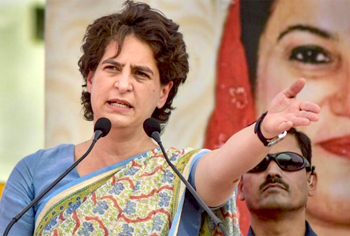
"I have not seen a more cowardly and weak prime minister than him (Modi) in my life," she told at an election meeting in Pratapgarh, a day after Modi fired yet another salvo targeting her father and former prime minister Rajiv Gandhi, accusing him of using warship INS Viraat as a "personal taxi" for a family holiday.

Priyanka claimed that Modi had failed to answer people's questions on his "unfulfilled" promises about generating two crore jobs and doubling farmers' income.

"The power of politics does not come from big campaigns and television shows. People are the biggest in democracy. One should have the power to listen and redress people's problems. He (Modi) should have the power to listen to the Opposition. Leave aside listening to you, this prime minister does know how to reply to you," she said.

"You have been cheated. He (Modi) had promised to check corruption, but now who has been exposed as corrupt?.... He hides the reality with his campaigns. If Modi comes to you, you should tell him that in Amethi, a lady got a Rs-35,000 electricity bill despite having no power connection, while another person showed a bill of Rs 50,000," the Congress general secretary in-charge of eastern Uttar Pradesh said.

She claimed that loans of big industrialists were waived, "but when (Congress chief) Rahul (Gandhi) asked for farm loan waiver, he was told there was no money".

Priyanka also claimed that farmers' insurance money was never paid to them and they were battling the stray cattle menace.

"If the prime minister is so powerful, he should say why he could not solve your problems. In every speech, he mentions Pakistan, but he should also tell you what his government has done and will do in the next five years. We are here due to you people and you have made us leaders. People are bigger, not us," she said.

The Congress leader alleged that when thousand of farmers from all over the country had gathered in Delhi and sought "a five-minute appointment from the prime minister, he did not give them time".

"In his (Modi's) constituency, Varanasi, in the last five years, he could not even spare five minutes to visit the people in the villages, ask them how they are and what are their problems," she said.

Polling for the ongoing Lok Sabha election will be held in 14 seats of Uttar Pradesh, including Pratapgarh and Jaunpur, in the sixth phase on 12 May and the results will be announced on 23 May.

The war of words between the ruling Bharatiya Janata Party (BJP) and the Congress has turned shriller with Modi raising the issue of alleged corruption during the tenure of Rajiv Gandhi as prime minister, saying his life had ended as "bhrashtachari number 1" (corrupt number one).

At a rally in Delhi on Wednesday, Modi said, "INS Viraat was insulted by using it as a personal taxi. This happened when Rajiv Gandhi and his family was out for a 10-day vacation."

The Congress hit back, accusing Modi of spreading lies about its late leader, who was the prime minister over 30 years ago, as he could see his "imminent defeat" in the ongoing polls.

Later, addressing a rally at Jaunpur, Priyanka alleged that under the current BJP-led government, those who asked for their rights were termed as "traitors".

"The prime minister has not uttered a word on the SC/ST Act. At Amethi, BJP men beat up two persons to prevent them from casting their votes. The prime minister does not have the courage to talk about your problems," she said at Badlapur, about 40 kilometres from the Jaunpur district headquarters.

The Congress leader said political power came from hearing the grievances of the public and redressing them, listening to criticism and also from lending an ear to rival parties.

"But this prime minister neither listens nor gives answers to your problems," she said, adding that the people of the country were deceived by the Modi government.

Priyanka wrapped up her day-long visit with a roadshow in Sultanpur, where people lined up on both sides of the road and perched atop rooftops and trees to catch a glimpse of her.

She was garlanded by Congress workers and supporters who put up welcome arches all along the three-km route of her roadshow and shouted slogans welcoming her.


Comments

Add new comment

  • Coastaldigest.com reserves the right to delete or block any comments.
  • Coastaldigset.com is not responsible for its readers’ comments.
  • Comments that are abusive, incendiary or irrelevant are strictly prohibited.
  • Please use a genuine email ID and provide your name to avoid reject.
News Network
December 19,2025

Saudi Arabia has abolished fees on expatriate workers employed in licensed industrial establishments, signaling a strong push to empower national factories and enhance the Kingdom’s global industrial competitiveness. The move reflects the leadership’s commitment to building a sustainable and resilient industrial economy under Saudi Vision 2030.

The decision was approved by the Council of Ministers, chaired by Crown Prince and Prime Minister Mohammed bin Salman, following a recommendation from the Council of Economic and Development Affairs (CEDA). It forms part of a broader strategy to support, modernize, and strengthen the industrial sector.

By removing fees on foreign workers, industrial establishments gain greater operational flexibility and relief from financial pressures. This is expected to help factories expand production, improve efficiency, and compete more effectively in international markets, while reinforcing long-term sustainability.

The initiative aligns closely with Saudi Vision 2030, which identifies industry as a key pillar of economic diversification. A competitive and resilient industrial base is viewed as essential for driving innovation, attracting investment, and sustaining long-term economic growth.

Overall, the fee exemption underscores the Kingdom’s commitment to creating a supportive environment for industrial development and ensuring that Saudi factories remain globally competitive and capable of leading the nation’s economic transformation.

Comments

Add new comment

  • Coastaldigest.com reserves the right to delete or block any comments.
  • Coastaldigset.com is not responsible for its readers’ comments.
  • Comments that are abusive, incendiary or irrelevant are strictly prohibited.
  • Please use a genuine email ID and provide your name to avoid reject.
News Network
December 13,2025

New Delhi: School-going children are picking up drug and smoking habits and engaging in consumption of alcohol, with the average age of introduction to such harmful substances found to be around 13 years, suggesting a need for earlier interventions as early as primary school, a multi-city survey by AIIMS-Delhi said.

The findings also showed substance use increased in higher grades, with grade XI/XII students two times more likely to report use of substances when compared with grade VIII students. This emphasised the importance of continued prevention and intervention through middle and high school.

The study led by Dr Anju Dhawan of AIIMS's National Drug Dependence Treatment Centre, published in the National Medical Journal of India this month, looks at adolescent substance use across diverse regions.

The survey included 5,920 students from classes 8, 9, 11 and 12 in urban government, private and rural schools across 10 cities -- Bengaluru, Chandigarh, Delhi, Dibrugarh, Hyderabad, Imphal, Jammu, Lucknow, Mumbai, and Ranchi. The data were collected between May 2018 and June 2019.

The average age of initiation for any substance was 12.9 (2.8) years. It was lowest for inhalants (11.3 years) followed by heroin (12.3 years) and opioid pharmaceuticals (without prescription; 12.5 years).

Overall, 15.1 per cent of participants reported lifetime use, 10.3 per cent reported past year use, and 7.2 per cent reported use in the past month of any substance, the study found.

The most common substances used in the past year, after tobacco (4 per cent) and alcohol (3.8 per cent), were opioids (2.8 per cent), followed by cannabis (2 per cent) and inhalants (1.9 per cent). Use of non-prescribed pharmaceutical opioids was most common among opioid users (90.2 per cent).

On being asked, 'Do you think this substance is easily available for a person of your age' separately for each substance category, nearly half the students (46.3 per cent) endorsed that tobacco products and more than one-third of the students (36.5 per cent) agreed that a person of their age can easily procure alcohol products.

Similarly, for Bhang (21.9 per cent), ganja/charas (16.1 per cent), inhalants (15.2 per cent), sedatives (13.7 per cent), opium and heroin (10 per cent each), the students endorsed that these can be easily procured.

About 95 per cent of the children, irrespective of their grade, agreed with the statement that 'drug use is harmful'.

The rates of substance use (any) among boys were significantly higher than those of girls for substance use (ever), use in the past year and use in the past 30 days. Compared to grade VIII students, grade IX students were more likely, and grade XI/XII students were twice as likely to have used any substance (ever).

The likelihood of past-year use of any substance was also higher for grade IX students and for grade XI/XII students as compared to grade VIII students.

About 40 per cent of students mentioned that they had a family member who used tobacco or alcohol each. The use of cannabis (any product) and opioid (any product) by a family member was reported by 8.2 per cent and 3.9 per cent of students, respectively, while the use of other substances, such as inhalants/sedatives by family was 2-3 per cent, the study found.

A relatively smaller percentage of students reported use of tobacco or alcohol among peers as compared to among family members, while a higher percentage reported inhalants, sedatives, cannabis or opioid use among peers.

Children using substances (past year) compared to non-users reported significantly higher any substance use by their family members and peers.

There were 25.7 per cent students who replied 'yes' to the question 'conflicts/fights often occur in your family'. Most students also replied affirmatively to 'family members are aware of how their time is being spent' and 'damily members are aware of with whom they spend their time'.

Comments

Add new comment

  • Coastaldigest.com reserves the right to delete or block any comments.
  • Coastaldigset.com is not responsible for its readers’ comments.
  • Comments that are abusive, incendiary or irrelevant are strictly prohibited.
  • Please use a genuine email ID and provide your name to avoid reject.
News Network
December 6,2025

pilot.jpg

New Delhi: IndiGo, India’s largest airline, faced major operational turbulence this week after failing to prepare for new pilot-fatigue regulations issued by the Directorate General of Civil Aviation (DGCA). The stricter rules—designed to improve flight safety—took effect in phases through 2024, with the latest implementation on November 1. IndiGo has acknowledged that inadequate roster planning led to widespread cancellations and delays.

Below are the key DGCA rules that affected IndiGo’s operations:

1. Longer Mandatory Weekly Rest

Weekly rest for pilots has been increased from 36 hours to 48 hours.

The government says the extended break is essential to curb cumulative fatigue. This rule remains in force despite the current crisis.

2. Cap on Night Landings

Pilots can now perform only two night landings per week—a steep reduction from the earlier limit of six.

Night hours, defined as midnight to early morning, are considered the least alert period for pilots.

Given the disruptions, this rule has been temporarily relaxed for IndiGo until February 10.

3. Reduced Maximum Night Flight Duty

Flight duty that stretches into the night is now capped at 10 hours.

This measure has also been kept on hold for IndiGo until February 10 to stabilize operations.

4. Weekly Rest Cannot Be Replaced With Personal Leave

Airlines can no longer count a pilot’s personal leave as part of the mandatory 48-hour rest.

Pilots say this closes a loophole that previously reduced actual rest time.

Currently, all airlines are exempt from this rule to normalise travel.

5. Mandatory Fatigue Monitoring

Airlines must submit quarterly fatigue reports along with corrective actions to DGCA.

This system aims to create a transparent fatigue-tracking framework across the industry.

The DGCA has stressed that these rules were crafted to strengthen flight safety and align India with global fatigue-management standards. The temporary relaxations are expected to remain until February 2025, giving IndiGo time to stabilise its schedules and restore normal air travel.

Comments

Add new comment

  • Coastaldigest.com reserves the right to delete or block any comments.
  • Coastaldigset.com is not responsible for its readers’ comments.
  • Comments that are abusive, incendiary or irrelevant are strictly prohibited.
  • Please use a genuine email ID and provide your name to avoid reject.