Ready to take job of Congress leader in LS if offered: Shashi Tharoor

Agencies
May 28, 2019

New Delhi, May 28: Rahul Gandhi is the best person to pull the Congress out of its predicament following the setback in the Lok Sabha polls, says party leader Shashi Tharoor while declaring that his party is “alive and kicking” and it is too premature to write its obituary.

The Congress has no time to sit and lick its wounds as it must immediately pick itself up for the upcoming state elections, Tharoor said.

The party faces an existential crisis with the party president adamant on his decision to quit after the poll debacle -- winning just 52 Lok Sabha seats -- and its state governments facing an uncertain future.

Tharoor, who scored an electoral hat-trick by winning from the Thiruvanathapuram seat in the Lok Sabha polls, also said he is ready to take on the job of the Congress’ leader in the Lok Sabha if offered the post.

The Congress still represents the only credible national alternative to the BJP and it will take its message to the country, hopefully under Gandhi’s leadership, he said.

In his view, the Gandhi-Nehru family will continue to command “great clout and respect” within the party, on the basis of the tremendous contributions it has made in shaping and guiding the party since Independence.

The former Union minister said Gandhi has led the party from the front and still has far more to offer to the party.

Asked about Gandhi’s offer to resign and if he was still Congress’ best bet in terms of leadership, Tharoor said attempts in the media to pin all the blame for the party’s electoral setback on his shoulders are simplistic and unfair.

“I think it does a disservice to the very complex challenges facing the Congress party to reduce it to a question of one person.

“While Rahulji has bravely taken full responsibility for the defeat, we all are responsible for what went wrong and we all have a responsibility to ensure the party’s revival,” the 63-year-old leader said.

Gandhi will easily beat any other interested candidate by a landslide if the party decides to hold a free and fair election tomorrow for the position of party president, he claimed.

 
“That is the kind of place he has built in the hearts of the rank and file of the Congress party and therefore, to my mind, he still undoubtedly remains the best person to help rally the party out of the predicament it finds itself in and help us collectively move forward,” Tharoor said.

Asked whether a non-Gandhi could lead the party, Tharoor said others can rise to prominent positions in the Congress and a case in point is that the last two Congress prime ministers were not Gandhis.

“Still, I have no doubt the Gandhi-Nehru family will continue to command great clout and respect within the party, just on the basis of the tremendous contributions they have made in shaping and guiding the party since Independence,” the former diplomat said.

Two former prime ministers from the Gandhi family -- Indira Gandhi and Rajiv Gandhi -- even sacrificed their lives for the nation and this is the proud legacy to which Rahul Gandhi is heir, he said.

Asked if the Congress still remains a credible alternative to the BJP, he said, “It’s far too premature to write any obituary for the party – as Kerala and Punjab have shown, we are very much alive and kicking.” Despite Congress’ poor showing across the country, the party performed well in Kerala and Punjab, winning 15 and eight seats respectively.

 “I strongly believe that we have no time to sit and lick our wounds and must instead pick up again immediately and effectively — not least because we have several state elections coming up, some of which are four or five months away,” he said.

Elections are due in the states of Jharkhand, Haryana and Maharashtra later this year.

Tharoor said he strongly disagreed with Swaraj India leader Yogendra Yadav’s recent “ill-considered” statement that the “Congress must die”.

 “I genuinely and passionately believe that what the Congress stands for and offers the nation is fundamentally indispensable to the future of the country,” he said.

The Congress represents an alternate vision of the idea of India, an inclusive and pluralist vision, that reflects truly the heart and soul of the country, Tharoor said.

Asked if he would take up the role of Congress leader in the Lok Sabha, he said, “If offered, certainly I would, but that is not for me to determine. It is clear, though, that since so many of our stalwarts have lost these elections, those of us who remain will have to pull our weight and take on extra responsibility. I am ready for that.” Talking about polarisation playing a role in elections, Tharoor said certainly the party has to understand why voters chose not to vote in their economic self-interest.

With unemployment at a 45-year high, farmers in such distress that record numbers are committing suicide, and small and micro enterprises are shutting down all over the country, one would think that economics would decide the election, he said.

 “...Why should a young man who voted for Modi in 2014 in the hope of getting a job vote for him again in 2019 when he still doesn’t have a job? And yet he did,” Tharoor said.

“Undoubtedly, the increasing religious polarisation was a factor. But it is not the whole story, I think. The larger-than-life personality cult around the PM seems to have convinced some voters that he is the only one to lead the country and keep it safe from real and imagined enemies, within and without,” he said. 

Comments

Add new comment

  • Coastaldigest.com reserves the right to delete or block any comments.
  • Coastaldigset.com is not responsible for its readers’ comments.
  • Comments that are abusive, incendiary or irrelevant are strictly prohibited.
  • Please use a genuine email ID and provide your name to avoid reject.
News Network
December 16,2025

jordan.jpg

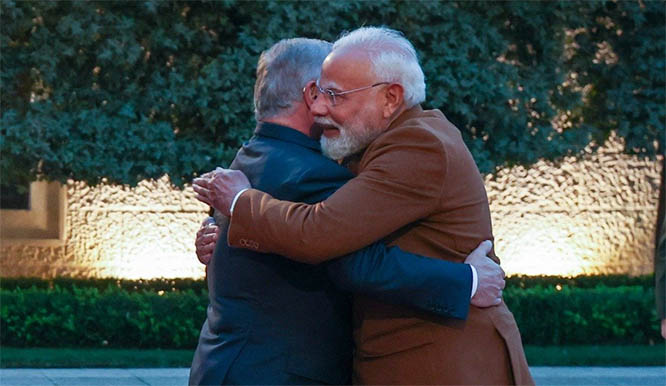
Prime Minister Narendra Modi on Monday held talks with Jordan’s King Abdullah II in Amman, during which the two leaders discussed ways to further strengthen bilateral relations, with the Prime Minister outlining an eight-point vision covering key areas of cooperation.

Describing the meeting as “productive”, PM Modi said he shared a roadmap focused on trade and economy, fertilisers and agriculture, information technology, healthcare, infrastructure, critical and strategic minerals, civil nuclear cooperation, and people-to-people ties.

In a post on social media platform X, the Prime Minister praised King Abdullah II’s personal commitment to advancing India–Jordan relations, particularly as both countries mark the 75th anniversary of the establishment of diplomatic ties this year.

“Held productive discussions with His Majesty King Abdullah II in Amman. His personal commitment towards vibrant India-Jordan relations is noteworthy. This year, we are celebrating the 75th anniversary of our bilateral diplomatic relations,” PM Modi said.

The meeting took place at the Al Husseiniya Palace, where the two leaders also exchanged views on regional and global issues of mutual interest. According to the Ministry of External Affairs (MEA), both sides agreed to further deepen cooperation in areas including trade and investment, defence and security, counter-terrorism and de-radicalisation, fertilisers and agriculture, infrastructure, renewable energy, tourism, and heritage.

The MEA said both leaders reaffirmed their united stand against terrorism.

PM Modi arrived in Amman earlier on Monday and was received by Jordanian Prime Minister Jafar Hassan, who accorded him a formal welcome. Following the talks, King Abdullah II hosted a banquet dinner in honour of the Prime Minister, reflecting the warmth of bilateral ties.

Jordan is the first leg of PM Modi’s three-nation tour. From Amman, the Prime Minister will travel to Ethiopia at the invitation of Prime Minister Abiy Ahmed Ali, marking his first official visit to the African nation. The tour will conclude with a visit to Oman.

Comments

Add new comment

  • Coastaldigest.com reserves the right to delete or block any comments.
  • Coastaldigset.com is not responsible for its readers’ comments.
  • Comments that are abusive, incendiary or irrelevant are strictly prohibited.
  • Please use a genuine email ID and provide your name to avoid reject.
News Network
December 16,2025

bengal.jpg

The deletion of over 58 lakh names from West Bengal’s draft electoral rolls following a Special Intensive Revision (SIR) has sparked widespread concern and is likely to deepen political tensions in the poll-bound state.

According to the Election Commission, the revision exercise has identified 24 lakh voters as deceased, 19 lakh as relocated, 12 lakh as missing, and 1.3 lakh as duplicate entries. The draft list, published after the completion of the first phase of SIR, aims to remove errors and duplication from the electoral rolls.

However, the scale of deletions has raised fears that a large number of eligible voters may have been wrongly excluded. The Election Commission has said that individuals whose names are missing can file objections and seek corrections. The final voter list is scheduled to be published in February next year, after which the Assembly election announcement is expected. Notably, the last Special Intensive Revision in Bengal was conducted in 2002.

The development has intensified the political row over the SIR process. Chief Minister Mamata Banerjee and her Trinamool Congress have strongly opposed the exercise, accusing the Centre and the Election Commission of attempting to disenfranchise lakhs of voters ahead of the elections.

Addressing a rally in Krishnanagar earlier this month, Banerjee urged people to protest if their names were removed from the voter list, alleging intimidation during elections and warning of serious consequences if voting rights were taken away.

The BJP, meanwhile, has defended the revision and accused the Trinamool Congress of politicising the issue to protect what it claims is an illegal voter base. Leader of the Opposition Suvendu Adhikari alleged that the ruling party fears losing power due to the removal of deceased, fake, and illegal voters.

The controversy comes amid earlier allegations by the Trinamool Congress that excessive work pressure during the SIR led to the deaths by suicide of some Booth Level Officers (BLOs), for which the party blamed the Election Commission. With the draft list now out, another round of political confrontation appears imminent.

As objections begin to be filed, the focus will be on whether the correction mechanism is accessible, transparent, and timely—critical factors in ensuring that no eligible voter is denied their democratic right ahead of a crucial election.

Comments

Add new comment

  • Coastaldigest.com reserves the right to delete or block any comments.
  • Coastaldigset.com is not responsible for its readers’ comments.
  • Comments that are abusive, incendiary or irrelevant are strictly prohibited.
  • Please use a genuine email ID and provide your name to avoid reject.
News Network
December 13,2025

New Delhi: School-going children are picking up drug and smoking habits and engaging in consumption of alcohol, with the average age of introduction to such harmful substances found to be around 13 years, suggesting a need for earlier interventions as early as primary school, a multi-city survey by AIIMS-Delhi said.

The findings also showed substance use increased in higher grades, with grade XI/XII students two times more likely to report use of substances when compared with grade VIII students. This emphasised the importance of continued prevention and intervention through middle and high school.

The study led by Dr Anju Dhawan of AIIMS's National Drug Dependence Treatment Centre, published in the National Medical Journal of India this month, looks at adolescent substance use across diverse regions.

The survey included 5,920 students from classes 8, 9, 11 and 12 in urban government, private and rural schools across 10 cities -- Bengaluru, Chandigarh, Delhi, Dibrugarh, Hyderabad, Imphal, Jammu, Lucknow, Mumbai, and Ranchi. The data were collected between May 2018 and June 2019.

The average age of initiation for any substance was 12.9 (2.8) years. It was lowest for inhalants (11.3 years) followed by heroin (12.3 years) and opioid pharmaceuticals (without prescription; 12.5 years).

Overall, 15.1 per cent of participants reported lifetime use, 10.3 per cent reported past year use, and 7.2 per cent reported use in the past month of any substance, the study found.

The most common substances used in the past year, after tobacco (4 per cent) and alcohol (3.8 per cent), were opioids (2.8 per cent), followed by cannabis (2 per cent) and inhalants (1.9 per cent). Use of non-prescribed pharmaceutical opioids was most common among opioid users (90.2 per cent).

On being asked, 'Do you think this substance is easily available for a person of your age' separately for each substance category, nearly half the students (46.3 per cent) endorsed that tobacco products and more than one-third of the students (36.5 per cent) agreed that a person of their age can easily procure alcohol products.

Similarly, for Bhang (21.9 per cent), ganja/charas (16.1 per cent), inhalants (15.2 per cent), sedatives (13.7 per cent), opium and heroin (10 per cent each), the students endorsed that these can be easily procured.

About 95 per cent of the children, irrespective of their grade, agreed with the statement that 'drug use is harmful'.

The rates of substance use (any) among boys were significantly higher than those of girls for substance use (ever), use in the past year and use in the past 30 days. Compared to grade VIII students, grade IX students were more likely, and grade XI/XII students were twice as likely to have used any substance (ever).

The likelihood of past-year use of any substance was also higher for grade IX students and for grade XI/XII students as compared to grade VIII students.

About 40 per cent of students mentioned that they had a family member who used tobacco or alcohol each. The use of cannabis (any product) and opioid (any product) by a family member was reported by 8.2 per cent and 3.9 per cent of students, respectively, while the use of other substances, such as inhalants/sedatives by family was 2-3 per cent, the study found.

A relatively smaller percentage of students reported use of tobacco or alcohol among peers as compared to among family members, while a higher percentage reported inhalants, sedatives, cannabis or opioid use among peers.

Children using substances (past year) compared to non-users reported significantly higher any substance use by their family members and peers.

There were 25.7 per cent students who replied 'yes' to the question 'conflicts/fights often occur in your family'. Most students also replied affirmatively to 'family members are aware of how their time is being spent' and 'damily members are aware of with whom they spend their time'.

Comments

Add new comment

  • Coastaldigest.com reserves the right to delete or block any comments.
  • Coastaldigset.com is not responsible for its readers’ comments.
  • Comments that are abusive, incendiary or irrelevant are strictly prohibited.
  • Please use a genuine email ID and provide your name to avoid reject.