Is Reliance Jio going to be a game-changer?

September 5, 2016

The entry of Reliance Jio to the telecom market signals a paradigm shift heralding the arrival of the digital era and making voice telephony a mere byproduct.
jio
Recent projections are that as the price of data falls from about Rs 228 per GB as on 2016 to about Rs 66 per GB in 2020, led by the windfall price-cut offers from Jio, the mobile broadband penetration is slated to increase from the current user base of 132 million (14.1%) to 650 million (52%).

What a change from voice-over Internet phones being considered illegal and a threat to the revenues of phone companies, to them becoming a byproduct, to be given away free in a changed business model where data is the main business item! As industrialist Anand Mahindra said, “video is the new voice.” Rather, more broadly, data is the new voice.

The announcement by Mukesh Ambani in RIL’s AGM rocked the rivals and RIL itself; Airtel and Idea’s shares plummeted 3% and 2%, respectively, and RIL’s own shares were down by about 1.8% (Vodafone India’s shares are not listed, but the parent Vodafone’s shares dipped on September 2, though recovered next day).

What are the likely short-term and long-term consequences for Jio, its competitors, consumers and economy as a whole? What is the revenue model for Jio and what are the drivers for its optimism to make money, in the face of its showering the consumers with free unlimited voice calls and text messages and drastic reduction in data rates?

After all, there is no disruptive technology here unique to Jio and absent with incumbents. Bharti Airtel and Vodafone are as nimble and efficient as any firm can get. In fact, Vodafone has cut its teeth in blistering competition in India, and having survived successfully, is finding the going in other countries, mainly UK, a child’s play, and is getting away with profits unthinkable here!

To understand the rationale for entry of Jio in such a hyper-competitive market, one has to understand the nature of the industry first. Telecom is a networked industry. Here, larger the network one has, and larger the number of customers, even more customers will flock to it, to be part of the big network.

Economists call this bandwagon effect. The regulator may try to attenuate the network effect, and provide a level-playing field by insisting on non-discriminatory open access to each other’s networks, but the firms will increase it by giving discounts to customers for calls made within its own network. Here, market share is everything, and the winner takes the most. This existence of network effect, however, does not dilute the incentive for competition, rather it intensifies it; everyone wants to be numero uno.

An example would be the erstwhile dominance of Microsoft in Windows, but later challenged by Google with open source platforms. In fact in India, this ‘inequality’ is exacerbated by the revenue market share being even more skewed than consumer-based market share, indicating that the high value customers are already with the No. 1 or No.2. This poses a formidable entry barrier to any potential entrant.

In such an intimidating environment, what key success factor did Jio count on its side? To understand the rationale for Jio’s entry, one has to understand the changes in technology that have resulted in the industry structure from the days of land line telephony to the age of mobile technology.

The advent of mobile technology, however, evaporated the economies of scale, made natural monopoly character defunct and enabled vibrant competition among companies with much smaller investment. The only significant costs were the costs of acquiring spectrum and cost of towers. In the latter, even these costs were shared by rivals, and their common use became the industry norm. This was all right for the world of ‘voice’.

Back to natural monopoly

Jio has in mind a different world, a world with an insatiable appetite for data. Such humongous data needs can be satisfied only by fibre optic cables, which again call for huge investments, economies of scale etc, thus in effect shifting a competitive industry back to natural monopoly! It is here that Jio has a unique advantage, for it has laid out the major part of the comprehensive fibre optic network apart from being a partner in global sea-link project for under-sea optic fibre cables.

At this stage, it is necessary to understand another unique feature of this industry: it has large fixed costs and near-zero costs to serve extra customer or give an extra GB. With majority of optic fibre network under its control, Reliance Jio is able to offer such low data tariff which is unique to Jio, because the competitors’ networks are evolved from voice telephony. To migrate to this digital telecom, experts estimate that rivals will need to spend about Rs 12,000 crore to bridge the circuitry from mobile towers to fibre optic cables.

The fibre optic asset has given extraordinary bandwidth of virtually unlimited capacity to Jio, which the competitors do not possess in equal measure, thus limiting their bandwidth. This, in turn, gives a unique ability to Jio to cut prices, which cannot be easily replicated by rivals, because to use others’ fibre optic networks, they have to pay, whereas for Jio, it is what economists call ‘sunk costs’.

What about the demand side? Here, Jio is betting on its Apps, which will bring revenues through movie on demand, mobile TV, music online etc. Eventually, it may also go into appliance market. All this is still based on one critical assumption coming true, to make the Rs 1.5 trillion investment financially viable – the 100 million customers coming to them by 2017 or at least by 2020. That depends on how hard the rivals are going to fight back.

Comments

Add new comment

  • Coastaldigest.com reserves the right to delete or block any comments.
  • Coastaldigset.com is not responsible for its readers’ comments.
  • Comments that are abusive, incendiary or irrelevant are strictly prohibited.
  • Please use a genuine email ID and provide your name to avoid reject.
News Network
December 6,2025

indigoticket.jpg

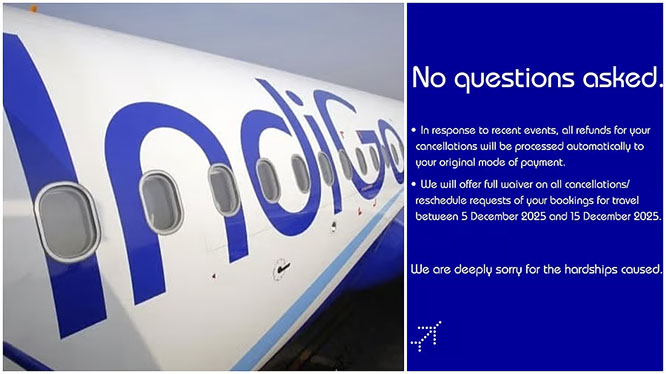
With IndiGo flight disruptions impacting thousands of passengers, the airline on Saturday said that it will offer full waiver on all cancellations/reschedule requests for travel bookings between December 5, 2025 and December 15, 2025.

Earlier in the day, the civil aviation ministry had directed the airline to complete the ticket refund process for the cancelled flights by Sunday evening, as well as ensure baggage separated from the travellers are delivered in the next two days.

In a post on X, titled 'No questions asked', IndiGo wrote, "In response to recent events, all refunds for your cancellations will be processed automatically to your original mode of payment."

"We are deeply sorry for the hardships caused," it further added.

Several passengers, however, complained of not getting full refund as promised by the airline.

Netizens have shared screenchots of getting charged for airline cancellation fee and convenience fee.

"Please tell me why u have did this airline cancellation charges when u say full amount will be refunded (sic)," a user wrote sharing a screenshot of the refund page.

"Well, but you have still debited the convenience charges," wrote another.

Passengers have also raised concerns about the "cancel" option being disabled on the IndiGo app. "First enable the 'Cancel' button on your App & offer full refund on tickets cancelled by customers between the said dates," wrote a user.

A day after the country's largest airline, IndiGo, cancelled more than 1,000 flights and caused disruptions for the fifth day on Saturday, the ministry said that any delay or non-compliance in refund processing will invite immediate regulatory action.

The refund process for all cancelled or disrupted flights must be completed by 8 pm on Sunday, the ministry said in a statement.

"Airlines have also been instructed not to levy any rescheduling charges for passengers whose travel plans were affected by cancellations," it said.

On Saturday, more than 400 flights were cancelled at various airports.

IndiGo has also been instructed to set up dedicated passenger support and refund facilitation cells.

Comments

Add new comment

  • Coastaldigest.com reserves the right to delete or block any comments.
  • Coastaldigset.com is not responsible for its readers’ comments.
  • Comments that are abusive, incendiary or irrelevant are strictly prohibited.
  • Please use a genuine email ID and provide your name to avoid reject.
News Network
December 4,2025

indigoflight.jpg

Domestic carrier IndiGo has cancelled over 180 flights from three major airports — Mumbai, Delhi and Bengaluru — on Thursday, December 4, as the airline struggles to secure the required crew to operate its flights in the wake of new flight-duty and rest-period norms for pilots.

While the number of cancellations at Mumbai airport stands at 86 (41 arrivals and 45 departures) for the day, at Bengaluru, 73 flights have been cancelled, including 41 arrivals, according to a PTI report that quoted sources.

"IndiGo cancelled over 180 flights on Thursday at three airports-Mumbai, Delhi and Bengaluru," the source told the news agency.

Besides, it had cancelled as many as 33 flights at Delhi airport for Thursday, the source said, adding, "The number of cancellations is expected to be higher by the end of the day."

The Gurugram-based airline's On-Time Performance (OTP) nosedived to 19.7 per cent at six key airports — Delhi, Mumbai, Chennai, Kolkata, Bengaluru and Hyderabad — on December 3, as it struggled to get the required crew to operate its services, down from almost half of December 2, when it was 35 per cent.

"IndiGo has been facing acute crew shortage since the implementation of the second phase of the FDTL (Flight Duty Time Limitations) norms, leading to cancellations and huge delays in its operations across the airports," a source had told PTI on Wednesday.

Chaos continued at several major airports for the third day on Thursday because of the cancellations.

A spokesperson for the Kempegowda International Airport (KIA) in Bengaluru said that 73 IndiGo flights had been cancelled on Thursday.

At least 150 flights were cancelled and dozens of others delayed on Wednesday, airport sources said, leaving thousands of travellers stranded, according to news agency Reuters.

The Directorate General of Civil Aviation (DGCA) has said it is investigating IndiGo flight disruptions and has asked the airline to submit the reasons for the current situation, as well as its plans to reduce flight cancellations and delays.

It may be mentioned here that the pilots' body, Federation of Indian Pilots (FIP), has alleged that IndiGo, despite getting a two-year preparatory window before the full implementation of new flight duty and rest period norms for cockpit crew, "inexplicably" adopted a "hiring freeze".

The FIP said it has urged the safety regulator, the DGCA, not to approve airlines' seasonal flight schedules unless they have adequate staff to operate their services "safely and reliably" in accordance with the New Flight Duty Time Limitations (FDTL) norms.

In a letter to the DGCA late on Wednesday, the FIP urged the DGCA to consider re-evaluating and reallocating slots to other airlines, which have the capacity to operate them without disruption during the peak holiday and fog season if IndiGo continues to "fail in delivering on its commitments to passengers due to its own avoidable staffing shortages."

Comments

Add new comment

  • Coastaldigest.com reserves the right to delete or block any comments.
  • Coastaldigset.com is not responsible for its readers’ comments.
  • Comments that are abusive, incendiary or irrelevant are strictly prohibited.
  • Please use a genuine email ID and provide your name to avoid reject.
News Network
December 5,2025

indigoCEO.jpg

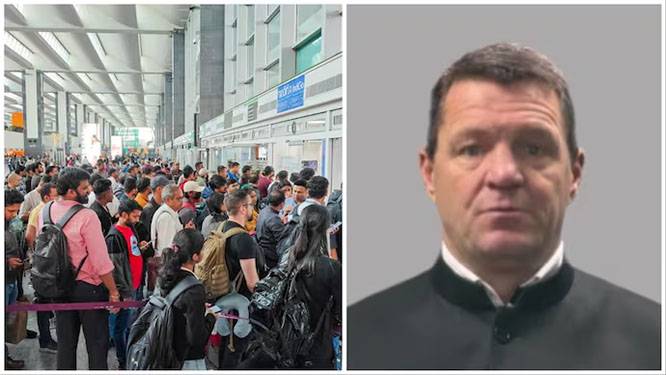
New Delhi, Dec 5: IndiGo CEO Pieter Elbers issued a public apology this evening after more than a thousand flights were cancelled today, making it the "most severely impacted day" in terms of cancellations. The biggest airline of the country cancelled "more than half" of its daily number of flights on Friday, said Elbers. He also said that even though the crisis will persist on Saturday, the airline anticipates fewer than 1,000 flight cancellations.

"Full normalisation is expected between December 10 and 15, though IndiGo cautions that recovery will take time due to the scale of operations," the IndiGo CEO said. 

IndiGo operates around 2,300 domestic and international flights daily.

Pieter Elbers, while apologising for the major inconvenience due to delays and cancellations, said the situation is a result of various causes.

The crisis at IndiGo stems from new regulations that boost pilots' weekly rest requirements by 12 hours to 48 and allow only two night-time landings per week, down from six. IndiGo has attributed the mass cancellations to "misjudgment and planning gaps".

Elbers also listed three lines of action that the airline will adopt to address the issue.

"Firstly, customer communication and addressing your needs, for this, messages have been sent on social media. And just now, a more detailed communication with information, refunds, cancellations and other customer support measures was sent," he said.

The airline has also stepped up its call centre capacity.

"Secondly, due to yesterday's situation, we had customers stranded mostly at the nation's largest airports. Our focus was for all of them to be able to travel today itself, which will be achieved. For this, we also ask customers whose flights are cancelled not to come to the airports as notifications are sent," the CEO said.

"Thirdly, cancellations were made for today to align our crew and planes to be where they need to start tomorrow morning afresh. Earlier measures of the last few days, regrettable, have proven not to be enough, but we have decided today to reboot all our systems and schedules, resulting in the highest numbers of cancellations so far, but imperative for progressive improvements starting from tomorrow," he added.

As airports witnessed chaotic scenes, the Directorate General of Civil Aviation (DGCA) stepped in to grant IndiGo a temporary exemption from stricter night duty rules for pilots. It also allowed substitution of leaves with a weekly rest period. 

Civil Aviation Minister Ram Mohan Naidu has said a high-level inquiry will be ordered and accountability will be fixed.

Comments

Add new comment

  • Coastaldigest.com reserves the right to delete or block any comments.
  • Coastaldigset.com is not responsible for its readers’ comments.
  • Comments that are abusive, incendiary or irrelevant are strictly prohibited.
  • Please use a genuine email ID and provide your name to avoid reject.