Remembering Maulana Abul Kalam Azad, the visionary

Shaastra Bhat Urimajalu
November 11, 2017

On November 11 every year, India celebrates the National Education Day to commemorate the birth anniversary of Maulana Abul Kalam Azad, a prominent freedom fighter and first education minister of independent India, who played a crucial role in synthesizing Muslims and Hindus of the country by exposing the divide-and-rule policy of the British.

In the independent country, the focus on education was paramount for the learned understood that no true nation can develop until and unless education was considered a fundamental pillar. Speaking at All India Education on January 16, 1948, Azad had said, "We must not for a moment forget, it is a birthright of every individual to receive at least the basic education without which he cannot fully discharge his duties as a citizen."

Maulana Azad was born as Abul Kalam Ghulam Muhiyuddin on November 11, 1888 in Makkah in an Indian origin family. Since a very young age, Maulana Azad was a literature enthusiast. He had mastered several languages including Urdu, Hindi, Persian, Bengali, Arabic and English. He translated the meaning of Quran to Urdu. He is considered as one of the greatest Urdu writers of the 20th century. His work was recognized through his journalistic practice, publishing works critical of the colonial British Raj and espousing the causes of Indian nationalism. He has also written many books including India Wins Freedom, Ghubar-e-Khatir, Tazkirah and Tarjumanul Quran.

Maulana Azad became the leader of the Khilafat Movement, during which he came into close contact with the Indian leader Mahatma Gandhi. He was an enthusiastic supporter of Gandhi's ideas of non-violent civil disobedience, and worked to organise the non-co-operation movement in protest of the 1919 Rowlatt Acts. In 1920, he was elected as one of the founding members to establish Jamia Millia Islamia at Aligarh in Uttar Pradesh without the help of the British. In 1923, at an age of 35, he became the youngest person to serve as the President of the Indian National Congress.

Maulana Azad was given the charge of the Education Minister for free India in 1947. At the time, India, though free, was reeling through the years of exploitation. Contrary to ordinary belief, the education system under the British India was rudimentary at best. The only schools of excellence were set up by the Indian revolutionaries who managed to bring modern education to India. At a grass root level, however, India was still suffering from widespread illeteracy.

Understanding the fundamental role education plays in the development of the nation, Maulana Azad as the Chairman of Central Advisory Board of Education, gave impetus to Adult Education and Literacy. Not only did he lay emphasis on elementary education but also propagated diversification of secondary education and vocational training.

Under his tenure as Education Minister (1947 to 1958), he founded most of the major cultural and literary academies we have today including Sangeet Natak Academy, Lalit Kala Academy, Sahitya Academy as well as the Indian Council for Cultural Relations and School of Planning and Architecture.

He was responsible for setting up of The Central Institute of Education, Delhi which later became the Department of Education of Delhi University. The setting up of Indian Institute of Technology (IIT) in 1951, the University Grants Commission (UGC) in 1953 are all credited to his vision. He also lay stress on and was the primary propagator of Indian Institute of Science, Bengaluru and Faculty of Technology of Delhi University and a founder of Jamia Millia Islamia University.

Maulana Azad always emphasised on quality education and considered schools as laboratories which produced future citizens of the country. He strongly believed in free primary education and compulsory education to all children. He was awarded with the highest civilian honour, the Bharat Ratna in 1992.

Comments

Add new comment

  • Coastaldigest.com reserves the right to delete or block any comments.
  • Coastaldigset.com is not responsible for its readers’ comments.
  • Comments that are abusive, incendiary or irrelevant are strictly prohibited.
  • Please use a genuine email ID and provide your name to avoid reject.
News Network
January 23,2026

modIKERALA.jpg

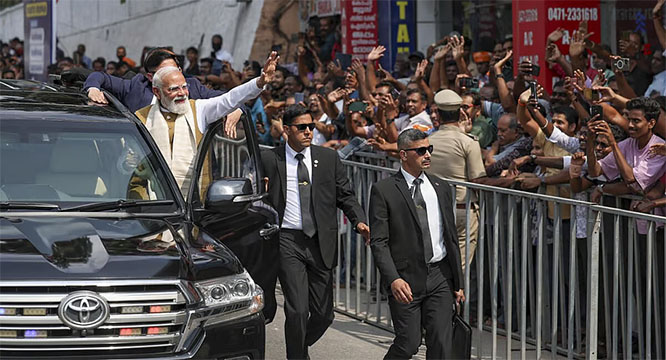
Prime Minister Narendra Modi, during his visit to Thiruvananthapuram on Friday, January 23, indicated that the Bharatiya Janata Party (BJP) is aiming to expand its political footprint in Kerala ahead of the Assembly elections scheduled in the coming months.

Speaking at a BJP-organised public meeting, Modi drew parallels between the party’s early electoral gains in Gujarat and its recent victory in the Thiruvananthapuram Municipal Corporation. The civic body win, which ended decades of Left control, was cited by the Prime Minister as a possible starting point for the party’s broader ambitions in the state.

Recalling BJP’s political trajectory in Gujarat, Modi said the party was largely insignificant before 1987 and received little media attention. He pointed out that the BJP’s first major breakthrough came with its victory in the Ahmedabad Municipal Corporation that year.

“Just as our journey in Gujarat began with one city, Kerala’s journey has also started with a single city,” Modi said, suggesting that the party’s municipal-level success could translate into wider electoral acceptance.

The Prime Minister alleged that successive governments led by the Left Democratic Front (LDF) and the United Democratic Front (UDF) had failed to adequately develop Thiruvananthapuram. He accused both fronts of corruption and neglect, claiming that basic infrastructure and facilities were denied to the capital city for decades.

According to Modi, the BJP’s control of the civic body represents a shift driven by public dissatisfaction with the existing political alternatives. He asserted that the BJP administration in Thiruvananthapuram had begun working towards development, though no specific details or timelines were outlined.

Addressing the gathering at Putharikandam Maidan, Modi said the BJP intended to project Thiruvananthapuram as a “model city,” reiterating his party’s commitment to governance-led change.

The Prime Minister’s visit to Kerala also included the inauguration of several development projects and the flagging off of new train services, as the BJP intensifies its political outreach in the poll-bound state.

Comments

Add new comment

  • Coastaldigest.com reserves the right to delete or block any comments.
  • Coastaldigset.com is not responsible for its readers’ comments.
  • Comments that are abusive, incendiary or irrelevant are strictly prohibited.
  • Please use a genuine email ID and provide your name to avoid reject.
News Network
February 1,2026

US President Donald Trump on Saturday claimed that the government of India led by Prime Minister Narendra Modi has made a deal to buy Venezuelan oil, as opposed to purchasing it from Iran.

"We've already made that deal, the concept of the deal," he told reporters on Air Force One.

Trump had imposed 25% tariffs on countries buying Venezuelan oil, including India, in March 2025. He had also hit India with tariffs for buying Russian oil, saying it was "funding" President Vladimir Putin's war against Ukraine.

Trump has said that the US has taken control of the oil-rich Venezuela after capturing former President Nicolas Maduro in January.

A fleet of 18 ships loaded with crude oil bound for refineries in Texas, Louisiana, and Mississippi in January, the most since December 2024, according to a report by the news agency Bloomberg.

Combined crude deliveries to the US will reach about 2,75,000 barrels a day, more than doubling volumes seen in December last year. Shipments to China, which averaged 4,00,000 barrels a day last year, fell to zero in January.

PM Modi, Venezuelan President Agree To Expand Ties

Prime Minister Narendra Modi and Venezuela's acting President Delcy Rodriguez spoke on Friday and agreed to take the bilateral relations to "new heights" in the years ahead.

It was the first phone call between the two leaders since the capture of Maduro and his wife by the US on January 3.

"Spoke with Acting President of Venezuela, Ms. Delcy Rodriguez. We agreed to further deepen and expand our bilateral partnership in all areas, with a shared vision of taking India-Venezuela relations to new heights in the years ahead," PM Modi said in a post on X.

A statement from Prime Minister Modi's office said the two leaders agreed to further expand and deepen the India-Venezuela partnership in all areas, including trade and investment, energy, digital technology, health, agriculture, and people-to-people ties.

They exchanged views on various regional and global issues of mutual interest and underscored the importance of their close cooperation for the Global South, the statement said.

Rodriguez also said that they discussed partnerships in the fields of agriculture, science and technology, mining, and tourism, as well as the pharmaceutical and automotive industries.

Comments

Add new comment

  • Coastaldigest.com reserves the right to delete or block any comments.
  • Coastaldigset.com is not responsible for its readers’ comments.
  • Comments that are abusive, incendiary or irrelevant are strictly prohibited.
  • Please use a genuine email ID and provide your name to avoid reject.