



Sabarimala temple opens today; tension as women stopped from going to the shrine

Agencies
October 17, 2018

Thiruvananthapuram, Oct 17: Hundreds of women devotees of Lord Ayyappa on October 16 checked vehicles for girls and women of menstrual age at Nilackal, the main gateway to Sabarimala in Kerala, and stopped them from proceeding to the hill shrine, as tension mounted in the area ahead of the opening of the temple gates on October 17.
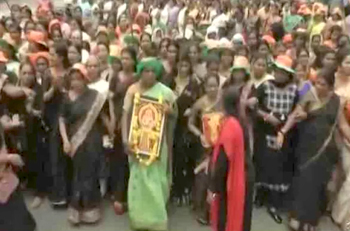
With the gates set to be opened for the first time since the Supreme Court last month lifted the centuries-old ban on women in the 10-50 age group and allowed women of all age groups to enter the shrine, 20 kilometres (km) from Nilackal and about 225 km from Thiruvananthapuram, Kerala waited with bated breath amid ominous warnings of "mass suicides" and threats of disruption.

There were also reports that members of the local tribal community were keeping a tight vigil to ensure that women between the ages of 10 to 50 (the typical duration of time when a woman menstruates) were not allowed to enter the Lord Ayyappa temple which is specifically dedicated to the celibate form of the deity.

A last ditch effort by the Travancore Devaswom Board (TDB), which manages the temple, to defuse the tense situation failed to yield a solution with the Pandalam royal family and other stakeholders walking out of a meeting called by it over its reluctance to discuss the issue of filing a review petition against the apex court order.

Chief Minister Pinarayi Vijayan, facing a tough time tackling the highly emotive religious issue which has also acquired political overtones, issued a stern warning to those who dared block devotees from entering the temple.

Lustily chanting "Swamiya Saranam Ayyappa" hailing the Lord, women devotees picketed the road at Nilackal and checked buses and private vehicles for girls and women of the "banned" age group and forced them to abandon their pilgrimage to the shrine which also involved a 6-km arduous hill trek.

A woman journalist Ritu was one of those who was stopped by the protesting women devotees. Ritu claimed she was heading for the temple on assignment and had no intention of entering the shrine, something that could have offended the religious sensibilities of Ayyappa devotees.

"No woman belonging to the banned age group of 10-50 will be allowed to travel further from Nilackal and offer prayers at the shrine when it opens for the monthly pooja tomorrow evening," asserted a woman protester as tempers ran high at Nilackal.

A small police contingent looked the other way.

Television channels showed some college students, including young girls wearing black dresses, being ordered to get down a bus.

"We will ensure security to all. Nobody will be allowed to take law into their hands. My government will not allow any violence in the name of Sabarimala," Vijayan told reporters in Thiruvananthapuram as Ayyappa devotees virtually besieged Nilackal.

"Stern action will be taken against anyone who prevents devotees from going to Sabarimala," he warned, and ruled out any rethink of his government's decision against seeking a review of the Supreme Court order.

"We will go by what the Supreme Court says," he asserted.

The TDB went into a huddle with stakeholders, including the Pandalam royal family representatives and priests, to soothe frayed tempers amid escalating protests by the Hindu right and common Ayyappa devotees.

The meeting also attended by Ayyappa Seva Samajam and Yoga Kshema Sabha ended in a deadlock as the TDB stuck to its stand of not filing a review petition.

"It is very painful and we cannot agree. We wanted a decision on filing the review petition to be taken today itself, but the board said it can be discussed only at the next meeting of TDB on October 19," Shashikumar Varma, a member of the Pandalam royal family said.

"We all wish that Sabarimala should not be made a war zone," Varma, the president of Pandalam Royal Palace Trust, told journalists after walking out of the meeting in a huff.

TDB president A Padmakumar, however, dismissed suggestions that the meeting was a "failure".

"What they (stakeholders) wanted was to file the review petition now itself. But the Supreme Court is closed till October 22. They also wanted to maintain the status quo on the customs and traditions.

"As the Supreme Court has passed a verdict, what can the board do? But the board will continue to talk with them to resolve the issue," Padmakumar said. He said the October 19 meeting will take up the issue of the review petition.

Kerala has witnessed a series of protests and prayer marches over the last few days over the government's decision to enforce the Supreme Court order.

The Shiv Sena recently warned of "mass suicides" if women of menstrual age were allowed into the temple. Some other organisations have said women and girls aged between 10 and 50 years will have to tread on them before entering the temple.

However, some intrepid women like Reshma Nishanth, a 32-year-old Kannur native, has decided to offer prayers there despite being "slut-shamed".

The TDB, meanwhile, covered a signboard at the base camp in Pamba, which said the entry of women of menstrual age into the temple was prohibited. Pamba is the base from where the trek to the shrine begins.

The multi-lingual board reading "Women between 10-50 are not allowed to visit Sannidhanam (Sabarimala temple)" was covered in the evening with a plastic banner that said: "Use of plastic is prohibited here".

Comments

Add new comment

  • Coastaldigest.com reserves the right to delete or block any comments.
  • Coastaldigset.com is not responsible for its readers’ comments.
  • Comments that are abusive, incendiary or irrelevant are strictly prohibited.
  • Please use a genuine email ID and provide your name to avoid reject.
News Network
December 22,2025

bhagavat.jpg

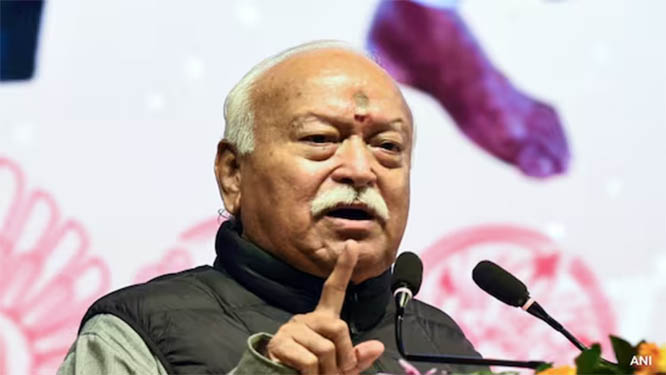
Kolkata: Stressing that India is a "Hindu nation," Rashtriya Swayamsevak Sangh (RSS) Chief Mohan Bhagwat on Sunday said that no constitutional approval is needed as it is the "truth".

Addressing an event marking 100 years of the RSS, Bhagwat said that India is, and will remain, a Hindu nation until Indian culture is appreciated in the country.

"The Sun rises in the east; we don't know since when this has been happening. So, do we need constitutional approval for that, too? Hindustan is a Hindu nation. Whoever considers India their motherland appreciates Indian culture, as long as there is even one person alive on the land of Hindustan who believes in and cherishes the glory of Indian ancestors, India is a Hindu nation. This is the ideology of the Sangh," he said at the '100 Vyakhyan Mala' program of RSS in Kolkata.

"If Parliament ever decides to amend the Constitution and add that word, whether they do it or not, it's fine. We don't care about that word because we are Hindus, and our nation is a Hindu nation. That is the truth. The caste system based on birth is not the hallmark of Hindutva," he added.

RSS has always argued that India is a "Hindu Nation," given the culture and majority's affiliations to Hinduism. However, 'secular' was not originally part of the Preamble of the Constitution, but it was added along with the word 'socialist' by the Constitution (42nd Amendment) Act, 1976, during the Emergency imposed by then Prime Minister Indira Gandhi.

Bhagwat also urged people to visit the organisation's offices and 'shakhas' to understand its work, so that what he dubbed as the “false perception” of the organisation as anti-Muslim can be dispelled!

Bhagwat said that people have understood that the organisation advocates for the protection of Hindus, and are "staunch nationalists," but not anti-muslim.

"If there is a perception that we are anti-Muslim, then, as I said, the RSS work is transparent. You can come anytime and see for yourself, and if you see anything like that happening, then you keep your views, and if you don't see it, then you change your views. There is a lot to understand (about RSS), but if you don't want to understand, then no one can change your mind," Bhagwat said.

He said, but anyone unwilling to learn cannot be helped.

"After seeing, people have said that you are staunch nationalists. You organise Hindus, and you advocate for the protection of Hindus. But you are not anti-Muslim. Many people have accepted this, and those who want to know more should come and see the RSS for themselves," he said.

Comments

Add new comment

  • Coastaldigest.com reserves the right to delete or block any comments.
  • Coastaldigset.com is not responsible for its readers’ comments.
  • Comments that are abusive, incendiary or irrelevant are strictly prohibited.
  • Please use a genuine email ID and provide your name to avoid reject.
News Network
December 16,2025

jordan.jpg

Prime Minister Narendra Modi on Monday held talks with Jordan’s King Abdullah II in Amman, during which the two leaders discussed ways to further strengthen bilateral relations, with the Prime Minister outlining an eight-point vision covering key areas of cooperation.

Describing the meeting as “productive”, PM Modi said he shared a roadmap focused on trade and economy, fertilisers and agriculture, information technology, healthcare, infrastructure, critical and strategic minerals, civil nuclear cooperation, and people-to-people ties.

In a post on social media platform X, the Prime Minister praised King Abdullah II’s personal commitment to advancing India–Jordan relations, particularly as both countries mark the 75th anniversary of the establishment of diplomatic ties this year.

“Held productive discussions with His Majesty King Abdullah II in Amman. His personal commitment towards vibrant India-Jordan relations is noteworthy. This year, we are celebrating the 75th anniversary of our bilateral diplomatic relations,” PM Modi said.

The meeting took place at the Al Husseiniya Palace, where the two leaders also exchanged views on regional and global issues of mutual interest. According to the Ministry of External Affairs (MEA), both sides agreed to further deepen cooperation in areas including trade and investment, defence and security, counter-terrorism and de-radicalisation, fertilisers and agriculture, infrastructure, renewable energy, tourism, and heritage.

The MEA said both leaders reaffirmed their united stand against terrorism.

PM Modi arrived in Amman earlier on Monday and was received by Jordanian Prime Minister Jafar Hassan, who accorded him a formal welcome. Following the talks, King Abdullah II hosted a banquet dinner in honour of the Prime Minister, reflecting the warmth of bilateral ties.

Jordan is the first leg of PM Modi’s three-nation tour. From Amman, the Prime Minister will travel to Ethiopia at the invitation of Prime Minister Abiy Ahmed Ali, marking his first official visit to the African nation. The tour will conclude with a visit to Oman.

Comments

Add new comment

  • Coastaldigest.com reserves the right to delete or block any comments.
  • Coastaldigset.com is not responsible for its readers’ comments.
  • Comments that are abusive, incendiary or irrelevant are strictly prohibited.
  • Please use a genuine email ID and provide your name to avoid reject.
News Network
December 13,2025

New Delhi: School-going children are picking up drug and smoking habits and engaging in consumption of alcohol, with the average age of introduction to such harmful substances found to be around 13 years, suggesting a need for earlier interventions as early as primary school, a multi-city survey by AIIMS-Delhi said.

The findings also showed substance use increased in higher grades, with grade XI/XII students two times more likely to report use of substances when compared with grade VIII students. This emphasised the importance of continued prevention and intervention through middle and high school.

The study led by Dr Anju Dhawan of AIIMS's National Drug Dependence Treatment Centre, published in the National Medical Journal of India this month, looks at adolescent substance use across diverse regions.

The survey included 5,920 students from classes 8, 9, 11 and 12 in urban government, private and rural schools across 10 cities -- Bengaluru, Chandigarh, Delhi, Dibrugarh, Hyderabad, Imphal, Jammu, Lucknow, Mumbai, and Ranchi. The data were collected between May 2018 and June 2019.

The average age of initiation for any substance was 12.9 (2.8) years. It was lowest for inhalants (11.3 years) followed by heroin (12.3 years) and opioid pharmaceuticals (without prescription; 12.5 years).

Overall, 15.1 per cent of participants reported lifetime use, 10.3 per cent reported past year use, and 7.2 per cent reported use in the past month of any substance, the study found.

The most common substances used in the past year, after tobacco (4 per cent) and alcohol (3.8 per cent), were opioids (2.8 per cent), followed by cannabis (2 per cent) and inhalants (1.9 per cent). Use of non-prescribed pharmaceutical opioids was most common among opioid users (90.2 per cent).

On being asked, 'Do you think this substance is easily available for a person of your age' separately for each substance category, nearly half the students (46.3 per cent) endorsed that tobacco products and more than one-third of the students (36.5 per cent) agreed that a person of their age can easily procure alcohol products.

Similarly, for Bhang (21.9 per cent), ganja/charas (16.1 per cent), inhalants (15.2 per cent), sedatives (13.7 per cent), opium and heroin (10 per cent each), the students endorsed that these can be easily procured.

About 95 per cent of the children, irrespective of their grade, agreed with the statement that 'drug use is harmful'.

The rates of substance use (any) among boys were significantly higher than those of girls for substance use (ever), use in the past year and use in the past 30 days. Compared to grade VIII students, grade IX students were more likely, and grade XI/XII students were twice as likely to have used any substance (ever).

The likelihood of past-year use of any substance was also higher for grade IX students and for grade XI/XII students as compared to grade VIII students.

About 40 per cent of students mentioned that they had a family member who used tobacco or alcohol each. The use of cannabis (any product) and opioid (any product) by a family member was reported by 8.2 per cent and 3.9 per cent of students, respectively, while the use of other substances, such as inhalants/sedatives by family was 2-3 per cent, the study found.

A relatively smaller percentage of students reported use of tobacco or alcohol among peers as compared to among family members, while a higher percentage reported inhalants, sedatives, cannabis or opioid use among peers.

Children using substances (past year) compared to non-users reported significantly higher any substance use by their family members and peers.

There were 25.7 per cent students who replied 'yes' to the question 'conflicts/fights often occur in your family'. Most students also replied affirmatively to 'family members are aware of how their time is being spent' and 'damily members are aware of with whom they spend their time'.

Comments

Add new comment

  • Coastaldigest.com reserves the right to delete or block any comments.
  • Coastaldigset.com is not responsible for its readers’ comments.
  • Comments that are abusive, incendiary or irrelevant are strictly prohibited.
  • Please use a genuine email ID and provide your name to avoid reject.
