From son of a coffee planter to the Coffee King of India

News Network
July 31, 2019

He wanted to be an investment banker and had little interest in his family's coffee business. But a chat with the owners of German coffee chain, Tchibo, got V G Siddhartha to set up the Indian rival of Starbucks before debt and tax woes allegedly led him to end his life.

Siddhartha, the founder of India's biggest coffee chain, Cafe Coffee Day, was confirmed dead on Wednesday, days after he went missing. A purported letter written by him indicated that pressure from banks, investor and tax authorities drove him to end it.

Coming from a family that has a 140-year history of growing coffee, Siddhartha, around 60, initially dabbled in stock trading and wanted to work as an investment banker in Mumbai after completing his Master's degree in Economics from Mangalore University.

In 1984, he launched his own investment and venture capital firm Sivan Securities in Bangalore and began investing the profits from his start-up to buy coffee plantations in Karnataka's Chikmagalur district.

Around this time, he also began taking interest in his family's coffee business. In 1993, he set up a coffee trading company called Amalgamated Bean Company (ABC) with an annual turnover of over Rs 6 crore and over the years it increased to over Rs 2,500 crore.

Inspired by a chat with the owners of Tchibo, a German coffee chain, Siddhartha decided to open his own chain of cafes in a country that had no formative cultural grounding in cappuccinos. He opened Cafe Coffee Day's first outlet on Bangalore's upscale Brigade Road in 1994 with a tag line 'A lot can happen over a cup of coffee'.

It's now the largest chain of coffee shops in India, a nation of tea drinkers, with 1,750 cafes in more than 200 cities, including outlets in Prague, Vienna and Kuala Lumpur. Coffee Day went public in 2015.

Siddhartha currently has 200 exclusive retail outlets selling his brand of Coffee Day powder all over South India. ABC is also India's largest exporter of green coffee.

Expanding his business portfolio, Siddhartha ventured into IT sector and founded Global Technology Ventures Ltd that identifies invests and mentors technology companies.

He also entered the financial sector with investment firm Sivan Securities Private Ltd. The company has three subsidiaries - Chetan Wood Processing Pvt Ltd, hospitality business Barefoot Resorts and timber trading - Dark Forest Furniture Company.

In 1999, Siddhartha was roped in by IT veteran Ashok Soota when Subroto Bagchi, Rostow Ravanan and KK Natarajan were putting together IT firm Mindtree.

He was once the largest shareholder of Mindtree but decided to cash out. In March this year, he sold out his 20.41 per cent stake in MindTree to Larsen & Toubro (L&T), making close to Rs 2,858 crores profit. That deal helped him repay his debt of about Rs 2,900 crore.

Son-in-law of former Karnataka Chief Minister SM Krishna, Siddhartha found himself in trouble in September 2017, when the Income Tax (I-T) department conducted raids at over 20 locations linked to him.

Siddhartha reportedly had been witnessing rising debts, especially in the last few years.

His Coffee Day Enterprises Ltd had seen net loss widening to Rs 67.71 crore in the fiscal year ended March 31, 2018, from Rs 22.28 crore loss in the previous year. This despite revenues climbing 59 per cent to Rs 122.32 crore.

He was reportedly in talks to sell his real estate venture Tanglin Developments Ltd to New York-based private equity giant Blackstone Group.

The MindTree sale had vastly improved his financial condition and the real estate deal would have further cut his debt. He was also in talks to sell Coffee Day Enterprises, where he held 32.75 per cent stake, to Coca-Cola for as much as USD 1.45 billion.

And so his sudden disappearance from Jappinamogaru, which is very close to Netravathi river and three kilometres from the sea, on Monday evening has left questions unanswered.

A letter by him to the CCD Board claimed that he was being pressured by "one of the private equity partners" forcing him to buy back shares, a transaction he had partially completed six months ago by borrowing a large sum of money from "a friend".

The letter also talked about "harassment" by I-T Department official, who initially attached his shares in Mindtree.

The I-T Department on its part refuted the charges made out in the letter saying the signature on it does not match with the record available with it.

His wife, Malavika Hegde, with whom he has two children, is on the CCD board.

"Company is professionally managed and led by a competent leadership team, which will ensure continuity of business," the CCD Enterprise said in a regulatory filing.

Comments

Add new comment

  • Coastaldigest.com reserves the right to delete or block any comments.
  • Coastaldigset.com is not responsible for its readers’ comments.
  • Comments that are abusive, incendiary or irrelevant are strictly prohibited.
  • Please use a genuine email ID and provide your name to avoid reject.
News Network
January 23,2026

Karnataka Governor Thaawarchand Gehlot read only three lines from the 122-paragraph address prepared by the Congress-led state government while addressing the joint session of the Legislature on Thursday, effectively bypassing large sections critical of the BJP-led Union government.

The omitted portions of the customary Governor’s address outlined what the state government described as a “suppressive situation in economic and policy matters” under India’s federal framework. The speech also sharply criticised the Centre’s move to replace the Mahatma Gandhi National Rural Employment Guarantee Act (MGNREGA) with the Viksit Bharat–Guarantee for Rozgar and Ajeevika Mission (Gramin) Act, commonly referred to as the VB-GRAM (G) Act.

Governor Gehlot had earlier conveyed his objection to several paragraphs that were explicitly critical of the Union government. On Thursday, he confined himself to the opening lines — “I extend a warm welcome to all of you to the joint session of the State legislature. I am extremely pleased to address this august House” — before jumping directly to the concluding sentence of the final paragraph.

He ended the address by reading the last line of paragraph 122: “Overall, my government is firmly committed to doubling the pace of the State’s economic, social and physical development. Jai Hind — Jai Karnataka.”

According to the prepared speech, the Karnataka government demanded the scrapping of the VB-GRAM (G) Act, describing it as “contractor-centric” and detrimental to rural livelihoods, and called for the full restoration of MGNREGA. The state government argued that the new law undermines decentralisation, weakens labour protections, and centralises decision-making in violation of constitutional norms.

Key points from the unread sections of the speech:

•    Karnataka facing a “suppressive” economic and policy environment within the federal system

•    Repeal of MGNREGA described as a blow to rural livelihoods

•    VB-GRAM (G) Act accused of protecting corporate and contractor interests

•    New law alleged to weaken decentralised governance

•    Decision-making said to be imposed by the Centre without consulting states

•    Rights of Adivasis, women, backward classes and agrarian communities curtailed

•    Labourers allegedly placed under contractor control

•    States facing mounting fiscal stress due to central policies

•    VB-GRAM (G) Act accused of enabling large-scale corruption

Comments

Add new comment

  • Coastaldigest.com reserves the right to delete or block any comments.
  • Coastaldigset.com is not responsible for its readers’ comments.
  • Comments that are abusive, incendiary or irrelevant are strictly prohibited.
  • Please use a genuine email ID and provide your name to avoid reject.
coastaldigest.com news network
January 19,2026

rizwanzameer.jpg

Bengaluru: As the dust settles on the recent legislative session, the corridors of Vidhana Soudha are buzzing with more than just policy talk. A high-stakes game of political musical chairs has begun, exposing a deepening rift within the Congress party’s Muslim leadership as a major Cabinet reshuffle looms.

With the party hierarchy signaling a "50% refresh" to gear up for the 2028 Assembly elections, the race to fill three projected Muslim ministerial berths has transformed from a strategic discussion into an all-out turf war.

The "Star Son" Spark

The internal friction turned public this week following provocative remarks by Zaid Khan, actor and son of Wakf Minister Zameer Ahmed Khan. Zaid’s claim—that his father "helped" secure a ticket for Shivajinagar MLA Rizwan Arshad in 2023—has acted as a lightning rod for resentment.

Rizwan’s camp was quick to fire back, dismissing the comment as a desperate attempt by Zameer to manufacture seniority. "Rizwan’s political pedigree was forged in the NSUI and Youth Congress long before Zameer even stepped into the party," a supporter noted, highlighting Rizwan’s tenure as an AICC secretary and his two-term presidency of the State Youth Congress.

A Tale of Two Loyalists

While both Zameer Ahmed Khan and Rizwan Arshad are staunch allies of Chief Minister Siddaramaiah and represent Bengaluru strongholds, their political DNA could not be more different:

•    Zameer Ahmed Khan: A four-time MLA who crossed over from JD(S) in 2018. Known for his "overzealous" and often polarizing outreach during communal flashpoints—from the DJ Halli riots to the recent Wakf land notice controversy—his style has frequently left the Congress high command in a state of "discomfort."

•    Rizwan Arshad: A homegrown organizational man. Seen as a "quiet performer," Arshad represents the sophisticated, moderate face of the party, preferred by those who find Zameer’s brand of politics too volatile.

The Outsiders Looking In

The bickering isn't limited to a duo. The "Beary" community, represented by leaders like N A Haris and Saleem Ahmed, is demanding its pound of flesh. Saleem Ahmed, the Chief Whip in the Legislative Council, has dropped the veil of diplomacy, openly declaring his ministerial aspirations.

"I was the only working president not included in the Cabinet last time," Saleem noted pointedly, signaling that the "loyalty quota" is no longer enough to keep the peace.

As Chief Minister Siddaramaiah prepares to finalize the list, he faces a delicate balancing act: rewarding the aggressive grassroots mobilization of Zameer’s camp without alienating the organizational stalwarts and minority sub-sects who feel increasingly sidelined by the "Chamarajpet-Shivajinagar" binary.

Comments

Add new comment

  • Coastaldigest.com reserves the right to delete or block any comments.
  • Coastaldigset.com is not responsible for its readers’ comments.
  • Comments that are abusive, incendiary or irrelevant are strictly prohibited.
  • Please use a genuine email ID and provide your name to avoid reject.
coastaldigest.com news network
January 19,2026

badriya.jpg

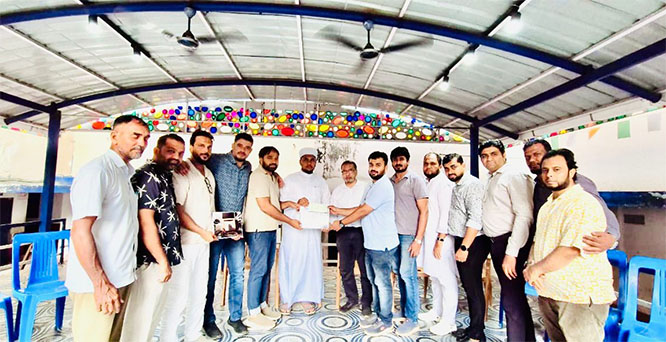
Mangaluru: The Phase I project of Badria Vision 2028 was formally launched at a ceremony held at the Badria Campus on January 17, marking an important step in the institution’s long-term development roadmap.

The programme was attended by P.B. Abdul Hameed, Secretary of the MEA, and P.C. Hasir, Correspondent of the MEA, who presided over the event and underscored the institution’s commitment to growth and academic excellence.

Office-bearers of the Badria Alumni Association were present in large numbers, including A.K. Sajid (President), Shamsuddin and S.M. Farooq (Vice-Presidents), Shaheed (General Secretary), and Khaleel (Treasurer), reflecting strong alumni engagement in the initiative.

The gathering was blessed by Sayyid Shamsuddeen Basith Thangal Kukkaje, Qateeb of Zeenat Yatheem Bakshi, who led a special dua seeking divine guidance and success for the project.

The ceremony also witnessed the participation of prominent alumnus and local corporate professional Abdul Latheef, along with alumni members Naushad, Kalandar, Safwan, members of the core committee, and several other former students.

A key moment of the event was the formal handover of a cheque to Ameen Woodland Architect, signalling the immediate commencement of construction work under Phase I of the project.

Organisers said the launch of Phase I reflects a shared vision, institutional unity, and collective resolve to realise the objectives of Badria Vision 2028.

Comments

Add new comment

  • Coastaldigest.com reserves the right to delete or block any comments.
  • Coastaldigset.com is not responsible for its readers’ comments.
  • Comments that are abusive, incendiary or irrelevant are strictly prohibited.
  • Please use a genuine email ID and provide your name to avoid reject.