



A tailor by day and killer by night; Bhopal man murdered 33

TOI
September 12, 2018

Bhopal, Sept 12: During the day Adesh Khamra stitched clothes, hunched over his sewing machine in a small shop on the fringes of Bhopal. In the night, as he tossed in bed, consumed by visions of deadly crimes that he wanted to commit, he perhaps saw himself switching the needle for an axe, the thread into a hangman's noose.

Then the killings started. Sometime around 2010. The first one in Amravati, the other in Nashik. Soon, bodies started popping up everywhere in MP, some even in Maharashtra, UP and Bihar. There was one element that connected the murders. All the victims were truck drivers and their helpers. But no one thought the quiet, affable tailor from Mandideep could have been behind the brutality.

Last week, when the local police finally nabbed Khamra, they were stunned he admitted to 30 killings. On Tuesday, he said he had killed three more. At 33 serial strikes, that would make him one of India's deadliest killers, behind the likes of Raman Raghav, who was charged with slaughtering 42, Surendra Koli and the Stoneman of Kolkata. Khamra, who was arrested from the jungles of Sultanpur in UP by a daring woman cop after a three-day chase last week, "was admitting to murders so rapidly" that the raiding team said it was struggling to keep up with the flow of information.

‘He killed drivers to give them salvation’

It was Bhopal city SP Bittu Sharma — a taekwondo black belt and Asian Games bronze medalist in judo — who took Khamra down at gunpoint in the dead of the night. Neither she nor SP Lodha Rahul Kumar, who headed investigations into two recent murders of truckers, had any clue then that they possibly had one of India’s most notorious serial killers in their custody. “This is a once-in-a-lifetime case,” said Lodha.

Co-accused Jaykaran has told police that whenever they asked him why he killed the drivers, he would laugh and say he is granting them salvation. “They lead hard lives,” he would laugh. “I am giving them mukti, freeing them from pain.”

Friends and relatives said it was unbelievable that they had lived next to a monster all this while. “He was a quiet man, well behaved. There is no way anyone will accept he has the blood of so many on his hands,” said a neighbor.

Bhopal DIG Dharmendra Choudhary said Khamra, 48 now, could put up a disarming show of warmth and friendliness. He used this to befriend truckers and trap them. While his men looted the cargo, he would strangle the drivers with a length of rope. Occasionally, he used poison to silence his victims.

The modus operandi was chillingly effective — ensnare truckers over drinks, drug them, murder them, strip them of every bit of clothing that could lead to their identification, and dump bodies under culverts or on hilly roads.

This way, bodies would turn up in states ranging from MP to Maharashtra, UP, Bihar and Jharkhand, with police struggling to join the dots. “That is what makes this gang so deadly. We don’t know how many more cold cases will be traced back to them,” said an officer interrogating Khamra.

Talking to Khamra is quite unsettling, police officers involved in the probe said. He shows no remorse. “And he remembers every little detail about everyone he has killed. The victim’s last meal, where they ate, what they wore, where and how he was killed and where exactly the body was dumped. The details are bloodcurdling. In postmortem reports, the injuries were exactly where he had dealt the blows,” added a police officer.

For police, there were more startling disclosures in store. Khamra was most likely influenced by a dreaded killer he called uncle, a man whose name was Ashok Khamra. Ashok himself had admitted to 100 trucker murders when he was arrested in 2010, police said. Ashok drugged his police escort while being brought to Bhopal by train and escaped. He hasn’t been seen since.

In the close-knit Khamra community — a group of hard working, educated people whose forefathers came as refugees from Pakistan — Ashok’s notoriety is a matter of shame. So is Khamra’s now.

Comments

Add new comment

  • Coastaldigest.com reserves the right to delete or block any comments.
  • Coastaldigset.com is not responsible for its readers’ comments.
  • Comments that are abusive, incendiary or irrelevant are strictly prohibited.
  • Please use a genuine email ID and provide your name to avoid reject.
News Network
January 20,2026

Mangaluru: In a major step towards strengthening rural innovation, the Office of the Principal Scientific Adviser (PSA) to the Government of India is supporting the establishment of RuTAGe Smart Village Centres (RSVCs) across the country through collaborations with academic institutions, civil society organisations and philanthropic partners.

As part of this national initiative, Nitte (Deemed to be University) will set up the first RSVCs in the region at Nitte GP in Udupi district and at the Nitte Health Centre, Sevanjali Trust, Farangipete, in Dakshina Kannada district. The centres will be inaugurated on January 21. In South India, the programme is being implemented by the Section Infin-8 Foundation (SI-8).

Speaking to reporters on Monday, SI-8 founder-director Vishwas US said experts from Nitte University and SI-8 would work closely with farmers, students, youth and local entrepreneurs to adapt and deploy technologies tailored to local needs.

Project head Prof Iddya Karunasagar, representing Nitte DU, said the RSVCs at Nitte and Farangipete would serve as demonstration hubs for a wide range of agriculture, energy, skill-development and assistive technologies. These include solar dryers for fruits, vegetables and crops; soil-testing solutions; power weeders and women-friendly farm tools; wind-powered devices for rural artisans; grain storage systems; grass-cutting and tree-climbing equipment; and liquid fertiliser production using cowshed waste.

SI-8 CEO Aravind C Kumar said the centres would also provide access to digital and knowledge-based platforms such as ISRO applications, government scheme portals, market linkage tools and gamified learning resources, along with assistive technologies for persons with visual impairments.

Highlighting the broader impact of the initiative, Principal Scientific Adviser Prof Ajay Kumar Sood said it demonstrated how applied research could bridge the rural–urban divide and help create self-reliant, technology-enabled villages.

The initiative has been made possible through philanthropic support from Dr NC Murthy of ACM Business Solutions, LLC, USA. Dr Sapna Poti, Director (Strategic Alliances) at the Office of the Principal Scientific Adviser, said the long-term objective is to build self-sufficient, technology-driven communities capable of generating sustainable livelihoods on their own.

Comments

Add new comment

  • Coastaldigest.com reserves the right to delete or block any comments.
  • Coastaldigset.com is not responsible for its readers’ comments.
  • Comments that are abusive, incendiary or irrelevant are strictly prohibited.
  • Please use a genuine email ID and provide your name to avoid reject.
News Network
February 1,2026

Bengaluru: The Karnataka High Court has refused to quash an investigation against a WhatsApp group administrator accused of allowing the circulation of obscene and offensive images depicting Hindutva politicians and idols in 2021.

Justice M Nagaprasanna observed that, prima facie, the ingredients of the offence under Section 295A of the Indian Penal Code were made out. “The offence under Section 295A of the IPC is met to every word of its ingredient, albeit prima facie,” the judge said.

The petitioner, Sirajuddin, a resident of Belthangady taluk in Dakshina Kannada district, had challenged the FIR registered against him at the CEN (Cyber, Economics and Narcotics) police station, Mangaluru, for offences under Section 295A of the IPC and Section 67 of the Information Technology Act. Section 295A relates to punishment for deliberate and malicious acts intended to outrage the religious feelings of any class of citizens.

According to the complaint filed by K Jayaraj Salian, also a resident of Belthangady taluk, he received a WhatsApp group link from an unknown source and was added to the group after accessing it. The group reportedly had six administrators and around 250 participants, where obscene and offensive images depicting Hindu deities and certain political figures were allegedly circulated repeatedly.

Sirajuddin was arrested in connection with the case and later released on bail on February 16, 2021. He argued before the court that he was being selectively targeted, while other administrators—including the creator of the group—were neither arrested nor investigated. He also contended that the Magistrate could not have taken cognisance of the offence under Section 295A without prior sanction under Section 196(1) of the CrPC.

Rejecting the argument, Justice Nagaprasanna held that prior sanction is required only at the stage of taking cognisance, and not at the stage of registration of the crime or during investigation.

The judge noted that the State had produced the entire investigation material before the court. “A perusal of the material reveals depictions of Hindu deities in an extraordinarily obscene, demeaning and profane manner. The content is such that its reproduction in a judicial order would itself be inappropriate,” the court said, adding that the material, on its face, had the tendency to outrage religious feelings and disturb communal harmony.

Observing that the case was still at the investigation stage, the court said it could not interdict the probe at this juncture. However, it expressed concern that the investigating officer appeared to have not proceeded uniformly against all administrators. The court clarified that if the investigation revealed the active involvement of any member in permitting the circulation of such content, they must also be proceeded against.

“At this investigative stage, any further observation by this Court would be unnecessary,” the order concluded.

Comments

Add new comment

  • Coastaldigest.com reserves the right to delete or block any comments.
  • Coastaldigset.com is not responsible for its readers’ comments.
  • Comments that are abusive, incendiary or irrelevant are strictly prohibited.
  • Please use a genuine email ID and provide your name to avoid reject.
News Network
January 19,2026

trump.jpg

Donald Trump has linked his repeated threats to seize Greenland to his failure to win the Nobel Peace Prize, in a letter to Norwegian Prime Minister Jonas Gahr Støre.

The authenticity of the letter, in which Trump says he no longer feels obligated to “think purely of peace,” was confirmed by Støre to the Norwegian newspaper VG.

“Considering your country decided not to give me the Nobel Peace Prize for having stopped eight wars plus, I no longer feel an obligation to think purely of peace,” Trump wrote, adding he can now “think about what is good and proper for the United States.”

Støre said Trump’s letter was in response to a short message he had sent earlier, on behalf of himself and Finland’s President Alexander Stubb.

Trump has escalated rhetoric toward Greenland, a self-governing Danish territory, insisting the US will take control “one way or the other.” Over the weekend, he tweeted: “Now it is time, and it will be done!!!”

On Saturday, Trump threatened a 10% tariff on imports from Denmark, Norway, Sweden, France, Germany, the UK, the Netherlands, and Finland from 1 February until the US is allowed to purchase the island. EU diplomats met for emergency talks on possible retaliatory tariffs and sanctions.

In his letter, Trump argued Denmark “cannot protect” Greenland from Russia or China, questioning Danish ownership: “There are no written documents; it’s only that a boat landed there hundreds of years ago.” He added that NATO should support the US, claiming the world is “not secure unless we have complete and total control of Greenland.”

Trump’s stance has unsettled the EU and NATO, as he refused to rule out military action to take control of the mineral-rich island.

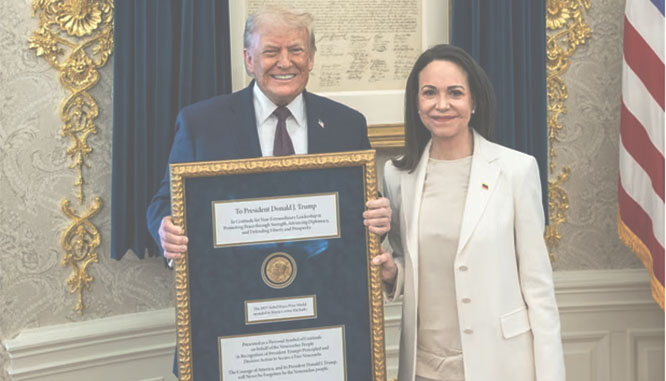
The Nobel Peace Prize is awarded by the independent Norwegian Nobel Committee, not the government. Trump had campaigned for last year’s prize, which went to Venezuelan opposition leader María Corina Machado, who dedicated her award to him.

Støre reiterated that the Nobel Prize decision rests solely with the committee.

Comments

Add new comment

  • Coastaldigest.com reserves the right to delete or block any comments.
  • Coastaldigset.com is not responsible for its readers’ comments.
  • Comments that are abusive, incendiary or irrelevant are strictly prohibited.
  • Please use a genuine email ID and provide your name to avoid reject.