



US Clears $930 Million Deal To Sell 6 Apache Helicopters To India

Agencies
June 13, 2018

Washington, Jun 13:The United States government has approved a deal to sell the Indian military six AH-64E Apache attack helicopters for $930 million, the State Department said Tuesday.

The agreement has been passed to the US Congress for approval, but if no US lawmaker raises an objection the contract is expected to go ahead.

Boeing and Indian partner Tata have begun to produce Apache fuselages at a plant in India, but Tuesday's approval concerns a direct sale of finished products from US manufacturers.

The lead contractors are US arms, aviations and engineering giants Lockheed Martin, General Electric and Raytheon.

In addition to aircraft, the contract includes night vision sensors, GPS guidance and hundreds of Hellfire anti-armor and Stinger air-to-air missiles.

"This support for the AH-64E will provide an increase in India's defensive capability to counter ground-armored threats and modernize its armed forces," the US Defense Security Cooperation Agency said, in a statement.

"India will have no difficulty absorbing the helicopters and support equipment into its armed forces. The proposed sale of this equipment and support will not alter the basic military balance in the region."

Comments

Add new comment

  • Coastaldigest.com reserves the right to delete or block any comments.
  • Coastaldigset.com is not responsible for its readers’ comments.
  • Comments that are abusive, incendiary or irrelevant are strictly prohibited.
  • Please use a genuine email ID and provide your name to avoid reject.
News Network
December 7,2025

envoy.jpg

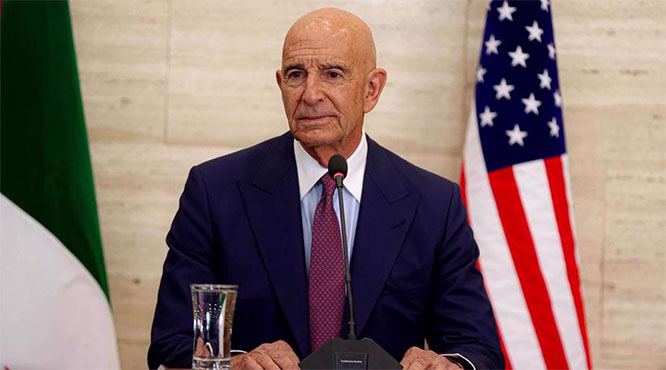
Since 1946, the United States has attempted 93 coups or “regime change” operations across the world — including two in Iran, US Special Envoy for Syria Tom Barrack has admitted.

Speaking to the UAE-based IMI Media Group, in remarks published by The National, Barrack said Washington tried twice to overthrow the Iranian government but failed both times. 

“For (Trump) then to be imputed with regime change — we had two regime changes in Iran already. Neither one worked. So I think wisely leave it to the region to solve,” said Barrack, who also serves as the US ambassador to Turkey.

His comments come six months after the US joined Israel in airstrikes against Iran during ongoing indirect nuclear negotiations between Tehran and Washington.

On June 13, Israel launched an attack on Iran that killed at least 1,064 people and hit civilian infrastructure. Days later, the United States targeted three nuclear facilities — Fordow, Natanz and Isfahan — in what Iran called a clear violation of international law. Iranian retaliation eventually forced a halt to the assault on June 24.

Barrack further claimed that US President Donald Trump and Foreign Secretary Marco Rubio are “not into regime change” and prefer a regional approach driven by Middle Eastern countries themselves. According to him, regional dialogue and non-interference by outside powers offer a more durable path forward.

He added that Washington is still open to an agreement with Tehran if Iranian authorities show “seriousness” and willingness to engage constructively.

However, Iran maintains the US has not shown readiness for meaningful talks. In an interview with Japan’s Kyodo News, Iranian Foreign Minister Abbas Araghchi said negotiations could advance only if Washington acknowledges Iran’s right to peaceful nuclear energy and lifts unilateral sanctions.

Comments

Add new comment

  • Coastaldigest.com reserves the right to delete or block any comments.
  • Coastaldigset.com is not responsible for its readers’ comments.
  • Comments that are abusive, incendiary or irrelevant are strictly prohibited.
  • Please use a genuine email ID and provide your name to avoid reject.
News Network
December 6,2025

pilot.jpg

New Delhi: IndiGo, India’s largest airline, faced major operational turbulence this week after failing to prepare for new pilot-fatigue regulations issued by the Directorate General of Civil Aviation (DGCA). The stricter rules—designed to improve flight safety—took effect in phases through 2024, with the latest implementation on November 1. IndiGo has acknowledged that inadequate roster planning led to widespread cancellations and delays.

Below are the key DGCA rules that affected IndiGo’s operations:

1. Longer Mandatory Weekly Rest

Weekly rest for pilots has been increased from 36 hours to 48 hours.

The government says the extended break is essential to curb cumulative fatigue. This rule remains in force despite the current crisis.

2. Cap on Night Landings

Pilots can now perform only two night landings per week—a steep reduction from the earlier limit of six.

Night hours, defined as midnight to early morning, are considered the least alert period for pilots.

Given the disruptions, this rule has been temporarily relaxed for IndiGo until February 10.

3. Reduced Maximum Night Flight Duty

Flight duty that stretches into the night is now capped at 10 hours.

This measure has also been kept on hold for IndiGo until February 10 to stabilize operations.

4. Weekly Rest Cannot Be Replaced With Personal Leave

Airlines can no longer count a pilot’s personal leave as part of the mandatory 48-hour rest.

Pilots say this closes a loophole that previously reduced actual rest time.

Currently, all airlines are exempt from this rule to normalise travel.

5. Mandatory Fatigue Monitoring

Airlines must submit quarterly fatigue reports along with corrective actions to DGCA.

This system aims to create a transparent fatigue-tracking framework across the industry.

The DGCA has stressed that these rules were crafted to strengthen flight safety and align India with global fatigue-management standards. The temporary relaxations are expected to remain until February 2025, giving IndiGo time to stabilise its schedules and restore normal air travel.

Comments

Add new comment

  • Coastaldigest.com reserves the right to delete or block any comments.
  • Coastaldigset.com is not responsible for its readers’ comments.
  • Comments that are abusive, incendiary or irrelevant are strictly prohibited.
  • Please use a genuine email ID and provide your name to avoid reject.
News Network
December 19,2025

Mangaluru: Public transport in Mangaluru is set for a state-led transformation as the government moves to deploy 100 new electric govt buses to replace unreliable private services. The initiative aims to provide a dependable alternative to private operators who have been frequently "cutting trips," leaving thousands of commuters stranded.

The announcement was made by Deputy Commissioner and MCC Administrator Darshan HV during a public phone-in session. The move specifically targets routes where private bus service has become erratic, ensuring that citizens no longer have to rely on a fluctuating private sector for their daily commute.

Restoring the Govt Presence

The transport crisis was brought to the forefront by Ramayya, a resident of Bajal, who highlighted a growing trend of private buses skipping morning and night trips. With the previous KSRTC (govt) services discontinued, residents have been left without a fallback option.

To fix this, the DC confirmed that the PM-eBus Sewa Scheme will bring 100 government-owned electric buses to the city:

•    Phased Deployment: The first 50 of the new 100 government buses are scheduled to arrive by March 2026.

•    State Infrastructure: Two new government depots, including one at Mudipu, are being prepared for operations.

•    Recruitment: The state has already begun training a new batch of government bus drivers to ensure the fleet is operational the moment it arrives.

Comments

Add new comment

  • Coastaldigest.com reserves the right to delete or block any comments.
  • Coastaldigset.com is not responsible for its readers’ comments.
  • Comments that are abusive, incendiary or irrelevant are strictly prohibited.
  • Please use a genuine email ID and provide your name to avoid reject.
