Vajpayee - pragmatist, orator and statesman who went beyond BJP's nationalist political agenda

Agencies
August 16, 2018

New Delhi, Aug 16: Statesman and pragmatist, orator and poet, a man of peace and conviction. Atal Bihari Vajpayee was a towering nationalist who softened the often sharp edge of his party's politics with a gentle sophistry of words, earning him the sobriquet "ajaat shatru" or the man with no enemies.

The first prime minister from a non-Congress party to complete a full term in office, Vajpayee began shakily -- his first stint as prime minister in 1996 lasted only 13 days when his unlikely coalition government failed to get support from other parties. The BJP-led coalition government came back to power in 1998, and this time Vajpayee stayed in office for 13 months before losing a no-confidence motion by one vote.

The National Democratic Alliance returned to power in October 1999 with Vajpayee as prime minister once again. This time he lasted the entire term, capping a glorious career that saw him go from student activist to journalist, Rashtriya Swayamsewak Sangh pracharak, Member of Parliament, foreign minister, opposition leader and finally a much-loved leader of the nation.

Like many of his generation, Vajpayee _ who died today at age 93 _ came into politics as an 18-year old during the Independence movement in 1942 when the Quit India movement was going on.

A lifelong bachelor, Vajpayee was first elected to Lok Sabha in 1957 from Balrampur in Uttar Pradesh in India's second general elections. His maiden speech in Parliament so impressed his peers and colleagues that the then Prime Minister Jawaharlal Nehru introduced Vajpayee to a visiting foreign dignitary thus: "This young man one day will become the country's prime minister." 

He remained a member of Parliament for 47 years -- elected 10 times to the Lok Sabha and twice to Rajya Sabha.

Vajpayee's signature in politics was achieving pragmatic consensus, and in this process he earned the respect of his party, allies and opponents. Abroad, he projected a harmonious image of India and connected it to the world through his foreign policy outreach.

Fluent in English, his oratory was at its best in Hindi. With his well-timed wit, and carefully-chosen words delivered with trademark long pauses, Vajpayee immediately connected with all those who came in contact with him -- the common man, politicians, bureaucrats, students and world leaders.

As foreign minister under the Janata Party government headed by Morarji Desai in 1977, Vajpayee was the first leader to deliver a speech to the United Nations General Assembly in Hindi.

He was awarded India's highest civilian award, the Bharat Ratna, in March 2015. 

While his six years in office were defined by several crises _ including the hijacking of an Indian Airlines jetliner to Kandahar, Afghanistan in 1999, an attack on the Parliament building in 2001, communal riots in Gujarat in 2002 _ he also left a mark with peace initiatives and infrastructural projects. Chief among them is the Golden Quadrilateral Highway network, connecting India's four major metropolises with 5,846 kilometers of roads. 

During his second term as prime minister, Vajpayee ordered nuclear tests in May 1998 in a strategic masterstroke to blunt Pakistan's nuclear ambitions while at the same time announcing a moratorium on future testing. He followed this up with peace overtures to Pakistan, riding on the first direct bus from India to Pakistan in February 1999.

Undeterred by party hawks, Vajpayee arrived in Lahore on the bus, accompanied among others by legendary actor Dev Anand. Vajpayee met with then Prime Minister Nawaz Sharif in what was hailed as the dawn of a new era in India-Pakistan relations.

However, then army chief Gen. Pervez Musharraf did not turn up to greet him at the Wagah border. It soon became clear why.

Only months later, in June 1999, Pakistan began hostilities in Kargil that took the two countries to the brink of a full-scale war. Vajpayee felt betrayed and never hid his bitterness whenever Kargil was mentioned. He tried again to build peace with Pakistan -- which people close to him say was the mission of his life -- by holding a historic summit in Agra with Musharraf in 2001, who by then had become the president. But the summit too failed spectacularly.

Another historic event that he expressed anguish about was the post-Godhra communal riots in Gujarat in 2002 when Prime minister Narendra Modi was the chief minister.

Unwilling to hide his feelings over the riots, Prime Minister Vajpayee said the government must follow "raj dharma". In his autobiography, former President Pranab Mukherjee wrote that the Gujarat riots were "possibly the biggest blot" on Vajpayee's government that could have cost the Bharatiya Janata Party the 2004 Lok Sabha elections.

After the NDA was routed in the elections, Vajpayee announced his retirement from politics in 2005 and slipped into relative political oblivion. He was rarely seen in public after suffering a stroke in 2009, and subsequently developed dementia. However, his influence loomed large over the party, which often quoted him and his policies. 

In his Independence Day speech yesterday, Modi said he wants to resolve the Kashmir issue through Vajpayee's doctrine of "Insaniyat, Kashmiriyat, Jamhooriyat", which seeks to preserve the composite Kashmiri culture while ensuring democracy in a humane manner. 

When he assumed office for the second time in 1999 as the head of a more stable coalition, Vajpayee had to abandon some of the cornerstones of BJP's policies to get the backing of more secular groups. This included the BJP's demands for scrapping the special status for Jammu and Kashmir, building a Hindu temple on the site of the Babri mosque in Ayodhya and abolishing the separate civil code for Muslims.

The demolition of Babri Masjid by kar sewaks in December 1992, when he was the Leader of Opposition in Lok Sabha, was an acid test for Vajpayee's secular agenda and his stand within the party. Vajpayee's trusted lieutenant L K Advani and most BJP politicians supported the demolition but Vajpayee condemned the attack unequivocally.

At times he tried to appeal to Muslims and other minority groups, and was seen as a reassuring figure for India's mainly secular establishment.

His personal integrity was never seriously questioned but arms bribery scandals exposed corruption in his government and at times cast doubts on his judgment.

A romantic at heart, Vajpayee wrote poetry in his spare time, and was a connoisseur of good food.

Vajpayee was born on December 25, 1924 in Gwalior, Madhya Pradesh to a schoolteacher, Krishna Bihari Vajpayee, and Krishna Devi. Today, his birthday is celebrated as Good Governance Day'.

After schooling, he graduated from Victoria College in Gwalior, now known as Laxmi Bai College. He did his M.A. in political science from DAV College in Kanpur. Following a brief flirtation with communism, he became a full-time worker of RSS in 1947.

Vajpayee subsequently entered journalism and was editor of Rashtradharma, a Hindi monthly, the Panchjanya Hindi weekly and the dailies, Swadesh and Veer Arjun.

He became a close follower of Syama Prasad Mookerjee, the founder of the Bharatiya Jana Sangh, the precursor to Jana Sangh and later the BJP. Under Mookerjee's tutelage, Vajpayee's right-wing philosophy shaped. 

Vajpayee accompanied Mookerjee to Kashmir in early 1950s during the BJS leader's fast-unto-death to protest the identity card requirement for Indian citizens visiting the state. It was Vajpayee's first insight into the Kashmir problem, which decades later he addressed in 2003 with the "Insaniyat, Kashmiriyat, Jamhooriyat" doctrine. 

Vajpayee is survived by his adopted daughter, Namita Kaul Bhattacharya

Comments

Add new comment

  • Coastaldigest.com reserves the right to delete or block any comments.
  • Coastaldigset.com is not responsible for its readers’ comments.
  • Comments that are abusive, incendiary or irrelevant are strictly prohibited.
  • Please use a genuine email ID and provide your name to avoid reject.
News Network
December 22,2025

bhagavat.jpg

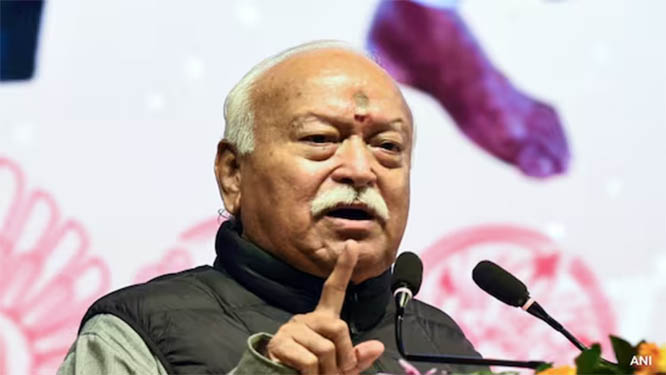
Kolkata: Stressing that India is a "Hindu nation," Rashtriya Swayamsevak Sangh (RSS) Chief Mohan Bhagwat on Sunday said that no constitutional approval is needed as it is the "truth".

Addressing an event marking 100 years of the RSS, Bhagwat said that India is, and will remain, a Hindu nation until Indian culture is appreciated in the country.

"The Sun rises in the east; we don't know since when this has been happening. So, do we need constitutional approval for that, too? Hindustan is a Hindu nation. Whoever considers India their motherland appreciates Indian culture, as long as there is even one person alive on the land of Hindustan who believes in and cherishes the glory of Indian ancestors, India is a Hindu nation. This is the ideology of the Sangh," he said at the '100 Vyakhyan Mala' program of RSS in Kolkata.

"If Parliament ever decides to amend the Constitution and add that word, whether they do it or not, it's fine. We don't care about that word because we are Hindus, and our nation is a Hindu nation. That is the truth. The caste system based on birth is not the hallmark of Hindutva," he added.

RSS has always argued that India is a "Hindu Nation," given the culture and majority's affiliations to Hinduism. However, 'secular' was not originally part of the Preamble of the Constitution, but it was added along with the word 'socialist' by the Constitution (42nd Amendment) Act, 1976, during the Emergency imposed by then Prime Minister Indira Gandhi.

Bhagwat also urged people to visit the organisation's offices and 'shakhas' to understand its work, so that what he dubbed as the “false perception” of the organisation as anti-Muslim can be dispelled!

Bhagwat said that people have understood that the organisation advocates for the protection of Hindus, and are "staunch nationalists," but not anti-muslim.

"If there is a perception that we are anti-Muslim, then, as I said, the RSS work is transparent. You can come anytime and see for yourself, and if you see anything like that happening, then you keep your views, and if you don't see it, then you change your views. There is a lot to understand (about RSS), but if you don't want to understand, then no one can change your mind," Bhagwat said.

He said, but anyone unwilling to learn cannot be helped.

"After seeing, people have said that you are staunch nationalists. You organise Hindus, and you advocate for the protection of Hindus. But you are not anti-Muslim. Many people have accepted this, and those who want to know more should come and see the RSS for themselves," he said.

Comments

Add new comment

  • Coastaldigest.com reserves the right to delete or block any comments.
  • Coastaldigset.com is not responsible for its readers’ comments.
  • Comments that are abusive, incendiary or irrelevant are strictly prohibited.
  • Please use a genuine email ID and provide your name to avoid reject.
News Network
December 21,2025

hadith.jpg

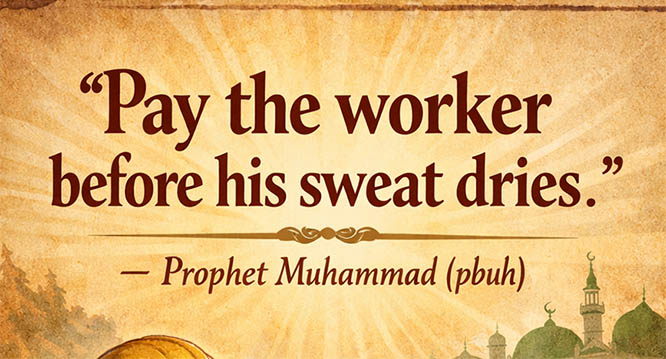
Invoking the teachings of Prophet Muhammad—“pay the worker before his sweat dries”—the Madras High Court has directed a municipal corporation to settle long-pending legal dues owed to a former counsel. The court observed that this principle reflects basic fairness and applies equally to labour and service-related disputes.

Justice G. R. Swaminathan made the observation while hearing a petition filed by advocate P. Thirumalai, who claimed that the Madurai City Municipal Corporation failed to pay him legal fees amounting to ₹13.05 lakh. Earlier, the High Court had asked the corporation to consider his representation. However, a later order rejected a major portion of his claim, prompting the present petition.

The court allowed Thirumalai to approach the District Legal Services Authority (DLSA) and submit a list of cases in which he had appeared. It also directed the corporation to settle the verified fee bills within two months, without interest. The court noted that the petitioner had waited nearly 18 years before challenging the non-payment and that the corporation could not be fully blamed, as the fee bills were not submitted properly.

‘A Matter of Embarrassment’

Justice Swaminathan described it as a “matter of embarrassment” that the State has nearly a dozen Additional Advocate Generals. He observed that appointing too many law officers often leads to unnecessary allocation of work and frequent adjournments, as government counsel claim that senior officers are engaged elsewhere.

He expressed hope that such practices would end at least in the Madurai Bench of the High Court and added that Additional Advocate Generals should “turn a new leaf” from 2026 onwards.

‘Scandalously High Amounts’

While stating that the court cannot examine the exact fees paid to senior counsel or law officers, Justice Swaminathan stressed that good governance requires public funds to be used prudently. He expressed concern over the “scandalously high amounts” paid by government and quasi-government bodies to a few favoured law officers.

In contrast, the court noted that Thirumalai’s total claim was “a pittance” considering the large number of cases he had handled.

Background

Thirumalai served as the standing counsel for the Madurai City Municipal Corporation for more than 14 years, from 1992 to 2006. During this period, he represented the corporation in about 818 cases before the Madurai District Courts.

As the former counsel was unable to hire a clerk to obtain certified copies of judgments in all 818 cases, the court directed the District Legal Services Authority to collect the certified copies within two months. The court further ordered the corporation to bear the cost incurred by the DLSA and deduct that amount from the final settlement payable to the petitioner.

Comments

Add new comment

  • Coastaldigest.com reserves the right to delete or block any comments.
  • Coastaldigset.com is not responsible for its readers’ comments.
  • Comments that are abusive, incendiary or irrelevant are strictly prohibited.
  • Please use a genuine email ID and provide your name to avoid reject.
News Network
December 13,2025

New Delhi: School-going children are picking up drug and smoking habits and engaging in consumption of alcohol, with the average age of introduction to such harmful substances found to be around 13 years, suggesting a need for earlier interventions as early as primary school, a multi-city survey by AIIMS-Delhi said.

The findings also showed substance use increased in higher grades, with grade XI/XII students two times more likely to report use of substances when compared with grade VIII students. This emphasised the importance of continued prevention and intervention through middle and high school.

The study led by Dr Anju Dhawan of AIIMS's National Drug Dependence Treatment Centre, published in the National Medical Journal of India this month, looks at adolescent substance use across diverse regions.

The survey included 5,920 students from classes 8, 9, 11 and 12 in urban government, private and rural schools across 10 cities -- Bengaluru, Chandigarh, Delhi, Dibrugarh, Hyderabad, Imphal, Jammu, Lucknow, Mumbai, and Ranchi. The data were collected between May 2018 and June 2019.

The average age of initiation for any substance was 12.9 (2.8) years. It was lowest for inhalants (11.3 years) followed by heroin (12.3 years) and opioid pharmaceuticals (without prescription; 12.5 years).

Overall, 15.1 per cent of participants reported lifetime use, 10.3 per cent reported past year use, and 7.2 per cent reported use in the past month of any substance, the study found.

The most common substances used in the past year, after tobacco (4 per cent) and alcohol (3.8 per cent), were opioids (2.8 per cent), followed by cannabis (2 per cent) and inhalants (1.9 per cent). Use of non-prescribed pharmaceutical opioids was most common among opioid users (90.2 per cent).

On being asked, 'Do you think this substance is easily available for a person of your age' separately for each substance category, nearly half the students (46.3 per cent) endorsed that tobacco products and more than one-third of the students (36.5 per cent) agreed that a person of their age can easily procure alcohol products.

Similarly, for Bhang (21.9 per cent), ganja/charas (16.1 per cent), inhalants (15.2 per cent), sedatives (13.7 per cent), opium and heroin (10 per cent each), the students endorsed that these can be easily procured.

About 95 per cent of the children, irrespective of their grade, agreed with the statement that 'drug use is harmful'.

The rates of substance use (any) among boys were significantly higher than those of girls for substance use (ever), use in the past year and use in the past 30 days. Compared to grade VIII students, grade IX students were more likely, and grade XI/XII students were twice as likely to have used any substance (ever).

The likelihood of past-year use of any substance was also higher for grade IX students and for grade XI/XII students as compared to grade VIII students.

About 40 per cent of students mentioned that they had a family member who used tobacco or alcohol each. The use of cannabis (any product) and opioid (any product) by a family member was reported by 8.2 per cent and 3.9 per cent of students, respectively, while the use of other substances, such as inhalants/sedatives by family was 2-3 per cent, the study found.

A relatively smaller percentage of students reported use of tobacco or alcohol among peers as compared to among family members, while a higher percentage reported inhalants, sedatives, cannabis or opioid use among peers.

Children using substances (past year) compared to non-users reported significantly higher any substance use by their family members and peers.

There were 25.7 per cent students who replied 'yes' to the question 'conflicts/fights often occur in your family'. Most students also replied affirmatively to 'family members are aware of how their time is being spent' and 'damily members are aware of with whom they spend their time'.

Comments

Add new comment

  • Coastaldigest.com reserves the right to delete or block any comments.
  • Coastaldigset.com is not responsible for its readers’ comments.
  • Comments that are abusive, incendiary or irrelevant are strictly prohibited.
  • Please use a genuine email ID and provide your name to avoid reject.