


By the way, are Adivasis Hindus?

Ram Puniyani
February 13, 2020

Forthcoming Census and RSS campaign

Currently massive protests are going on against NPR, NCR and CAA. At the same time we are going to begin the process of decadal census in 2021. Already RSS is active in promoting NPR, NCR and CAA. At the same time RSS wants that Adivasis should register themselves as Hindus rather than ticking the column of ‘Others’. As per their spokesperson in the 2011 census many Adivasis groups ticked that column because of which the population of Hindus came down to by 0.7 percent point to come down to 79.8 %. This has sent signals to this Hindu nationalist organization and is planning to ensures that Adivasis tick the column of Hindus in this census.

As such RSS has a very clever attitude in defining the term Hindu. The first formulation was by Savakakar who said that all those who regard the land east of Indus as their Holy land and Father land are Hindus. This left out Muslims and Christians, and brought all others in the ambit of Hindu fold. From the decade of 1980s due to electoral compulsions they have been trying to articulate that all those who are living in India are Hindus. Murli Manohar Joshi stated that Muslims are Ahmadiya Hindus and Christians are Christi Hindus. Recently there was a controversy when they restated that Sikhs are not a separate religion but are a sect of Hinduism. Many Sikh organizations stood up to say that Sikhism is a religion by itself and recalled the book of Kahan Singh Nabha, “Hum Hindu Nahin”

As far as Adivasis are concerned in contrast to what is being planned by Hindu nationalist RSS, many Adivasis groups have been meeting from last couple of years to demand just the contrary. As per them there should be a column where they can tick their identity of Adivasis.  There are active campaigns among Adivasis groups to uphold their Adivasi identity in Census. As per them in the first census which was conducted in Independent India, the column, Aborigines, was there, which was later removed forcing them to club themselves with other religions.

After 1951 in addition to Hindu, Muslim, Sikh, Christian, Jain and Buddha, the column ‘others’ was also there which was removed in 2011. Even during British period if you look at the censuses of the British era (from 1871 to 1931); there was provision for tribes to choose Aborigine as an option. There are nearly 83 religious practices being followed by Adivasis. Few major of these are Sarna, Gondi, Punem, Adi, and Koya. What they share in common is that they are animists, worship nature and spirit of ancestors; do not have priestly class or Holy Scriptures and Gods and Goddesses characteristic of the broad Hindu pantheon.

RSS as per its political agenda of Hindu Nation regards them as Vanvasi. They pontificate that they have been part of Hindu society who were driven away to forests to escape the forcible conversion being done by the Muslim invaders. This concoction is contrary to the interpretations based on the studies from population genetics. The Hindu nationalist argues that Aryans have been the original inhabitants of the country from where they spread to other parts of the World. The book by Tony Joseph, ‘Early Indians’ tells us that away from the race theory, we are all mixed up. The first inhabitants in our land were the ones who emigrated from South Asia over Sixty thousand years ago.

The Indo-Aryans came here nearly three thousand years ago and they pushed the aborigines to the forests and hills and that’s what constitutes the Adivasi community of India.

Hindu Nationalists like all the nationalists who construct their nationalism around their religion claim to be the most original inhabitants of the land, and their interpretations of past are molded according to that. RSS right from beginning has not been using the word Adivasi, it calls them Vanvasi. As per its agenda it wants them to be part of Hindu fold, despite Adivasis themselves saying that they are not Hindus, they have beliefs and practices which are far away from Hinduism in whatever form.

To enhance its political reach from the decades of 1980s in particular its work in Adivasis areas has been intensified. While ‘Vanvasis Kalyan Ashram’, part of RSS Combine which was formed much earlier, it was in the decades of 1980s that their work was jacked up by sending more Pracharaks in Adivasi areas. We see that in Gujarat, Dangs and nearby area, Swami Aseemanand, in MP, centered around Jhabua-the followers of Asaram Bapu and in Orissa Swami Laxmananad stationed them. They saw Christian missionaries working in the field of education and health as an obstacle to Hinduization of Adivasis. Their propaganda against Christian missionaries led to the ghastly murder of Pastor Graham Stains. It was this propaganda which led to anti Christian violence in various forms, the most horrific being the Kandhamal violence of 2008.

In order to culturally co-opt them into the fold of Hinduism they began series of religious congregations, Kumbhs. Shabri Kumbh in Dangs and many other Adivasis predominant areas created an atmosphere of fear, Adivasis were asked to be part of it, saffron flags were distributed and they were made to put it in their houses. Two religious icons were popularized in these areas, one was Shabri and other was Hanuman. To cap it all, Ekal Vidyalayas, started spreading RSS’s interpretation of history in these areas. The other angle of the whole thing is that Adivasis are living in the areas rich in minerals, which the BJP supporter Corporate World wants to take over.

World over aborigines have similar pattern. They are animists and what they practice is a culture as such. Many have converted to other religions out of their choice for sure, but finally in these matters what is important is the self perception. Hemant Soren the Chief Minister of Jharkhand pointed out that “Adivasis are not Hindus. ”Keeping that in mind; the column of Aborigines needs to find its place in our census forms.

Comments

Add new comment

  • Coastaldigest.com reserves the right to delete or block any comments.
  • Coastaldigset.com is not responsible for its readers’ comments.
  • Comments that are abusive, incendiary or irrelevant are strictly prohibited.
  • Please use a genuine email ID and provide your name to avoid reject.
coastaldigest.com news network
January 19,2026

badriya.jpg

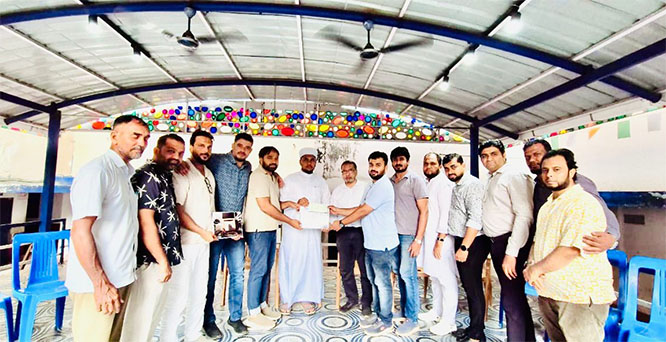
Mangaluru: The Phase I project of Badria Vision 2028 was formally launched at a ceremony held at the Badria Campus on January 17, marking an important step in the institution’s long-term development roadmap.

The programme was attended by P.B. Abdul Hameed, Secretary of the MEA, and P.C. Hasir, Correspondent of the MEA, who presided over the event and underscored the institution’s commitment to growth and academic excellence.

Office-bearers of the Badria Alumni Association were present in large numbers, including A.K. Sajid (President), Shamsuddin and S.M. Farooq (Vice-Presidents), Shaheed (General Secretary), and Khaleel (Treasurer), reflecting strong alumni engagement in the initiative.

The gathering was blessed by Sayyid Shamsuddeen Basith Thangal Kukkaje, Qateeb of Zeenat Yatheem Bakshi, who led a special dua seeking divine guidance and success for the project.

The ceremony also witnessed the participation of prominent alumnus and local corporate professional Abdul Latheef, along with alumni members Naushad, Kalandar, Safwan, members of the core committee, and several other former students.

A key moment of the event was the formal handover of a cheque to Ameen Woodland Architect, signalling the immediate commencement of construction work under Phase I of the project.

Organisers said the launch of Phase I reflects a shared vision, institutional unity, and collective resolve to realise the objectives of Badria Vision 2028.

Comments

Add new comment

  • Coastaldigest.com reserves the right to delete or block any comments.
  • Coastaldigset.com is not responsible for its readers’ comments.
  • Comments that are abusive, incendiary or irrelevant are strictly prohibited.
  • Please use a genuine email ID and provide your name to avoid reject.
News Network
January 23,2026

Karnataka Governor Thaawarchand Gehlot read only three lines from the 122-paragraph address prepared by the Congress-led state government while addressing the joint session of the Legislature on Thursday, effectively bypassing large sections critical of the BJP-led Union government.

The omitted portions of the customary Governor’s address outlined what the state government described as a “suppressive situation in economic and policy matters” under India’s federal framework. The speech also sharply criticised the Centre’s move to replace the Mahatma Gandhi National Rural Employment Guarantee Act (MGNREGA) with the Viksit Bharat–Guarantee for Rozgar and Ajeevika Mission (Gramin) Act, commonly referred to as the VB-GRAM (G) Act.

Governor Gehlot had earlier conveyed his objection to several paragraphs that were explicitly critical of the Union government. On Thursday, he confined himself to the opening lines — “I extend a warm welcome to all of you to the joint session of the State legislature. I am extremely pleased to address this august House” — before jumping directly to the concluding sentence of the final paragraph.

He ended the address by reading the last line of paragraph 122: “Overall, my government is firmly committed to doubling the pace of the State’s economic, social and physical development. Jai Hind — Jai Karnataka.”

According to the prepared speech, the Karnataka government demanded the scrapping of the VB-GRAM (G) Act, describing it as “contractor-centric” and detrimental to rural livelihoods, and called for the full restoration of MGNREGA. The state government argued that the new law undermines decentralisation, weakens labour protections, and centralises decision-making in violation of constitutional norms.

Key points from the unread sections of the speech:

•    Karnataka facing a “suppressive” economic and policy environment within the federal system

•    Repeal of MGNREGA described as a blow to rural livelihoods

•    VB-GRAM (G) Act accused of protecting corporate and contractor interests

•    New law alleged to weaken decentralised governance

•    Decision-making said to be imposed by the Centre without consulting states

•    Rights of Adivasis, women, backward classes and agrarian communities curtailed

•    Labourers allegedly placed under contractor control

•    States facing mounting fiscal stress due to central policies

•    VB-GRAM (G) Act accused of enabling large-scale corruption

Comments

Add new comment

  • Coastaldigest.com reserves the right to delete or block any comments.
  • Coastaldigset.com is not responsible for its readers’ comments.
  • Comments that are abusive, incendiary or irrelevant are strictly prohibited.
  • Please use a genuine email ID and provide your name to avoid reject.
News Network
January 23,2026

Mangaluru: The Karnataka Government Polytechnic (KPT), Mangaluru, has achieved autonomous status from the All India Council for Technical Education (AICTE), becoming the first government polytechnic in the country to receive such recognition in its 78-year history. The status was granted by AICTE, New Delhi, and subsequently approved by the Karnataka Board of Technical Education in October last year.

Officials said the autonomy was conferred a few months ago. Until recently, AICTE extended autonomous status only to engineering colleges, excluding diploma institutions. However, with a renewed national focus on skill development, several government polytechnics across India have now been granted autonomy.

KPT, the second-largest polytechnic in Karnataka, was established in 1946 with four branches and has since expanded to offer eight diploma programmes, including computer science and polymer technology. The institution is spread across a 19-acre campus.

Ravindra M Keni, the first dean of the institution, told The Times of India that AICTE had proposed autonomous status for polytechnic institutions that are over 25 years old. “Many colleges applied. In the first round, 100 institutions were shortlisted, which was further narrowed down to 15 in the second round. We have already completed one semester after becoming an autonomous institution,” he said. He added that nearly 500 students are admitted annually across eight three-year diploma courses.

Explaining the factors that helped KPT secure autonomy, Keni said the institution has consistently recorded 100 per cent admissions and placements for its graduates. He also noted its strong performance in sports, with the college emerging champions for 12 consecutive years, along with active student participation in NCC and NSS activities.

Autonomous status allows KPT to design industry-oriented curricula, conduct examinations, prepare question papers, and manage academic documentation independently. The institution can also directly collaborate with industries and receive priority funding from AICTE or the Ministry of Education. While academic autonomy has been granted, financial control will continue to rest with the state government.

“There will be separate committees for examinations, question paper setting, boards of studies, and boards of examiners. The institution will now have the freedom to conduct admissions without government notifications and issue its own marks cards,” Keni said, adding that new academic initiatives would be planned after a year of functioning under the autonomous framework.

Comments

Add new comment

  • Coastaldigest.com reserves the right to delete or block any comments.
  • Coastaldigset.com is not responsible for its readers’ comments.
  • Comments that are abusive, incendiary or irrelevant are strictly prohibited.
  • Please use a genuine email ID and provide your name to avoid reject.