



West Bengal government plans new law to tackle fake news on social media

Agencies
June 15, 2018

Kolkata, Jun 15: The West Bengal government is working on a new law to tackle the menace of fake news and posts on social media, a move which comes against the backdrop of such posts stirring trouble and unrest in many parts of the country.

A Home Department official told PTI that the state government intends to bring more clarity on the nature of the offence and punishment for those responsible for spreading fake news and posting morphed photographs with an aim to disrupt peace and communal harmony or spread hatred in society.

The state government has been preparing a data bank on fake news circulated on social media in West Bengal and other parts of the country in the past couple of years besides, keeping records of past offenders while framing the new law, he said.

The new legislation comes after several reports of fake news circulation surfacing in the state during the last couple of years. The recent incidents in Shillong, Godda in Jharkhand and Karbi Anglong district of Assam have added to the concern.

Fake news, morphed photographs, pictorial representation and write-ups posted on social networking sites could have major implications which can create unrest among the people and require strict law to deal with it, the officer said.

“There are several incidents in recent times when posts on social media had major implications. Different sections of the Indian Penal Code (IPC) are used to deal with cases depending on the nature of the crime or intent of the posts.

But the state government is trying to formulate a law for strict actions against persons or the organisation found guilty of such activities,” he said.

Currently, in West Bengal people who are found responsible for posting fake news and morphed photographs with the intent of causing fear or alarm among the public or commit an offence against the state or against public tranquillity are booked under Sections 505(1)(b) of the Indian Penal Code (IPC), he said.

The IPC section 505(1)(b) punishes those who intent to cause or likely to cause fear or alarm among the public, or any section of the public whereby any person may be induced to commit an offence against the State or against the public tranquillity.

The IPC section 504 is also applied for cases where “intentional insult with intent to provoke breach of peace” are found.

In the process of the drafting the law, the state government is taking assistance from the West Bengal Police.

Police have identified several paid Twitter handles and Facebook accounts which are constantly being used in different manner for such posts, he said.

“They have also identified how funds are routed through different channels to pay these people who were handling fake Twitter handle and Facebook accounts and sharing fake news, photographs, pictorial representations and articles,” he said.

“But we need to find out whether the posts are made deliberately or inadvertently. We also need to find out whether the posts are made only for fun or there is any wrongful gain by the person. We have to find out the motive of the person and depending on that he would be charged,” he said.

Last July, the state police had arrested Bhabatosh Chatterjee from Sonarpur in South 24 Parganas district for his alleged involvement in inciting communal violence at a time when incidents of clashes were reported from Basirhat. Police found that Chatterjee had allegedly uploaded a still of a Bhojpuri film showing a man forcibly pulling a woman’s saree and claiming it to have happened in Basirhat and Baduria in July last.

Last week also, a fake notification purportedly issued by the state finance department on a letterhead with the Biswa Bangla logo stating that the state government has declared holidays for five days, from June 12 to June 16, to celebrate the Eid festival, started doing the rounds. Declaring it to be fake, the Kolkata Police started a probe into the matter.

“A separate law for this purpose will help us in dealing with posts on social networking sites violating norms and disturbing harmony in society. This will give us a clarity in understanding the nature of crime or the intention of the person responsible for his or her posts as well as bringing charges against him,” he said.

Comments

Add new comment

  • Coastaldigest.com reserves the right to delete or block any comments.
  • Coastaldigset.com is not responsible for its readers’ comments.
  • Comments that are abusive, incendiary or irrelevant are strictly prohibited.
  • Please use a genuine email ID and provide your name to avoid reject.
News Network
December 5,2025

indigoCEO.jpg

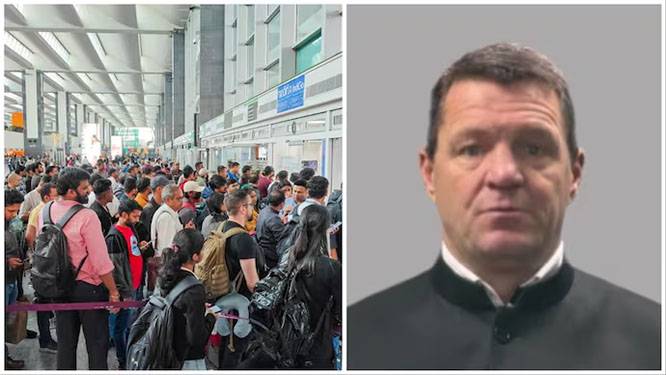
New Delhi, Dec 5: IndiGo CEO Pieter Elbers issued a public apology this evening after more than a thousand flights were cancelled today, making it the "most severely impacted day" in terms of cancellations. The biggest airline of the country cancelled "more than half" of its daily number of flights on Friday, said Elbers. He also said that even though the crisis will persist on Saturday, the airline anticipates fewer than 1,000 flight cancellations.

"Full normalisation is expected between December 10 and 15, though IndiGo cautions that recovery will take time due to the scale of operations," the IndiGo CEO said. 

IndiGo operates around 2,300 domestic and international flights daily.

Pieter Elbers, while apologising for the major inconvenience due to delays and cancellations, said the situation is a result of various causes.

The crisis at IndiGo stems from new regulations that boost pilots' weekly rest requirements by 12 hours to 48 and allow only two night-time landings per week, down from six. IndiGo has attributed the mass cancellations to "misjudgment and planning gaps".

Elbers also listed three lines of action that the airline will adopt to address the issue.

"Firstly, customer communication and addressing your needs, for this, messages have been sent on social media. And just now, a more detailed communication with information, refunds, cancellations and other customer support measures was sent," he said.

The airline has also stepped up its call centre capacity.

"Secondly, due to yesterday's situation, we had customers stranded mostly at the nation's largest airports. Our focus was for all of them to be able to travel today itself, which will be achieved. For this, we also ask customers whose flights are cancelled not to come to the airports as notifications are sent," the CEO said.

"Thirdly, cancellations were made for today to align our crew and planes to be where they need to start tomorrow morning afresh. Earlier measures of the last few days, regrettable, have proven not to be enough, but we have decided today to reboot all our systems and schedules, resulting in the highest numbers of cancellations so far, but imperative for progressive improvements starting from tomorrow," he added.

As airports witnessed chaotic scenes, the Directorate General of Civil Aviation (DGCA) stepped in to grant IndiGo a temporary exemption from stricter night duty rules for pilots. It also allowed substitution of leaves with a weekly rest period. 

Civil Aviation Minister Ram Mohan Naidu has said a high-level inquiry will be ordered and accountability will be fixed.

Comments

Add new comment

  • Coastaldigest.com reserves the right to delete or block any comments.
  • Coastaldigset.com is not responsible for its readers’ comments.
  • Comments that are abusive, incendiary or irrelevant are strictly prohibited.
  • Please use a genuine email ID and provide your name to avoid reject.
News Network
December 6,2025

pilot.jpg

New Delhi: IndiGo, India’s largest airline, faced major operational turbulence this week after failing to prepare for new pilot-fatigue regulations issued by the Directorate General of Civil Aviation (DGCA). The stricter rules—designed to improve flight safety—took effect in phases through 2024, with the latest implementation on November 1. IndiGo has acknowledged that inadequate roster planning led to widespread cancellations and delays.

Below are the key DGCA rules that affected IndiGo’s operations:

1. Longer Mandatory Weekly Rest

Weekly rest for pilots has been increased from 36 hours to 48 hours.

The government says the extended break is essential to curb cumulative fatigue. This rule remains in force despite the current crisis.

2. Cap on Night Landings

Pilots can now perform only two night landings per week—a steep reduction from the earlier limit of six.

Night hours, defined as midnight to early morning, are considered the least alert period for pilots.

Given the disruptions, this rule has been temporarily relaxed for IndiGo until February 10.

3. Reduced Maximum Night Flight Duty

Flight duty that stretches into the night is now capped at 10 hours.

This measure has also been kept on hold for IndiGo until February 10 to stabilize operations.

4. Weekly Rest Cannot Be Replaced With Personal Leave

Airlines can no longer count a pilot’s personal leave as part of the mandatory 48-hour rest.

Pilots say this closes a loophole that previously reduced actual rest time.

Currently, all airlines are exempt from this rule to normalise travel.

5. Mandatory Fatigue Monitoring

Airlines must submit quarterly fatigue reports along with corrective actions to DGCA.

This system aims to create a transparent fatigue-tracking framework across the industry.

The DGCA has stressed that these rules were crafted to strengthen flight safety and align India with global fatigue-management standards. The temporary relaxations are expected to remain until February 2025, giving IndiGo time to stabilise its schedules and restore normal air travel.

Comments

Add new comment

  • Coastaldigest.com reserves the right to delete or block any comments.
  • Coastaldigset.com is not responsible for its readers’ comments.
  • Comments that are abusive, incendiary or irrelevant are strictly prohibited.
  • Please use a genuine email ID and provide your name to avoid reject.
News Network
December 19,2025

Saudi Arabia has abolished fees on expatriate workers employed in licensed industrial establishments, signaling a strong push to empower national factories and enhance the Kingdom’s global industrial competitiveness. The move reflects the leadership’s commitment to building a sustainable and resilient industrial economy under Saudi Vision 2030.

The decision was approved by the Council of Ministers, chaired by Crown Prince and Prime Minister Mohammed bin Salman, following a recommendation from the Council of Economic and Development Affairs (CEDA). It forms part of a broader strategy to support, modernize, and strengthen the industrial sector.

By removing fees on foreign workers, industrial establishments gain greater operational flexibility and relief from financial pressures. This is expected to help factories expand production, improve efficiency, and compete more effectively in international markets, while reinforcing long-term sustainability.

The initiative aligns closely with Saudi Vision 2030, which identifies industry as a key pillar of economic diversification. A competitive and resilient industrial base is viewed as essential for driving innovation, attracting investment, and sustaining long-term economic growth.

Overall, the fee exemption underscores the Kingdom’s commitment to creating a supportive environment for industrial development and ensuring that Saudi factories remain globally competitive and capable of leading the nation’s economic transformation.

Comments

Add new comment

  • Coastaldigest.com reserves the right to delete or block any comments.
  • Coastaldigset.com is not responsible for its readers’ comments.
  • Comments that are abusive, incendiary or irrelevant are strictly prohibited.
  • Please use a genuine email ID and provide your name to avoid reject.
