"When Economy Is In A Tailspin...": Abhijit Banerjee Advises Government

Agencies
October 15, 2019

New York, Oct 15: Indian-American Abhijit Banerjee, who jointly won the 2019 Nobel Economics Prize with his wife Esther Duflo and Harvard's Michael Kremer, said on Monday that the Indian economy is "doing very badly" even as the government is increasingly recognising that there is a problem.

"The economy is doing very badly in my view," he told a press conference at the Massachusetts Institute of Technology after wining the prize.

When asked about his opinion on the state of the economy in India and its future, he said, "That's a statement not about what will work in the future but about what's going on now. That I'm entitled to have an opinion about."

Referring to the numbers put out by the National Sample Survey, that come out every 1.5 years and give estimates about the average consumption in urban and rural areas in India, Mr Banerjee said, "the fact that we see in that is that between 2014-15 and 2017-18, that number has slightly gone down. And that's the first time such a thing has happened in many many many many many years so that's a very glaring warning sign."

"There is enormous fight going on in India about which data is right and the government has a particular view of (that) all data that is inconvenient to it is wrong. But nonetheless, I think that this is something that I think even the government is increasingly recognising that there is a problem. So the economy slowing very very fast. How fast we don't know, there is this dispute about data but I think fast," he said.

Mr Banerjee added that he does not know exactly what to do. "The government has a large deficit but right now it's sort of at least aiming to please everybody by pretending to hold to some budgetary targets and monetary targets," he said.

He said that in his view when the economy is going into a "tailspin", is the time when "you don't worry so much about monetary stability and you worry a little bit more about demand. I think demand is a huge problem right now in economy."

Finance Minister Nirmala Sitharaman last week in Mumbai evaded a direct reply to a question on whether the government accepts there is an economic slowdown, and said the government is giving relief to all sectors who need help.

She said since the Budget in July, she has been meeting representatives of various industrial sectors, and sector-wise intervention is being made regularly.

Banerjee, Duflo and Harvard professor Kremer jointly won the 2019 Nobel Economics Prize "for their experimental approach to alleviating global poverty".

Banerjee, 58, and French-American Duflo both work at the Massachusetts Institute of Technology (MIT) while Kremer is at Harvard University.

In 2003, Mr Banerjee founded the Abdul Latif Jameel Poverty Action Lab (J-PAL), along with Duflo and Sendhil Mullainathan, and he remains one of its directors. He also served on the UN Secretary-General''s High-level Panel of Eminent Persons on the Post-2015 Development Agenda.

J-PAL, a global network of antipoverty researchers that conducts field experiments, has now become a major center of research, backing work across the world.

Walking into the press conference to a round of applause and standing ovation, Mr Banerjee in his opening remarks said that it is "wonderful" to get the Nobel Prize "because it''s a prize not, I think, for us, but also for the entire movement."

He said about 400 professors are associated in some way with J-PAL''s work and are doing randomised control trials on issues as diverse as US school in the Appalachia to governance problems in Indonesia, getting children immunised in India and getting children under bed nets in Sub Saharan Africa.

"So, this is a movement that, in some ways, we are kind of the beneficiaries of. I think it''s still going to be wonderful for the movement that this prize was given because I think it''s going to make it a little easier to penetrate the many doors that you know are half-open to us or not quite open to us and hopefully bring the message of policy-based on evidence and hard thinking to many other places as well," he said.

When asked how does he feel about being the sixth Nobel laureate from Kolkata, he said "I assume they''re all much more distinguished than me."

On what he hopes to do going forward, he said, "to be honest, we hope that we will get to do more of the same. I think we''re actually quite excited about what we are doing. This was not work that we did a long time ago, we''re excited about what we''re doing now and it''s fun. We''re learning new things. I''m really excited to look at the results from our latest intervention."

"So I think what I hope this will do is just open more opportunities to do more inventive things, but I don''t expect to do something entirely different. I think I''m content with what I''m doing and enjoying it very much," he said.


Comments

Add new comment

  • Coastaldigest.com reserves the right to delete or block any comments.
  • Coastaldigset.com is not responsible for its readers’ comments.
  • Comments that are abusive, incendiary or irrelevant are strictly prohibited.
  • Please use a genuine email ID and provide your name to avoid reject.
News Network
December 20,2025

train.jpg

At least seven elephants were killed and one calf injured after a herd collided with the Sairang-New Delhi Rajdhani Express in Assam's Hojai on Saturday morning, leading to disruption of rail services. 

The Sairang-New Delhi Rajdhani Express struck a herd of elephants, resulting in the derailment of the locomotive and five coaches. No passenger casualties or injuries were reported, officials said.

The New Delhi-bound train met with the accident around 2.17 am, PTI reported. The Sairang-New Delhi Rajdhani Express connects Mizoram's Sairang (near Aizawl) to Anand Vihar Terminal (Delhi). 

Railway has issued helpline numbers at the Guwahati Railway Station:-

•    0361-2731621
•    0361-2731622
•    0361-2731623

The accident site is located about 126 km from Guwahati. Following the incident, accident relief trains and railway officials rushed to the spot to initiate rescue operations.

Train Services Disrupted

Sources said that due to the derailment and elephant body parts scattered on the tracks, train services to Upper Assam and other parts of the Northeast were affected.

Passengers from the affected coaches were temporarily accommodated in vacant berths available in other coaches of the train. Once the train reaches Guwahati, additional coaches will be attached to accommodate all passengers, after which the train will resume its onward journey.

The incident occurred at a location that is not a designated elephant corridor. The loco pilot, upon spotting the herd on the tracks, applied emergency brakes. Despite this, the elephants dashed into the train, leading to the collision and derailment.

Last month, an elephant was killed after being hit by a train in Dhupguri in West Bengal's Jalpaiguri district. The incident took place on November 30. 

The adult elephant was killed on the spot, and a calf was discovered lying injured beside the tracks. 

Over 70 Elephants Killed In Train Collisions Over Last 5 Years

At least 79 elephants have died in train collisions across the country in the last five years, the Environment Ministry had informed Parliament in August.

In a written reply in the Lok Sabha, Minister of State for Environment Kirti Vardhan Singh had said the figure is based on reports from state governments and Union Territory administrations for the period 2020-21 to 2024-25.

He said that the ministry does not maintain consolidated data on the deaths of other wild animals on railway tracks, including in designated elephant corridors.

Singh confirmed that three elephants, including a mother and her calf, were killed on July 18 this year after being hit by a speeding express train on the Kharagpur-Tatanagar section in West Bengal's Paschim Midnapore district. The incident took place near Banstala between Jhargram and Banstala stations.

The minister said several measures have been taken jointly by the Environment Ministry and the Railways to prevent such accidents.

These include imposing speed restrictions in elephant habitats, pilot projects such as seismic sensor-based detection of elephants near tracks and construction of underpasses, ramps and fencing at vulnerable points.

The Wildlife Institute of India, in consultation with the ministry and other stakeholders, has also issued guidelines titled 'Eco-friendly Measures to Mitigate Impacts of Linear Infrastructure' to help agencies design railways and other projects in ways that reduce human-animal conflicts.

Singh added that capacity-building workshops were conducted for railway officials at the Wildlife Institute of India in 2023 and 2024 to raise awareness on elephant conservation and protection.

A detailed report titled 'Suggested Measures to Mitigate Elephant & Other Wildlife Train Collisions on Vulnerable Railway Stretches in India' had also been prepared after surveys across 127 railway stretches covering 3,452 km.

Of these, 77 stretches spanning 1,965 km in 14 states were prioritised for mitigation, with site-specific interventions suggested. 

Comments

Add new comment

  • Coastaldigest.com reserves the right to delete or block any comments.
  • Coastaldigset.com is not responsible for its readers’ comments.
  • Comments that are abusive, incendiary or irrelevant are strictly prohibited.
  • Please use a genuine email ID and provide your name to avoid reject.
News Network
December 6,2025

indigoticket.jpg

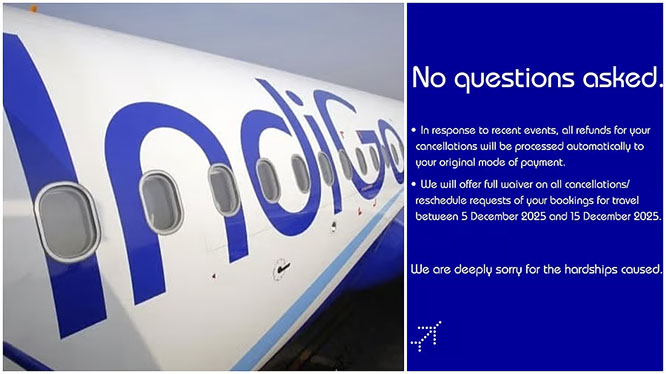
With IndiGo flight disruptions impacting thousands of passengers, the airline on Saturday said that it will offer full waiver on all cancellations/reschedule requests for travel bookings between December 5, 2025 and December 15, 2025.

Earlier in the day, the civil aviation ministry had directed the airline to complete the ticket refund process for the cancelled flights by Sunday evening, as well as ensure baggage separated from the travellers are delivered in the next two days.

In a post on X, titled 'No questions asked', IndiGo wrote, "In response to recent events, all refunds for your cancellations will be processed automatically to your original mode of payment."

"We are deeply sorry for the hardships caused," it further added.

Several passengers, however, complained of not getting full refund as promised by the airline.

Netizens have shared screenchots of getting charged for airline cancellation fee and convenience fee.

"Please tell me why u have did this airline cancellation charges when u say full amount will be refunded (sic)," a user wrote sharing a screenshot of the refund page.

"Well, but you have still debited the convenience charges," wrote another.

Passengers have also raised concerns about the "cancel" option being disabled on the IndiGo app. "First enable the 'Cancel' button on your App & offer full refund on tickets cancelled by customers between the said dates," wrote a user.

A day after the country's largest airline, IndiGo, cancelled more than 1,000 flights and caused disruptions for the fifth day on Saturday, the ministry said that any delay or non-compliance in refund processing will invite immediate regulatory action.

The refund process for all cancelled or disrupted flights must be completed by 8 pm on Sunday, the ministry said in a statement.

"Airlines have also been instructed not to levy any rescheduling charges for passengers whose travel plans were affected by cancellations," it said.

On Saturday, more than 400 flights were cancelled at various airports.

IndiGo has also been instructed to set up dedicated passenger support and refund facilitation cells.

Comments

Add new comment

  • Coastaldigest.com reserves the right to delete or block any comments.
  • Coastaldigset.com is not responsible for its readers’ comments.
  • Comments that are abusive, incendiary or irrelevant are strictly prohibited.
  • Please use a genuine email ID and provide your name to avoid reject.
News Network
December 19,2025

Mangaluru: In a decisive move to tackle the city’s deteriorating sanitation infrastructure, the Mangaluru City Corporation (MCC) has announced a massive ₹1,200 crore action plan to overhaul its underground drainage (UGD) network.

The initiative, spearheaded by Deputy Commissioner and MCC Administrator Darshan HV, aims to bridge "missing links" in the current system that have left residents grappling with overflowing sewage and environmental hazards.

The Breaking Point

The announcement follows a high-intensity phone-in session on Thursday, where the DC was flooded with grievances from frustrated citizens. Residents, including Savithri from Yekkur, described a harrowing reality: raw sewage from apartments leaking into stormwater drains, creating a "permanent stink" and turning residential zones into mosquito breeding grounds.

"We are facing immense difficulties due to the stench and the health risks. Local officials have remained silent until now," one resident reported during the session.

The Strategy: A Six-Year Vision

DC Darshan HV confirmed that the proposed plan is not a temporary patch but a comprehensive six-year roadmap designed to accommodate Mangaluru’s projected population growth. Key highlights of the plan include:

•    Infrastructure Expansion: Laying additional pipelines to connect older neighborhoods to the main grid.

•    STP Crackdown: Stricter enforcement of Sewage Treatment Plant (STP) regulations. While new apartments are required to have functional STPs, many older buildings lack them entirely, and several newer units are reportedly non-functional.

•    Budgetary Push: The plan has already been discussed with the district in-charge minister and the Secretary of the Urban Development Department. It is slated for formal presentation in the upcoming state budget.

Comments

Add new comment

  • Coastaldigest.com reserves the right to delete or block any comments.
  • Coastaldigset.com is not responsible for its readers’ comments.
  • Comments that are abusive, incendiary or irrelevant are strictly prohibited.
  • Please use a genuine email ID and provide your name to avoid reject.