"When Economy Is In A Tailspin...": Abhijit Banerjee Advises Government

Agencies
October 15, 2019

New York, Oct 15: Indian-American Abhijit Banerjee, who jointly won the 2019 Nobel Economics Prize with his wife Esther Duflo and Harvard's Michael Kremer, said on Monday that the Indian economy is "doing very badly" even as the government is increasingly recognising that there is a problem.

"The economy is doing very badly in my view," he told a press conference at the Massachusetts Institute of Technology after wining the prize.

When asked about his opinion on the state of the economy in India and its future, he said, "That's a statement not about what will work in the future but about what's going on now. That I'm entitled to have an opinion about."

Referring to the numbers put out by the National Sample Survey, that come out every 1.5 years and give estimates about the average consumption in urban and rural areas in India, Mr Banerjee said, "the fact that we see in that is that between 2014-15 and 2017-18, that number has slightly gone down. And that's the first time such a thing has happened in many many many many many years so that's a very glaring warning sign."

"There is enormous fight going on in India about which data is right and the government has a particular view of (that) all data that is inconvenient to it is wrong. But nonetheless, I think that this is something that I think even the government is increasingly recognising that there is a problem. So the economy slowing very very fast. How fast we don't know, there is this dispute about data but I think fast," he said.

Mr Banerjee added that he does not know exactly what to do. "The government has a large deficit but right now it's sort of at least aiming to please everybody by pretending to hold to some budgetary targets and monetary targets," he said.

He said that in his view when the economy is going into a "tailspin", is the time when "you don't worry so much about monetary stability and you worry a little bit more about demand. I think demand is a huge problem right now in economy."

Finance Minister Nirmala Sitharaman last week in Mumbai evaded a direct reply to a question on whether the government accepts there is an economic slowdown, and said the government is giving relief to all sectors who need help.

She said since the Budget in July, she has been meeting representatives of various industrial sectors, and sector-wise intervention is being made regularly.

Banerjee, Duflo and Harvard professor Kremer jointly won the 2019 Nobel Economics Prize "for their experimental approach to alleviating global poverty".

Banerjee, 58, and French-American Duflo both work at the Massachusetts Institute of Technology (MIT) while Kremer is at Harvard University.

In 2003, Mr Banerjee founded the Abdul Latif Jameel Poverty Action Lab (J-PAL), along with Duflo and Sendhil Mullainathan, and he remains one of its directors. He also served on the UN Secretary-General''s High-level Panel of Eminent Persons on the Post-2015 Development Agenda.

J-PAL, a global network of antipoverty researchers that conducts field experiments, has now become a major center of research, backing work across the world.

Walking into the press conference to a round of applause and standing ovation, Mr Banerjee in his opening remarks said that it is "wonderful" to get the Nobel Prize "because it''s a prize not, I think, for us, but also for the entire movement."

He said about 400 professors are associated in some way with J-PAL''s work and are doing randomised control trials on issues as diverse as US school in the Appalachia to governance problems in Indonesia, getting children immunised in India and getting children under bed nets in Sub Saharan Africa.

"So, this is a movement that, in some ways, we are kind of the beneficiaries of. I think it''s still going to be wonderful for the movement that this prize was given because I think it''s going to make it a little easier to penetrate the many doors that you know are half-open to us or not quite open to us and hopefully bring the message of policy-based on evidence and hard thinking to many other places as well," he said.

When asked how does he feel about being the sixth Nobel laureate from Kolkata, he said "I assume they''re all much more distinguished than me."

On what he hopes to do going forward, he said, "to be honest, we hope that we will get to do more of the same. I think we''re actually quite excited about what we are doing. This was not work that we did a long time ago, we''re excited about what we''re doing now and it''s fun. We''re learning new things. I''m really excited to look at the results from our latest intervention."

"So I think what I hope this will do is just open more opportunities to do more inventive things, but I don''t expect to do something entirely different. I think I''m content with what I''m doing and enjoying it very much," he said.

Comments

Add new comment

  • Coastaldigest.com reserves the right to delete or block any comments.
  • Coastaldigset.com is not responsible for its readers’ comments.
  • Comments that are abusive, incendiary or irrelevant are strictly prohibited.
  • Please use a genuine email ID and provide your name to avoid reject.
News Network
December 17,2025

melkar1.jpg

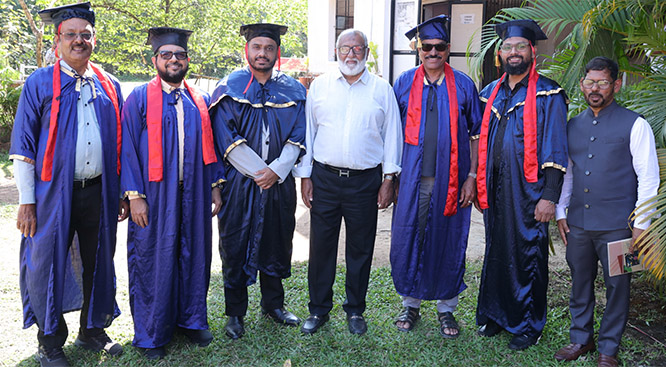
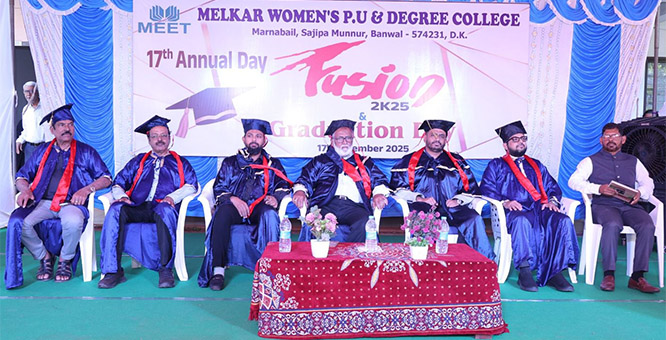
Melkar, Dec 17: The 17th Annual Day and Graduation Ceremony of Melkar Women’s PU and Degree College, themed “Fusion-2K25,” was celebrated with dignity and enthusiasm, marking a significant milestone in the institution’s academic journey. The programme reflected the college’s steadfast commitment to academic excellence, character building, and the holistic development of students.

The event was inaugurated by Mr. Asif Mohammed, whose presence greatly enriched the occasion. The celebration was further graced by the chief guests Mr. P. B. Ahmed Mudassir and Mr. Nissar Fakeer Mohammed, along with the distinguished guests of honour Mr. B. A. Nazeer and Mr. Ibrahim Gadiyar. In their inspiring addresses, the guests encouraged the graduating students and appreciated the dedicated efforts of the management, faculty, and students.

The annual report was presented by the Principal, Mr. Abdul Majeed S, highlighting the institution’s academic progress, notable achievements, and extracurricular accomplishments during the academic year.

The presidential address was delivered by the esteemed Chairman of Melkar Women’s PU and Degree College, Dr. Haji S. M. Rasheed, who emphasized the vital role of education in empowering women and shaping responsible citizens. He also stressed the importance of discipline, dedication, and perseverance in achieving success.

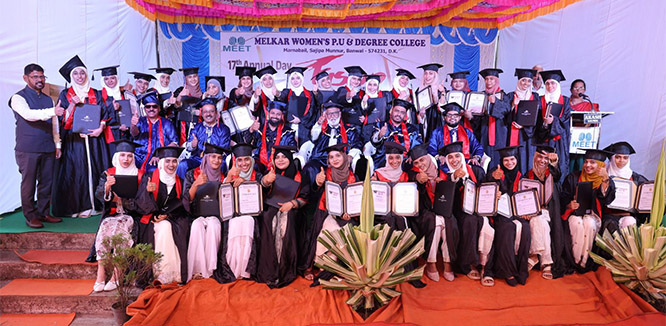
Cultural programmes and academic recognitions formed an integral part of the celebration, showcasing the talents and achievements of the students. The graduation ceremony was a proud moment for the outgoing students as they were formally conferred degrees and wished success in their future endeavours.

Ms. Mashmooma Fathima served as the Master of Ceremonies. The welcome address was delivered by Ms. Fathima Nida, and the programme concluded with a vote of thanks proposed by Ms. Ayisha Suhana.

The event successfully achieved its objectives and was highly appreciated by the guests and attendees.

melkar3.jpg

melkar2.jpg

Comments

Add new comment

  • Coastaldigest.com reserves the right to delete or block any comments.
  • Coastaldigset.com is not responsible for its readers’ comments.
  • Comments that are abusive, incendiary or irrelevant are strictly prohibited.
  • Please use a genuine email ID and provide your name to avoid reject.
News Network
December 21,2025

hadith.jpg

Invoking the teachings of Prophet Muhammad—“pay the worker before his sweat dries”—the Madras High Court has directed a municipal corporation to settle long-pending legal dues owed to a former counsel. The court observed that this principle reflects basic fairness and applies equally to labour and service-related disputes.

Justice G. R. Swaminathan made the observation while hearing a petition filed by advocate P. Thirumalai, who claimed that the Madurai City Municipal Corporation failed to pay him legal fees amounting to ₹13.05 lakh. Earlier, the High Court had asked the corporation to consider his representation. However, a later order rejected a major portion of his claim, prompting the present petition.

The court allowed Thirumalai to approach the District Legal Services Authority (DLSA) and submit a list of cases in which he had appeared. It also directed the corporation to settle the verified fee bills within two months, without interest. The court noted that the petitioner had waited nearly 18 years before challenging the non-payment and that the corporation could not be fully blamed, as the fee bills were not submitted properly.

‘A Matter of Embarrassment’

Justice Swaminathan described it as a “matter of embarrassment” that the State has nearly a dozen Additional Advocate Generals. He observed that appointing too many law officers often leads to unnecessary allocation of work and frequent adjournments, as government counsel claim that senior officers are engaged elsewhere.

He expressed hope that such practices would end at least in the Madurai Bench of the High Court and added that Additional Advocate Generals should “turn a new leaf” from 2026 onwards.

‘Scandalously High Amounts’

While stating that the court cannot examine the exact fees paid to senior counsel or law officers, Justice Swaminathan stressed that good governance requires public funds to be used prudently. He expressed concern over the “scandalously high amounts” paid by government and quasi-government bodies to a few favoured law officers.

In contrast, the court noted that Thirumalai’s total claim was “a pittance” considering the large number of cases he had handled.

Background

Thirumalai served as the standing counsel for the Madurai City Municipal Corporation for more than 14 years, from 1992 to 2006. During this period, he represented the corporation in about 818 cases before the Madurai District Courts.

As the former counsel was unable to hire a clerk to obtain certified copies of judgments in all 818 cases, the court directed the District Legal Services Authority to collect the certified copies within two months. The court further ordered the corporation to bear the cost incurred by the DLSA and deduct that amount from the final settlement payable to the petitioner.

Comments

Add new comment

  • Coastaldigest.com reserves the right to delete or block any comments.
  • Coastaldigset.com is not responsible for its readers’ comments.
  • Comments that are abusive, incendiary or irrelevant are strictly prohibited.
  • Please use a genuine email ID and provide your name to avoid reject.
News Network
December 16,2025

jordan.jpg

Prime Minister Narendra Modi on Monday held talks with Jordan’s King Abdullah II in Amman, during which the two leaders discussed ways to further strengthen bilateral relations, with the Prime Minister outlining an eight-point vision covering key areas of cooperation.

Describing the meeting as “productive”, PM Modi said he shared a roadmap focused on trade and economy, fertilisers and agriculture, information technology, healthcare, infrastructure, critical and strategic minerals, civil nuclear cooperation, and people-to-people ties.

In a post on social media platform X, the Prime Minister praised King Abdullah II’s personal commitment to advancing India–Jordan relations, particularly as both countries mark the 75th anniversary of the establishment of diplomatic ties this year.

“Held productive discussions with His Majesty King Abdullah II in Amman. His personal commitment towards vibrant India-Jordan relations is noteworthy. This year, we are celebrating the 75th anniversary of our bilateral diplomatic relations,” PM Modi said.

The meeting took place at the Al Husseiniya Palace, where the two leaders also exchanged views on regional and global issues of mutual interest. According to the Ministry of External Affairs (MEA), both sides agreed to further deepen cooperation in areas including trade and investment, defence and security, counter-terrorism and de-radicalisation, fertilisers and agriculture, infrastructure, renewable energy, tourism, and heritage.

The MEA said both leaders reaffirmed their united stand against terrorism.

PM Modi arrived in Amman earlier on Monday and was received by Jordanian Prime Minister Jafar Hassan, who accorded him a formal welcome. Following the talks, King Abdullah II hosted a banquet dinner in honour of the Prime Minister, reflecting the warmth of bilateral ties.

Jordan is the first leg of PM Modi’s three-nation tour. From Amman, the Prime Minister will travel to Ethiopia at the invitation of Prime Minister Abiy Ahmed Ali, marking his first official visit to the African nation. The tour will conclude with a visit to Oman.

Comments

Add new comment

  • Coastaldigest.com reserves the right to delete or block any comments.
  • Coastaldigset.com is not responsible for its readers’ comments.
  • Comments that are abusive, incendiary or irrelevant are strictly prohibited.
  • Please use a genuine email ID and provide your name to avoid reject.