Why India's general election is among the world's most expensive

Agencies
March 13, 2019

New Delhi, Mar 13: The world's biggest democracy will soon hold what's likely to be one of the world's costliest elections. India's six-week-long vote will span the Himalayan range in the north, the Indian Ocean in the south, the Thar desert in the west and the mangroves of the Sundarbans in the east.

This time the polling exercise, due to start on April 11 and be completed by May 19, will cost an unprecedented Rs 500 billion ($7 billion), according to the New Delhi-based Centre for Media Studies. About $6.5 billion was spent during the US presidential and congressional races in 2016, according to OpenSecrets.org, which tracks money in American politics.

The CMS projection marks a 40 percent jump from the $5 billion estimated to have been spent during India's 2014 parliamentary vote. And it amounts to roughly $8 spent per voter in a country where about 60 percent of the population lives on around $3 a day.

"Most of the jump in spending will come in use of social media, travel and advertising," said N Bhaskara Rao, chairman of the Centre for Media Studies, who has advised previous governments and ran a market research group.

Social media spending is likely to be dramatically higher, surging to about Rs 50 billion from Rs 2.5 billion in 2014, Rao said. His group—which bases its projections on field interviews, government data, contracts given out, and other research—also expects a jump in the use of helicopters, buses and other transportation by traveling candidates and party workers.

Specific data can be hard to pin down, but costs are rising in general as constituency sizes increase and more candidates join the fray, said Simon Chauchard, a Columbia University lecturer who has followed elections in India.

Indian politicians feel "you've got to do new things, and crazier things, and bigger things and louder things," Chauchard said. "It's a bunch of panicky candidates throwing money around to voters but also to vendors selling all kinds of stuff useful in a political campaign."

Here's a look at where some of the money goes:

Can goats help win votes?

With more than 8,000 contestants fighting for around 543 seats, there's tough competition to win over voters. And a secret ballot ensures that a bribe can't necessarily guarantee a vote. Gifts can help indicate to India's voters that the contestant wields influence and resources, according to Chauchard.

More than 90 percent of federal-level Indian politicians said their peers feel pressured to hand out gifts like cash, alcohol or other personal goods, according to a survey by Jennifer Bussell, an assistant professor at the University of California, Berkeley.

Blenders, television sets and occasionally even goats are handed out as gifts in some areas. The Election Commission seized more than Rs 1.3 billion of unaccounted cash, gold, alcohol and drugs last year during a tight election in the state of Karnataka.

Most of the spending isn't publicly disclosed. While candidates have a legal expenditure cap, parties can spend unrestricted amounts. The biggest national parties declared a combined income of just Rs 13 billion for the year through March 2018.

Rallying the troops with chicken curry

Indian politicians love a good rally: They crisscross the country, corralling locals into large tents where they're bombarded with campaign rhetoric.

To attract a crowd, some politicians may need to offer a box of food filled with biryani or chicken curry that can be too expensive for average citizens. That's not to mention money needed for firecrackers, chairs, microphones, security and vehicles to ferry the participants back and forth.

Dummy candidates

Election Commission has long warned about dummy candidates: nominating someone with the same name as a front runner to confuse voters and split the vote.

In populous states like Uttar Pradesh, where a name can identify the caste or clan of a particular candidate, this trick can be especially helpful. Popular figures are also targeted: In 2014, actress Hema Malini was up against two other Hema Malinis, the Hindustan Times reported.

But even fielding dummy candidates cost money. The expense can go as high as Rs 120 million, according to an investigation by India Today magazine in 2016. Parties also register multiple candidates to get around legal caps on how much an individual can spend, with the most popular member getting most of the resources.

As much as Rs 26 billion will be spent on advertising in the upcoming elections, according to Zenith India, a firm that arranges for slots on TV and in newspapers. That's more than double the 12 billion that the Election Commission estimates the two main parties spent in 2014.

In February alone, more than Rs 40 million was spent on political advertising on just one site—Facebook—the company's report shows. Then there are T-shirts with the slogan "NaMo Again" (Narendra Modi Again) peddled by his camp.

Hermits and elephants

Campaign spending by political parties accounts for almost all India's election outlays. But the Election Commission has also faced large costs organizing an election with polling stations running from 15,000 feet above sea level in the Himalayas and one for a sole hermit deep in the jungles of Western India.

India's budget has allocated Rs 2.62 billion to the Election Commission this fiscal year, a new high. Some of that may be used for elephants to carry electronic voting machines to relatively inaccessible regions, and boats to ferry men and materials across the mighty Brahmaputra river in the northeast.


Comments

Add new comment

  • Coastaldigest.com reserves the right to delete or block any comments.
  • Coastaldigset.com is not responsible for its readers’ comments.
  • Comments that are abusive, incendiary or irrelevant are strictly prohibited.
  • Please use a genuine email ID and provide your name to avoid reject.
News Network
December 21,2025

hadith.jpg

Invoking the teachings of Prophet Muhammad—“pay the worker before his sweat dries”—the Madras High Court has directed a municipal corporation to settle long-pending legal dues owed to a former counsel. The court observed that this principle reflects basic fairness and applies equally to labour and service-related disputes.

Justice G. R. Swaminathan made the observation while hearing a petition filed by advocate P. Thirumalai, who claimed that the Madurai City Municipal Corporation failed to pay him legal fees amounting to ₹13.05 lakh. Earlier, the High Court had asked the corporation to consider his representation. However, a later order rejected a major portion of his claim, prompting the present petition.

The court allowed Thirumalai to approach the District Legal Services Authority (DLSA) and submit a list of cases in which he had appeared. It also directed the corporation to settle the verified fee bills within two months, without interest. The court noted that the petitioner had waited nearly 18 years before challenging the non-payment and that the corporation could not be fully blamed, as the fee bills were not submitted properly.

‘A Matter of Embarrassment’

Justice Swaminathan described it as a “matter of embarrassment” that the State has nearly a dozen Additional Advocate Generals. He observed that appointing too many law officers often leads to unnecessary allocation of work and frequent adjournments, as government counsel claim that senior officers are engaged elsewhere.

He expressed hope that such practices would end at least in the Madurai Bench of the High Court and added that Additional Advocate Generals should “turn a new leaf” from 2026 onwards.

‘Scandalously High Amounts’

While stating that the court cannot examine the exact fees paid to senior counsel or law officers, Justice Swaminathan stressed that good governance requires public funds to be used prudently. He expressed concern over the “scandalously high amounts” paid by government and quasi-government bodies to a few favoured law officers.

In contrast, the court noted that Thirumalai’s total claim was “a pittance” considering the large number of cases he had handled.

Background

Thirumalai served as the standing counsel for the Madurai City Municipal Corporation for more than 14 years, from 1992 to 2006. During this period, he represented the corporation in about 818 cases before the Madurai District Courts.

As the former counsel was unable to hire a clerk to obtain certified copies of judgments in all 818 cases, the court directed the District Legal Services Authority to collect the certified copies within two months. The court further ordered the corporation to bear the cost incurred by the DLSA and deduct that amount from the final settlement payable to the petitioner.

Comments

Add new comment

  • Coastaldigest.com reserves the right to delete or block any comments.
  • Coastaldigset.com is not responsible for its readers’ comments.
  • Comments that are abusive, incendiary or irrelevant are strictly prohibited.
  • Please use a genuine email ID and provide your name to avoid reject.
News Network
December 20,2025

train.jpg

At least seven elephants were killed and one calf injured after a herd collided with the Sairang-New Delhi Rajdhani Express in Assam's Hojai on Saturday morning, leading to disruption of rail services. 

The Sairang-New Delhi Rajdhani Express struck a herd of elephants, resulting in the derailment of the locomotive and five coaches. No passenger casualties or injuries were reported, officials said.

The New Delhi-bound train met with the accident around 2.17 am, PTI reported. The Sairang-New Delhi Rajdhani Express connects Mizoram's Sairang (near Aizawl) to Anand Vihar Terminal (Delhi). 

Railway has issued helpline numbers at the Guwahati Railway Station:-

•    0361-2731621
•    0361-2731622
•    0361-2731623

The accident site is located about 126 km from Guwahati. Following the incident, accident relief trains and railway officials rushed to the spot to initiate rescue operations.

Train Services Disrupted

Sources said that due to the derailment and elephant body parts scattered on the tracks, train services to Upper Assam and other parts of the Northeast were affected.

Passengers from the affected coaches were temporarily accommodated in vacant berths available in other coaches of the train. Once the train reaches Guwahati, additional coaches will be attached to accommodate all passengers, after which the train will resume its onward journey.

The incident occurred at a location that is not a designated elephant corridor. The loco pilot, upon spotting the herd on the tracks, applied emergency brakes. Despite this, the elephants dashed into the train, leading to the collision and derailment.

Last month, an elephant was killed after being hit by a train in Dhupguri in West Bengal's Jalpaiguri district. The incident took place on November 30. 

The adult elephant was killed on the spot, and a calf was discovered lying injured beside the tracks. 

Over 70 Elephants Killed In Train Collisions Over Last 5 Years

At least 79 elephants have died in train collisions across the country in the last five years, the Environment Ministry had informed Parliament in August.

In a written reply in the Lok Sabha, Minister of State for Environment Kirti Vardhan Singh had said the figure is based on reports from state governments and Union Territory administrations for the period 2020-21 to 2024-25.

He said that the ministry does not maintain consolidated data on the deaths of other wild animals on railway tracks, including in designated elephant corridors.

Singh confirmed that three elephants, including a mother and her calf, were killed on July 18 this year after being hit by a speeding express train on the Kharagpur-Tatanagar section in West Bengal's Paschim Midnapore district. The incident took place near Banstala between Jhargram and Banstala stations.

The minister said several measures have been taken jointly by the Environment Ministry and the Railways to prevent such accidents.

These include imposing speed restrictions in elephant habitats, pilot projects such as seismic sensor-based detection of elephants near tracks and construction of underpasses, ramps and fencing at vulnerable points.

The Wildlife Institute of India, in consultation with the ministry and other stakeholders, has also issued guidelines titled 'Eco-friendly Measures to Mitigate Impacts of Linear Infrastructure' to help agencies design railways and other projects in ways that reduce human-animal conflicts.

Singh added that capacity-building workshops were conducted for railway officials at the Wildlife Institute of India in 2023 and 2024 to raise awareness on elephant conservation and protection.

A detailed report titled 'Suggested Measures to Mitigate Elephant & Other Wildlife Train Collisions on Vulnerable Railway Stretches in India' had also been prepared after surveys across 127 railway stretches covering 3,452 km.

Of these, 77 stretches spanning 1,965 km in 14 states were prioritised for mitigation, with site-specific interventions suggested. 

Comments

Add new comment

  • Coastaldigest.com reserves the right to delete or block any comments.
  • Coastaldigset.com is not responsible for its readers’ comments.
  • Comments that are abusive, incendiary or irrelevant are strictly prohibited.
  • Please use a genuine email ID and provide your name to avoid reject.
News Network
December 6,2025

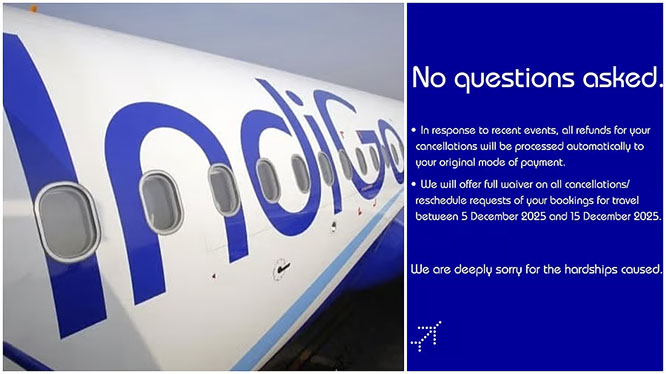
indigoticket.jpg

With IndiGo flight disruptions impacting thousands of passengers, the airline on Saturday said that it will offer full waiver on all cancellations/reschedule requests for travel bookings between December 5, 2025 and December 15, 2025.

Earlier in the day, the civil aviation ministry had directed the airline to complete the ticket refund process for the cancelled flights by Sunday evening, as well as ensure baggage separated from the travellers are delivered in the next two days.

In a post on X, titled 'No questions asked', IndiGo wrote, "In response to recent events, all refunds for your cancellations will be processed automatically to your original mode of payment."

"We are deeply sorry for the hardships caused," it further added.

Several passengers, however, complained of not getting full refund as promised by the airline.

Netizens have shared screenchots of getting charged for airline cancellation fee and convenience fee.

"Please tell me why u have did this airline cancellation charges when u say full amount will be refunded (sic)," a user wrote sharing a screenshot of the refund page.

"Well, but you have still debited the convenience charges," wrote another.

Passengers have also raised concerns about the "cancel" option being disabled on the IndiGo app. "First enable the 'Cancel' button on your App & offer full refund on tickets cancelled by customers between the said dates," wrote a user.

A day after the country's largest airline, IndiGo, cancelled more than 1,000 flights and caused disruptions for the fifth day on Saturday, the ministry said that any delay or non-compliance in refund processing will invite immediate regulatory action.

The refund process for all cancelled or disrupted flights must be completed by 8 pm on Sunday, the ministry said in a statement.

"Airlines have also been instructed not to levy any rescheduling charges for passengers whose travel plans were affected by cancellations," it said.

On Saturday, more than 400 flights were cancelled at various airports.

IndiGo has also been instructed to set up dedicated passenger support and refund facilitation cells.

Comments

Add new comment

  • Coastaldigest.com reserves the right to delete or block any comments.
  • Coastaldigset.com is not responsible for its readers’ comments.
  • Comments that are abusive, incendiary or irrelevant are strictly prohibited.
  • Please use a genuine email ID and provide your name to avoid reject.