Why Recreating Gandhi Murder?

Ram Puniyani
February 8, 2019

This 30th January 2019, when the whole country was observing the 71st martyrdom day of ‘Father of the Nation’, Mahatma Gandhi, the members of Hindu Mahasabha recreated the murder of Gandhi in Aligarh. Led by Hindu Mahasabha Secretary Pooja Shakun Pandey, a group of saffron wearing workers assembled with preparation for video shooting. Pandey fired three shots on the effigy of Gandhi and blood started dripping from the balloon behind the effigy. The Assembled Hindu Mahasabha workers shouted slogans condemning Gandhi and hailing Godse, the murderer of Gandhi. They shouted Mahatma Nathuram Godse Amar Rahein (Long live Nathuram Godse). They declared that from this year on they will recreate Gandhi murder every year the way Ravan’s effigy is burned on Dusshera day.  The video went viral. Pandey’s facebook post also showed an earlier picture of hers’ with BJP leaders, ex MP Chief Minister Shivraj Singh Chauhan and Central BJP minister Uma Bharati. Police has filed criminal cases against some of those participating in the event.

The hailing of Nathurm Godse, Vinayak Damodar Savarkar and attacking Gandhi has been the plank of Hindu Nationalists (Hindu Mahasabha and RSS). Few years ago in a public meeting Congress President Rahul Gandhi stated that RSS people killed Gandhi, a case was been filed against him, and RSS wants him to apologize as Rahul Gandhi holds on to his statement. A few years ago one leader of BJP, Gopal Krishnan, had said that Godse picked up the wrong target; he should have killed Nehru instead of Gandhi as Nehru was responsible for partition. Sakhshi Maharaj, the BJP MP stated that Godse was a patriot. Farmer RSS Sarsanghchalak Rajendra Singh had said that Godse had right intentions but his method was wrong.

None of these Hindu nationalists ever targeted Muslim League or Jinnah, who among others, had played a role in the partition of the country. During last few years those supporting Godse and Savarkar are becoming more assertive. There are few differences in the two branches of Hindu Nationalists, Hindu Mahasabha and RSS, still all those who oppose Indian nationalism and values of Indian Constitution have been covert or overt supporters of the ideology due to which Gandhi was murdered.

The plea given for Gandhi murder was that it’s due to Gandhi that Muslims became bolder, demanded Pakistan, and India had to give 55 corers to Pakistan. As a matter of fact the attempts to murder him had been on from 1934. The 30th January 1948 attack was the sixth in the sequence. Godse himself was involved in two earlier attacks. Nehru summed up the national mood when mourning the death of his mentor saying ‘light has gone and there is darkness around’. Teesta Setalvad in her compilation, ‘Beyond Doubt’ comprehensively deals with the issue. She quotes from Home ministry circulars, eminent books dealing with the issue (Jagan Phadnis –‘Mahtyamechi Akher’, Y.D. Phadke ‘Nathuramayan’ and Chunuibhai Vaidya’s book: ‘Spitting on the Sun’) and argues that the issue of partition and 55 Crores to the Pakistan were mere pretexts, as much before these issues came to surface, attempts on Gandhi’s life were made in 1934, 1940 and 1944. The real reason for attacks on the Mahatma was that he was a great Hindu and he was the greatest opponent of Hindu nationalism. Hindu nationalists saw him as the big obstacle to their agenda of Hindu nation. Surely Hindu nationalists’ major act of violence was to kill the greatest Hindu of our time, Gandhi.

Godse who succeeded in killing Gandhi was a trained Paracharak of RSS, who joined the Pune branch of Hindu Mahasabah in 1938 and edited a newspaper called Agrani subtitled Hindu Rashtra. In his journal a cartoon was carried with Gandhi as Ravan with ten heads (two heads being Patel and Netaji Bose) slayer being Savarkar. After the murder of Gandhi, RSS was banned by the then Home minster Sardar Patel, who in his letter to Shyama Prasad Mukherjee of Hindu Mahsabha stated that it was due to the hate spread by Hindu Mahasabha and RSS; due to which Nation had to lose its father. The main accused of Gandhi murder Godse had many accomplices one of whom was Savarkar. He was let off due to lack of any corroborative evidence. Jeevanlal Kapoor Commission, which went into the whole issue pointed out, “All these facts taken together were destructive of any theory other than the conspiracy to murder by Savarkar and his group.”

Also as far as Godse’s membership of RSS is concerned we should note that at that time RSS did not have a written Constitution and membership register. One of the conditions for lifting the ban on RSS was that it will have written Constitution. In Court Godse denied that he was member of RSS. RSS people also denied that Godse was part of RSS. In contrast Nathuram’s brother Gopal, who was a co accused with him, wrote, “The appeasement policy followed by him (Gandhi) and imposed on all Congress governments’ encouraged the Muslim separatist tendencies that eventually created Pakistan. Technically and theoretically he (Nathuram) was a member (of RSS), but he stopped workings for it later. His statement in the court that he had left the RSS was to protect the RSS workers; who would be imprisoned following the murder. On the understanding that they (RSS workers) would benefit from his dissociating himself from the RSS, he gladly did it.”

In RSS, Savarkar is given the high place for nationalism. The whole Nationalism as asserted by RSS-Hindu Mahasabha is sectarian Hindu Nationalism, the parallel and opposite of Muslim Nationalism propounded by Muslim League. It was Savarkar who had apologized to British to get released from Andmans., and later propounded ‘two nation (Hindu and Muslim) theory’. This was to opposes the Indian nationalism, which was surging under the leadership of Gandhi led Congress. The present recreation of the dastardly act is a symbol of rise in assertion of RSS-BJP during last few years in particular.

Comments

Add new comment

  • Coastaldigest.com reserves the right to delete or block any comments.
  • Coastaldigset.com is not responsible for its readers’ comments.
  • Comments that are abusive, incendiary or irrelevant are strictly prohibited.
  • Please use a genuine email ID and provide your name to avoid reject.
News Network
January 20,2026

KCFabudhabi.jpg

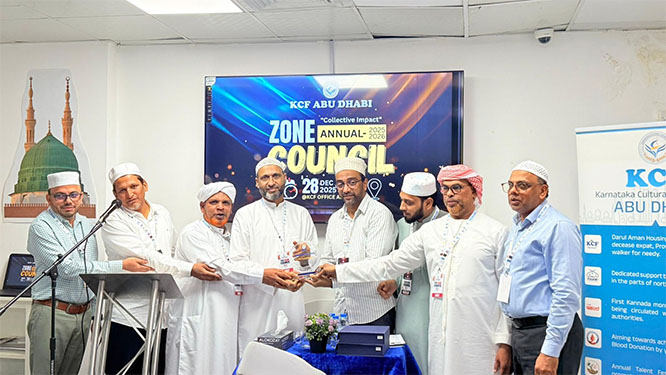
KCF, a global socio-cultural organisation of Karnataka expatriates, is actively involved in education, humanitarian initiatives and community well-being across several countries. The awardees were selected following a structured evaluation of nominations by the Annual Council Program Committee, based on the depth, consistency and long-term impact of their social service.

One of the award recipients, Abdul Razak Haji, a prominent UAE-based entrepreneur from the Qamcon Group of Companies, was honoured for his significant contributions to society. Through both his professional journey and personal initiatives, he has supported numerous employees and families, while also extending assistance in education, housing for the underprivileged and various charitable causes, largely carried out quietly over the years. His award was presented earlier during the Annual Council Program held at the KCF Abu Dhabi office.

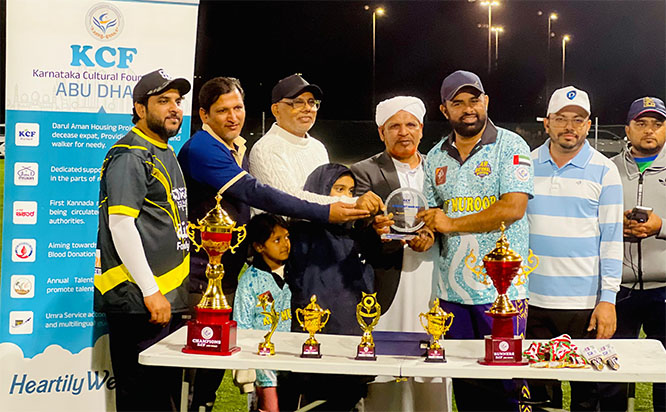
The second award was conferred on Latheef Kakkinje, a young social worker based in Abu Dhabi, in recognition of his active involvement in community engagement programmes, sports initiatives, talent festivals and family-oriented social activities. His consistent volunteering efforts and commitment to humanitarian causes were highly appreciated by the selection committee.

The award presentation ceremony for Latheef Kakkinje was held at the Zayed Cricket Stadium (Astro Turf Ground) in the presence of Kedumbady Ibrahim Saqafi, President of KCF UAE; Ibrahim, General Secretary; Kabeer Bayambady, President of KCF Abu Dhabi; Ummer Ishwaramangila, General Secretary; along with other members of the KCF Abu Dhabi cabinet.

Congratulating both awardees, KCF leaders reiterated the organisation’s commitment to recognising individuals who selflessly work for social upliftment and community service.

KCFabudhabi1.jpg

Comments

Add new comment

  • Coastaldigest.com reserves the right to delete or block any comments.
  • Coastaldigset.com is not responsible for its readers’ comments.
  • Comments that are abusive, incendiary or irrelevant are strictly prohibited.
  • Please use a genuine email ID and provide your name to avoid reject.
News Network
January 23,2026

modIKERALA.jpg

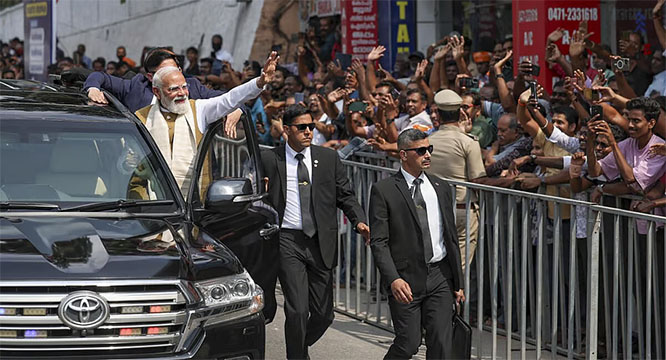
Prime Minister Narendra Modi, during his visit to Thiruvananthapuram on Friday, January 23, indicated that the Bharatiya Janata Party (BJP) is aiming to expand its political footprint in Kerala ahead of the Assembly elections scheduled in the coming months.

Speaking at a BJP-organised public meeting, Modi drew parallels between the party’s early electoral gains in Gujarat and its recent victory in the Thiruvananthapuram Municipal Corporation. The civic body win, which ended decades of Left control, was cited by the Prime Minister as a possible starting point for the party’s broader ambitions in the state.

Recalling BJP’s political trajectory in Gujarat, Modi said the party was largely insignificant before 1987 and received little media attention. He pointed out that the BJP’s first major breakthrough came with its victory in the Ahmedabad Municipal Corporation that year.

“Just as our journey in Gujarat began with one city, Kerala’s journey has also started with a single city,” Modi said, suggesting that the party’s municipal-level success could translate into wider electoral acceptance.

The Prime Minister alleged that successive governments led by the Left Democratic Front (LDF) and the United Democratic Front (UDF) had failed to adequately develop Thiruvananthapuram. He accused both fronts of corruption and neglect, claiming that basic infrastructure and facilities were denied to the capital city for decades.

According to Modi, the BJP’s control of the civic body represents a shift driven by public dissatisfaction with the existing political alternatives. He asserted that the BJP administration in Thiruvananthapuram had begun working towards development, though no specific details or timelines were outlined.

Addressing the gathering at Putharikandam Maidan, Modi said the BJP intended to project Thiruvananthapuram as a “model city,” reiterating his party’s commitment to governance-led change.

The Prime Minister’s visit to Kerala also included the inauguration of several development projects and the flagging off of new train services, as the BJP intensifies its political outreach in the poll-bound state.

Comments

Add new comment

  • Coastaldigest.com reserves the right to delete or block any comments.
  • Coastaldigset.com is not responsible for its readers’ comments.
  • Comments that are abusive, incendiary or irrelevant are strictly prohibited.
  • Please use a genuine email ID and provide your name to avoid reject.
News Network
January 31,2026

Roy.jpg

Bengaluru: The shooting incident involving CJ Roy, founder of the Confident Group, has once again put the spotlight on a businessman whose life has swung between flamboyant global success and persistent controversy at home.

Though Roy’s business interests extended across continents, his roots lay firmly in Karnataka. An alumnus of Christ School in Bengaluru, he later moved to Tumakuru to pursue an engineering degree. Those familiar with his early years describe him as intensely ambitious, beginning his career as a salesman at a small electronics firm dealing in computers.

Roy’s entry into large-scale real estate came through the Crystal Group, where he worked closely with Latha Namboothiri and rose from manager to director. However, the launch of the Confident Group in 2005 was clouded by industry speculation. Insiders speak of a fallout involving alleged “benami” properties and claims of deception that ultimately led to his independent venture—an episode Roy spent years trying to distance himself from, according to associates.

A tale of two cities

Roy’s professional trajectory diverged sharply across geographies.

In Dubai, he built a reputation as a bold and efficient developer, completing massive luxury residential projects in record time—some reportedly within 11 months. His rapid project delivery and lavish lifestyle in the Emirates earned him admiration and visibility in the real estate sector.

In Bengaluru, however, his image remained far more fractured. Sources say Roy stayed away from the city for several years amid disputes over unpaid dues to vendors and suppliers. Several projects were allegedly stalled, with accusations of unfulfilled commitments to cement and steel suppliers continuing to follow him.

Roy’s return to Bengaluru’s business and social circles began around 2018, marked by a conscious attempt at rebranding. His appointment as Honorary Consul of the Slovak Republic added diplomatic legitimacy, which he complemented with visible CSR initiatives, including ambulance donations and high-profile charity events.

Heavy police presence in Langford Town

Following the incident, police personnel from the Central division were deployed outside the Confident Group building in Langford Town, which also houses the Slovak Honorary Consulate in Bengaluru.

The otherwise busy premises near Hosur Road wore a deserted look on Friday, reflecting the shock and uncertainty that followed the tragedy.

Comments

Add new comment

  • Coastaldigest.com reserves the right to delete or block any comments.
  • Coastaldigset.com is not responsible for its readers’ comments.
  • Comments that are abusive, incendiary or irrelevant are strictly prohibited.
  • Please use a genuine email ID and provide your name to avoid reject.