Why Recreating Gandhi Murder?

Ram Puniyani
February 8, 2019

This 30th January 2019, when the whole country was observing the 71st martyrdom day of ‘Father of the Nation’, Mahatma Gandhi, the members of Hindu Mahasabha recreated the murder of Gandhi in Aligarh. Led by Hindu Mahasabha Secretary Pooja Shakun Pandey, a group of saffron wearing workers assembled with preparation for video shooting. Pandey fired three shots on the effigy of Gandhi and blood started dripping from the balloon behind the effigy. The Assembled Hindu Mahasabha workers shouted slogans condemning Gandhi and hailing Godse, the murderer of Gandhi. They shouted Mahatma Nathuram Godse Amar Rahein (Long live Nathuram Godse). They declared that from this year on they will recreate Gandhi murder every year the way Ravan’s effigy is burned on Dusshera day.  The video went viral. Pandey’s facebook post also showed an earlier picture of hers’ with BJP leaders, ex MP Chief Minister Shivraj Singh Chauhan and Central BJP minister Uma Bharati. Police has filed criminal cases against some of those participating in the event.

The hailing of Nathurm Godse, Vinayak Damodar Savarkar and attacking Gandhi has been the plank of Hindu Nationalists (Hindu Mahasabha and RSS). Few years ago in a public meeting Congress President Rahul Gandhi stated that RSS people killed Gandhi, a case was been filed against him, and RSS wants him to apologize as Rahul Gandhi holds on to his statement. A few years ago one leader of BJP, Gopal Krishnan, had said that Godse picked up the wrong target; he should have killed Nehru instead of Gandhi as Nehru was responsible for partition. Sakhshi Maharaj, the BJP MP stated that Godse was a patriot. Farmer RSS Sarsanghchalak Rajendra Singh had said that Godse had right intentions but his method was wrong.

None of these Hindu nationalists ever targeted Muslim League or Jinnah, who among others, had played a role in the partition of the country. During last few years those supporting Godse and Savarkar are becoming more assertive. There are few differences in the two branches of Hindu Nationalists, Hindu Mahasabha and RSS, still all those who oppose Indian nationalism and values of Indian Constitution have been covert or overt supporters of the ideology due to which Gandhi was murdered.

The plea given for Gandhi murder was that it’s due to Gandhi that Muslims became bolder, demanded Pakistan, and India had to give 55 corers to Pakistan. As a matter of fact the attempts to murder him had been on from 1934. The 30th January 1948 attack was the sixth in the sequence. Godse himself was involved in two earlier attacks. Nehru summed up the national mood when mourning the death of his mentor saying ‘light has gone and there is darkness around’. Teesta Setalvad in her compilation, ‘Beyond Doubt’ comprehensively deals with the issue. She quotes from Home ministry circulars, eminent books dealing with the issue (Jagan Phadnis –‘Mahtyamechi Akher’, Y.D. Phadke ‘Nathuramayan’ and Chunuibhai Vaidya’s book: ‘Spitting on the Sun’) and argues that the issue of partition and 55 Crores to the Pakistan were mere pretexts, as much before these issues came to surface, attempts on Gandhi’s life were made in 1934, 1940 and 1944. The real reason for attacks on the Mahatma was that he was a great Hindu and he was the greatest opponent of Hindu nationalism. Hindu nationalists saw him as the big obstacle to their agenda of Hindu nation. Surely Hindu nationalists’ major act of violence was to kill the greatest Hindu of our time, Gandhi.

Godse who succeeded in killing Gandhi was a trained Paracharak of RSS, who joined the Pune branch of Hindu Mahasabah in 1938 and edited a newspaper called Agrani subtitled Hindu Rashtra. In his journal a cartoon was carried with Gandhi as Ravan with ten heads (two heads being Patel and Netaji Bose) slayer being Savarkar. After the murder of Gandhi, RSS was banned by the then Home minster Sardar Patel, who in his letter to Shyama Prasad Mukherjee of Hindu Mahsabha stated that it was due to the hate spread by Hindu Mahasabha and RSS; due to which Nation had to lose its father. The main accused of Gandhi murder Godse had many accomplices one of whom was Savarkar. He was let off due to lack of any corroborative evidence. Jeevanlal Kapoor Commission, which went into the whole issue pointed out, “All these facts taken together were destructive of any theory other than the conspiracy to murder by Savarkar and his group.”

Also as far as Godse’s membership of RSS is concerned we should note that at that time RSS did not have a written Constitution and membership register. One of the conditions for lifting the ban on RSS was that it will have written Constitution. In Court Godse denied that he was member of RSS. RSS people also denied that Godse was part of RSS. In contrast Nathuram’s brother Gopal, who was a co accused with him, wrote, “The appeasement policy followed by him (Gandhi) and imposed on all Congress governments’ encouraged the Muslim separatist tendencies that eventually created Pakistan. Technically and theoretically he (Nathuram) was a member (of RSS), but he stopped workings for it later. His statement in the court that he had left the RSS was to protect the RSS workers; who would be imprisoned following the murder. On the understanding that they (RSS workers) would benefit from his dissociating himself from the RSS, he gladly did it.”

In RSS, Savarkar is given the high place for nationalism. The whole Nationalism as asserted by RSS-Hindu Mahasabha is sectarian Hindu Nationalism, the parallel and opposite of Muslim Nationalism propounded by Muslim League. It was Savarkar who had apologized to British to get released from Andmans., and later propounded ‘two nation (Hindu and Muslim) theory’. This was to opposes the Indian nationalism, which was surging under the leadership of Gandhi led Congress. The present recreation of the dastardly act is a symbol of rise in assertion of RSS-BJP during last few years in particular.

Comments

Add new comment

  • Coastaldigest.com reserves the right to delete or block any comments.
  • Coastaldigset.com is not responsible for its readers’ comments.
  • Comments that are abusive, incendiary or irrelevant are strictly prohibited.
  • Please use a genuine email ID and provide your name to avoid reject.
News Network
January 20,2026

DGP.jpg

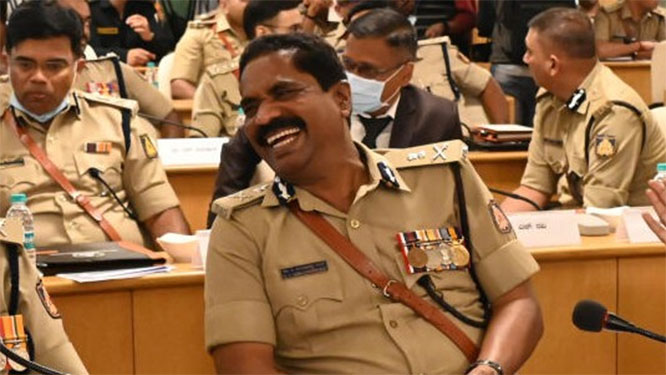
Karnataka DGP (Civil Rights Enforcement) K Ramachandra Rao was suspended with immediate effect, as per a state government order issued on Monday, 19 January. The order cited conduct unbecoming of a government servant and causing embarrassment to the state administration.

The Karnataka government suspended Rao after a purported video showed him in a compromising position with a woman inside his official chamber. The video went viral on social media. Rao rejected the videos outright, terming them "fabricated and false".

Who is K Ramachandra Rao?

Rao is a DGP-rank officer who was heading the Directorate of Civil Rights Enforcement until his suspension. He was promoted to DGP in September 2023 and assumed office in October 2023, the Sunday Guardian reported.

He also served as the Chairman and Managing Director of the Karnataka State Police Housing and Infrastructure Development Corporation Limited.

His stint as the Inspector General of Police (IGP) for the Southern Range was also marred by controversy. In 2014, during a cash seizure near Mysuru’s Yelwal, officials claimed the seized amount was ₹20 lakh, while the accused (Kerala-based merchants) claimed it was around ₹2.27 crore.

Rao, who was present during the seizure, denied all allegations. However, he was transferred soon after.

Allegations of collusion with a businessman surfaced, and a senior police officer was quoted by The Sunday Guardian as saying, “In Rao’s case, the CID has clearly mentioned that there was a great degree of lapse on the part of Rao and a deputy superintendent of police after it was brought to their notice that a few policemen, including a gunman attached to the IGP, were involved in the robbery.”

Rao had denied all wrongdoing in that incident. Despite past controversies, he rose to the state’s top police position, the Sunday Guardian reported.

Ranya Rao’s stepfather

Rao is the stepfather of Kannada actress Harshavardhini Ranya alias Ranya Rao, accused of orchestrating the illegal import of gold worth over ₹12.56 crore from Dubai to India along with two others — businessman Tarun Raju, and jewellery dealer Sahil Jain.

‘Obscene video’ controversy

A viral video showed Rao behaving inappropriately with a woman inside his office while in uniform.

The Karnataka government said in its Monday order that “vide videos and news reports widely broadcast on public news channels and media platforms, it is observed that Dr K Ramachandra Rao has acted in an obscene manner which is unbecoming of a Government Servant and also causing embarrassment to the Government.”

The order said the matter was examined by the state government, which found that the officer's conduct amounted to a violation of Rule 3 of the All India Services (Conduct) Rules, 1968.

The government said it is prima facie satisfied that "it is necessary to place Rao under suspension with immediate effect, pending inquiry".

During the suspension period, Rao will be entitled to subsistence allowance as per Rule 4 of the All India Services (Discipline and Appeal) Rules, 1969.

The order also places restrictions on his movement, stating that during the period of suspension, the officer must not leave headquarters under any circumstances without the written permission of the state government.

Comments

Add new comment

  • Coastaldigest.com reserves the right to delete or block any comments.
  • Coastaldigset.com is not responsible for its readers’ comments.
  • Comments that are abusive, incendiary or irrelevant are strictly prohibited.
  • Please use a genuine email ID and provide your name to avoid reject.
News Network
January 23,2026

Mangaluru: The Karnataka Government Polytechnic (KPT), Mangaluru, has achieved autonomous status from the All India Council for Technical Education (AICTE), becoming the first government polytechnic in the country to receive such recognition in its 78-year history. The status was granted by AICTE, New Delhi, and subsequently approved by the Karnataka Board of Technical Education in October last year.

Officials said the autonomy was conferred a few months ago. Until recently, AICTE extended autonomous status only to engineering colleges, excluding diploma institutions. However, with a renewed national focus on skill development, several government polytechnics across India have now been granted autonomy.

KPT, the second-largest polytechnic in Karnataka, was established in 1946 with four branches and has since expanded to offer eight diploma programmes, including computer science and polymer technology. The institution is spread across a 19-acre campus.

Ravindra M Keni, the first dean of the institution, told The Times of India that AICTE had proposed autonomous status for polytechnic institutions that are over 25 years old. “Many colleges applied. In the first round, 100 institutions were shortlisted, which was further narrowed down to 15 in the second round. We have already completed one semester after becoming an autonomous institution,” he said. He added that nearly 500 students are admitted annually across eight three-year diploma courses.

Explaining the factors that helped KPT secure autonomy, Keni said the institution has consistently recorded 100 per cent admissions and placements for its graduates. He also noted its strong performance in sports, with the college emerging champions for 12 consecutive years, along with active student participation in NCC and NSS activities.

Autonomous status allows KPT to design industry-oriented curricula, conduct examinations, prepare question papers, and manage academic documentation independently. The institution can also directly collaborate with industries and receive priority funding from AICTE or the Ministry of Education. While academic autonomy has been granted, financial control will continue to rest with the state government.

“There will be separate committees for examinations, question paper setting, boards of studies, and boards of examiners. The institution will now have the freedom to conduct admissions without government notifications and issue its own marks cards,” Keni said, adding that new academic initiatives would be planned after a year of functioning under the autonomous framework.

Comments

Add new comment

  • Coastaldigest.com reserves the right to delete or block any comments.
  • Coastaldigset.com is not responsible for its readers’ comments.
  • Comments that are abusive, incendiary or irrelevant are strictly prohibited.
  • Please use a genuine email ID and provide your name to avoid reject.
News Network
January 20,2026

KCFabudhabi.jpg

KCF, a global socio-cultural organisation of Karnataka expatriates, is actively involved in education, humanitarian initiatives and community well-being across several countries. The awardees were selected following a structured evaluation of nominations by the Annual Council Program Committee, based on the depth, consistency and long-term impact of their social service.

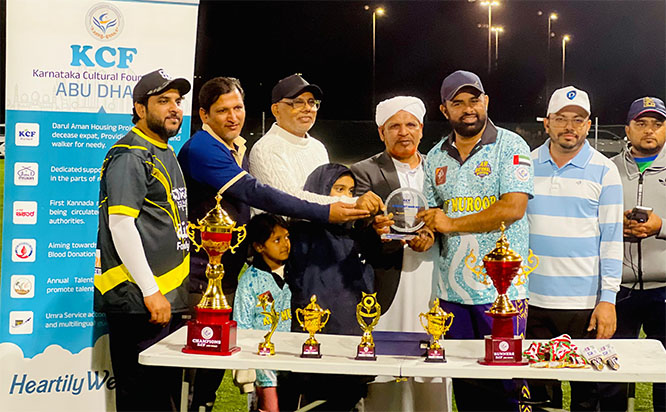
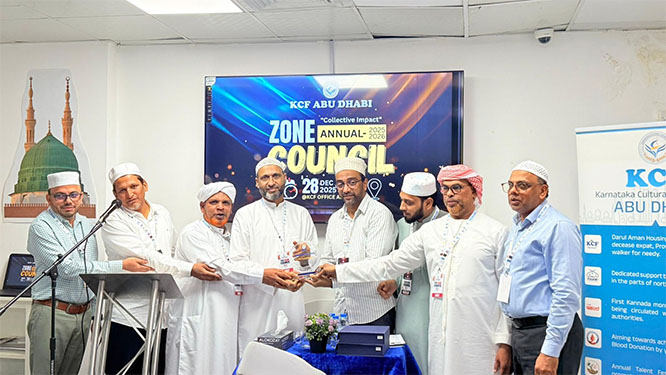
One of the award recipients, Abdul Razak Haji, a prominent UAE-based entrepreneur from the Qamcon Group of Companies, was honoured for his significant contributions to society. Through both his professional journey and personal initiatives, he has supported numerous employees and families, while also extending assistance in education, housing for the underprivileged and various charitable causes, largely carried out quietly over the years. His award was presented earlier during the Annual Council Program held at the KCF Abu Dhabi office.

The second award was conferred on Latheef Kakkinje, a young social worker based in Abu Dhabi, in recognition of his active involvement in community engagement programmes, sports initiatives, talent festivals and family-oriented social activities. His consistent volunteering efforts and commitment to humanitarian causes were highly appreciated by the selection committee.

The award presentation ceremony for Latheef Kakkinje was held at the Zayed Cricket Stadium (Astro Turf Ground) in the presence of Kedumbady Ibrahim Saqafi, President of KCF UAE; Ibrahim, General Secretary; Kabeer Bayambady, President of KCF Abu Dhabi; Ummer Ishwaramangila, General Secretary; along with other members of the KCF Abu Dhabi cabinet.

Congratulating both awardees, KCF leaders reiterated the organisation’s commitment to recognising individuals who selflessly work for social upliftment and community service.

KCFabudhabi1.jpg

Comments

Add new comment

  • Coastaldigest.com reserves the right to delete or block any comments.
  • Coastaldigset.com is not responsible for its readers’ comments.
  • Comments that are abusive, incendiary or irrelevant are strictly prohibited.
  • Please use a genuine email ID and provide your name to avoid reject.