



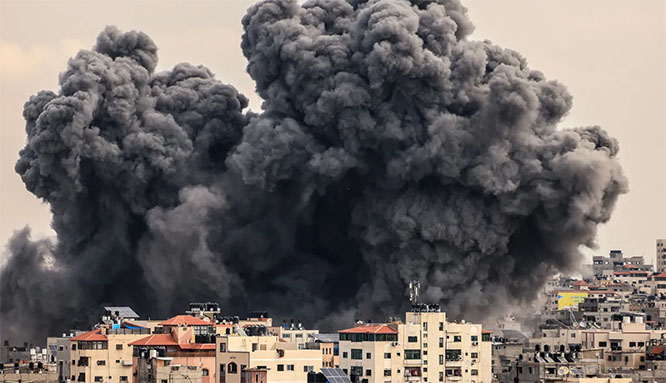
59 conflicts, 78 nations involved: World is now least peaceful since World War-2

News Network
June 19, 2025

conflict.jpg

The world is now witnessing the highest number of active state-based conflicts since the end of the Second World War, with 59 ongoing wars and 78 countries involved, according to the 2024 edition of the Global Peace Index released by the Institute for Economics & Peace.

The report paints a grim picture of international stability, warning that global peacefulness continues to erode amid a backdrop of deepening geopolitical rivalries, rising militarisation, and a growing number of cross-border disputes.

“Many of the leading indicators that typically precede large-scale conflict are now at their worst levels since 1945,” the study stated.

Sharp Rise in Conflicts

There are currently 59 active state-based armed conflicts, three more than last year, making this the most violent period since WWII. The conflicts are not only increasing in number but also in complexity, with 78 nations now engaged in violence beyond their borders, a trend that the index attributes to growing global fragmentation and the assertiveness of middle powers.

Major flashpoints highlighted in the report include:

Russia-Ukraine

Israel-Palestine and Israel-Iran

China-US tensions over Taiwan

India-Pakistan

Armenia-Azerbaijan

North Korea-US

Iran-US

Yemen-Saudi Arabia

EU-Russia and UK-Russia

The report particularly noted the recent escalation between Israel and Iran, where Israel launched airstrikes on June 13 targeting Iranian military and nuclear infrastructure, killing senior Iranian officers—an incident that marked a dangerous expansion of the Middle East conflict.

Internationalisation of War

Conflicts are no longer localised. The report stresses that 78 countries are directly involved in conflicts beyond their borders, marking a significant shift toward internationalised warfare. The causes range from proxy wars and foreign interventions to the increasing involvement of middle-tier powers asserting dominance in their regions.

Decline in Conflict Resolution

The world is also seeing a steep decline in effective conflict resolution. The success rate of wars ending in a decisive military victory has plummeted from 49% in the 1970s to just 9% in the 2010s, while peace agreements as a method of resolution have dropped from 23% to just 4%.

Meanwhile, the long-term trend of falling militarisation has reversed. In the last two years alone, 106 countries have become more militarised, reflecting a broader shift toward rearmament and power projection.

Global Rankings

The Global Peace Index ranks 163 countries and territories, covering 99.7% of the world’s population.

Most Peaceful Countries (Top 5):

Iceland (since 2008)

Ireland

Austria

New Zealand

Switzerland

Least Peaceful Countries (Bottom 5):

Russia (for the first time)

Ukraine

Sudan

Democratic Republic of Congo

Yemen

Regional Overview

Western and Central Europe remains the most peaceful region globally.

Middle East and North Africa (MENA) retains its position as the least peaceful.

South Asia is now the second least peaceful region, with growing political repression in Bangladesh and enduring tensions between India and Pakistan contributing to its decline.

Interestingly, South America was the only region to record an overall improvement in peacefulness last year, with 7 of 11 countries showing gains.

Final Outlook

Overall, 87 countries saw a decline in peacefulness, while only 74 improved, leading to a net global deterioration of 0.36%. The report concludes that without major diplomatic interventions, the world is on a trajectory of escalating conflict and instability unseen since the mid-20th century.


Comments

Add new comment

  • Coastaldigest.com reserves the right to delete or block any comments.
  • Coastaldigset.com is not responsible for its readers’ comments.
  • Comments that are abusive, incendiary or irrelevant are strictly prohibited.
  • Please use a genuine email ID and provide your name to avoid reject.
News Network
December 2,2025

Puttur: The long-cherished dream of a government medical college in Puttur has moved a decisive step closer to reality, with the Karnataka State Finance Department granting its official approval for the construction of a new 300-bed hospital.

Puttur MLA Ashok Kumar Rai announced the crucial development to reporters on Monday, confirming that the official communication from the finance department was issued on November 27. This 300-bed facility is intended to be the cornerstone for the establishment of the government medical college, a project announced in the state budget.

Fast-Track Implementation

The MLA outlined an aggressive timeline for the project:

•    A Detailed Project Report (DPR) for the hospital is expected to be ready within 45 days.

•    The tender process for the construction will be completed within two months.

Following the completion of the tender process, Chief Minister Siddaramaiah is scheduled to lay the foundation stone for the project.

"Setting up a medical college in Puttur is a historical decision by the Congress government in Karnataka," Rai stated. The project has an estimated budget allocation of Rs 1,000 crore for the medical college.

Focus on Medical Education Department

The MLA highlighted a key strategic move: requesting the government to implement the hospital construction through the Medical Education Department instead of the Health and Family Welfare Department. This is intended to streamline the entire process of establishing the full medical college, ensuring the facilities—including labs, operation theatres, and other necessary infrastructure—adhere to the strict guidelines set by the Medical Council of India (MCI). The proposed site for the project is in Bannur.

Rai also took the opportunity to address political criticism, stating that the government has fulfilled its promise despite "apprehensions" and "mocking and criticising" from opposition parties who had failed to take similar initiatives when they were in power. "Chief Minister Siddaramaiah has kept his word," he added.

Comments

Add new comment

  • Coastaldigest.com reserves the right to delete or block any comments.
  • Coastaldigset.com is not responsible for its readers’ comments.
  • Comments that are abusive, incendiary or irrelevant are strictly prohibited.
  • Please use a genuine email ID and provide your name to avoid reject.
News Network
December 4,2025

Mangaluru: Chaos erupted at Mangaluru International Airport (MIA) after IndiGo flight 6E 5150, bound for Mumbai, was repeatedly delayed and ultimately cancelled, leaving around 100 passengers stranded overnight. The incident highlights the ongoing country-wide operational disruptions affecting the airline, largely due to the implementation of new Flight Duty Time Limitations (FDTL) norms for crew.

The flight was initially scheduled for 9:25 PM on Tuesday but was first postponed to 11:40 PM, then midnight, before being cancelled around 3:00 AM. Passengers expressed frustration over last-minute communication and the lack of clarity, with elderly and ailing travellers particularly affected. “Though the airline arranged food, there was no proper communication, leaving us confused,” said one family member.

An IndiGo executive at MIA cited the FDTL rules, designed to prevent pilot fatigue by limiting crew working hours, as the cause of the cancellation. While alternative arrangements, including hotel stays, were offered, about 100 passengers chose to remain at the airport, creating tension. A replacement flight was arranged but also faced delays due to the same constraints, finally departing for Mumbai around 1:45 PM on Wednesday. Passengers either flew, requested refunds, or postponed their travel.

The Mangaluru delay is part of a broader crisis for IndiGo. The airline has been forced to make “calibrated schedule adjustments”—a euphemism for widespread cancellations and delays—after stricter FDTL norms came into effect on November 1.

While an IndiGo spokesperson acknowledged unavoidable flight disruptions due to technology issues, operational requirements, and the updated crew rostering rules, the DGCA has intervened, summoning senior airline officials to explain the chaos and outline corrective measures.

The ripple effect has been felt across the country, with major hubs like Bengaluru and Mumbai reporting numerous cancellations. The Mangaluru incident underscores the systemic operational strain currently confronting India’s largest carrier, leaving passengers nationwide grappling with uncertainty and delays.

Comments

Add new comment

  • Coastaldigest.com reserves the right to delete or block any comments.
  • Coastaldigset.com is not responsible for its readers’ comments.
  • Comments that are abusive, incendiary or irrelevant are strictly prohibited.
  • Please use a genuine email ID and provide your name to avoid reject.
News Network
December 7,2025

envoy.jpg

Since 1946, the United States has attempted 93 coups or “regime change” operations across the world — including two in Iran, US Special Envoy for Syria Tom Barrack has admitted.

Speaking to the UAE-based IMI Media Group, in remarks published by The National, Barrack said Washington tried twice to overthrow the Iranian government but failed both times. 

“For (Trump) then to be imputed with regime change — we had two regime changes in Iran already. Neither one worked. So I think wisely leave it to the region to solve,” said Barrack, who also serves as the US ambassador to Turkey.

His comments come six months after the US joined Israel in airstrikes against Iran during ongoing indirect nuclear negotiations between Tehran and Washington.

On June 13, Israel launched an attack on Iran that killed at least 1,064 people and hit civilian infrastructure. Days later, the United States targeted three nuclear facilities — Fordow, Natanz and Isfahan — in what Iran called a clear violation of international law. Iranian retaliation eventually forced a halt to the assault on June 24.

Barrack further claimed that US President Donald Trump and Foreign Secretary Marco Rubio are “not into regime change” and prefer a regional approach driven by Middle Eastern countries themselves. According to him, regional dialogue and non-interference by outside powers offer a more durable path forward.

He added that Washington is still open to an agreement with Tehran if Iranian authorities show “seriousness” and willingness to engage constructively.

However, Iran maintains the US has not shown readiness for meaningful talks. In an interview with Japan’s Kyodo News, Iranian Foreign Minister Abbas Araghchi said negotiations could advance only if Washington acknowledges Iran’s right to peaceful nuclear energy and lifts unilateral sanctions.

Comments

Add new comment

  • Coastaldigest.com reserves the right to delete or block any comments.
  • Coastaldigset.com is not responsible for its readers’ comments.
  • Comments that are abusive, incendiary or irrelevant are strictly prohibited.
  • Please use a genuine email ID and provide your name to avoid reject.