Afghan searches for survivors as death from quake tops 1,400; India sends humanitarian aid

coastaldigest.com news network
September 2, 2025


afghanquake.jpg

The Taliban have called for international aid as Afghanistan reels from an earthquake that killed more than 1,400 people and left thousands more injured.

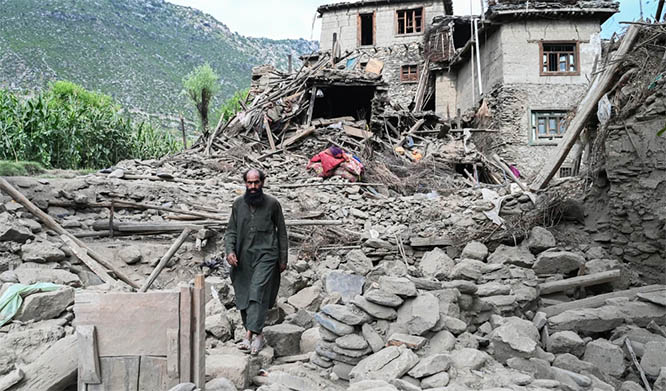
Rescuers searched into the night on Monday for survivors after the 6.0-magnitude quake struck on Sunday destroying entire villages across the country’s eastern Kunar province, which borders Pakistan.

Many remained trapped under the debris of mud and stone homes built into steep valleys, but rescuers struggled to reach remote areas because of rough mountainous terrain and inclement weather. It was a shallow earthquake, taking place just six miles beneath the Earth’s surface, which is known to have a particularly destructive impact. 

The death toll had passed 1,411, and more than 3,000 people were injured, Zabihullah Mujahid, a Taliban government spokesperson, said on Tuesday.

Authorities said they expected casualties to rise further once rescue teams reached more isolated locations, many of which remained inaccessible more than 24 hours after the earthquake struck.

Sharafat Zaman, a spokesperson for the health ministry in Kabul, called for international aid to tackle the devastation wreaked by the quake that struck at around midnight local time. “We need it because here lots of people lost their lives and houses,” he said.

Afghanistan had already been suffering from a severe economic crisis and a crippling withdrawal of international aid after the takeover of the country by the Taliban in 2021. Hardline Taliban policies such as a ban on female education and employment have spurred on a sharp drop in international aid funding and humanitarian assistance to the country.

The disaster will further stretch the resources of the war-torn nation’s Taliban administration, which is also grappling with the return of hundreds of thousands of Afghans deported by Iran and Pakistan in recent weeks.

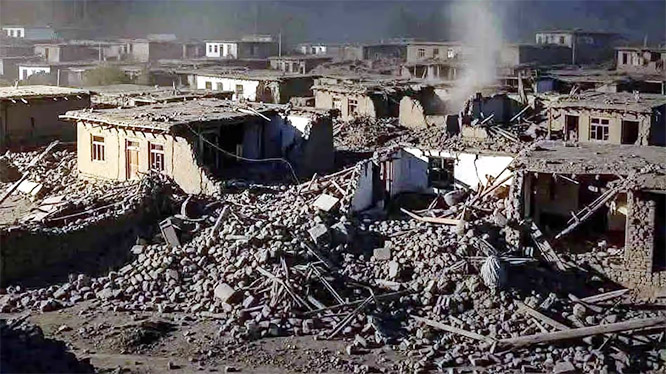
The quake razed three villages in Kunar and caused substantial damage in many others, authorities said. At least 610 people were killed in Kunar and there were 12 dead in Nangarhar, they added.

Ghazi Abad village, in the Nurgal district of Kunar, was a scene of devastation, the entire village destroyed. Homes had been reduced to rubble and many residents remained trapped under the debris.

Some villagers sat weeping amid the piled ruins of their homes. Others began laboriously clearing the debris by hand, or carried out the injured on makeshift stretchers.

“There is not a single standing room visible in this village,” said one resident, Abdullah. “The aftermath of the disaster suggests that life here was ended in mere seconds.”

Abdullah said adjoining villages had also suffered similar fates, completely levelled as the earthquake reduced every home to ruins. “The full extent of the earthquake’s impact will become clearer in the coming days as recovery efforts continue and many are still trapped,” he said.

“The losses are huge, people have no food and safe drinking water. While rescue operations are lacking, people are banding together to search for survivors and recover bodies all day and night. In one household there is no one left, everyone died here and their cattle are left alone.”

Another survivor said: “We need ambulances, we need doctors, we need everything to rescue the injured and recover the dead.”

In Kunar, the dead, some of them children, were wrapped in white shrouds by villagers who prayed over their bodies before burying them, while helicopters ferried the wounded to hospitals.

Rescuers were battling to reach remote mountainous areas cut off from mobile networks along the Pakistani border but their efforts were impeded by heavy rain, which heightened the risk of landslides and left many roads impassable. Military rescue teams fanned out across the region, the defence ministry said, with 40 flights carrying away 420 wounded and dead.

Experts urged the international community to step in and provide support, emphasising that the country’s own rescue and relief organisations were barely functional.

“The funds of the Afghan government that have been frozen by the US and other countries should be disbursed to international organisations that are carrying out relief work in Afghanistan,” said Osama Malik, an expert in international law. “The Pakistani government should also halt Afghan deportations at such a critical time when Afghanistan will be unable to manage an influx.”

On Monday, Britain set out emergency funding support for those affected by the recent earthquakes, saying it would ensure that the aid did not go to the Taliban administration by channelling it through its partners.

The US state department posted its condolences on X on Monday for the loss of life in the earthquake but did not immediately respond when asked if the US would provide any assistance.

India sends humanitarian aid

India has extended humanitarian assistance to Afghanistan following a series of powerful earthquakes. The Ministry of External Affairs (MEA) confirmed the aid in a post on X on Monday, stating, "India extends humanitarian assistance to Afghanistan in the wake of the earthquake."

The relief efforts include trucks loaded with sacks of rice and other essential food items. Early on Monday, a strong earthquake measuring 6.3 on the Richter scale struck eastern Afghanistan, with tremors felt as far away as Pakistan and India. The National Centre for Seismology (NCS) reported that several aftershocks followed, ranging between magnitudes 4 and 5.

Afghan.jpg

Comments

Add new comment

  • Coastaldigest.com reserves the right to delete or block any comments.
  • Coastaldigset.com is not responsible for its readers’ comments.
  • Comments that are abusive, incendiary or irrelevant are strictly prohibited.
  • Please use a genuine email ID and provide your name to avoid reject.
News Network
December 6,2025

pilot.jpg

New Delhi: IndiGo, India’s largest airline, faced major operational turbulence this week after failing to prepare for new pilot-fatigue regulations issued by the Directorate General of Civil Aviation (DGCA). The stricter rules—designed to improve flight safety—took effect in phases through 2024, with the latest implementation on November 1. IndiGo has acknowledged that inadequate roster planning led to widespread cancellations and delays.

Below are the key DGCA rules that affected IndiGo’s operations:

1. Longer Mandatory Weekly Rest

Weekly rest for pilots has been increased from 36 hours to 48 hours.

The government says the extended break is essential to curb cumulative fatigue. This rule remains in force despite the current crisis.

2. Cap on Night Landings

Pilots can now perform only two night landings per week—a steep reduction from the earlier limit of six.

Night hours, defined as midnight to early morning, are considered the least alert period for pilots.

Given the disruptions, this rule has been temporarily relaxed for IndiGo until February 10.

3. Reduced Maximum Night Flight Duty

Flight duty that stretches into the night is now capped at 10 hours.

This measure has also been kept on hold for IndiGo until February 10 to stabilize operations.

4. Weekly Rest Cannot Be Replaced With Personal Leave

Airlines can no longer count a pilot’s personal leave as part of the mandatory 48-hour rest.

Pilots say this closes a loophole that previously reduced actual rest time.

Currently, all airlines are exempt from this rule to normalise travel.

5. Mandatory Fatigue Monitoring

Airlines must submit quarterly fatigue reports along with corrective actions to DGCA.

This system aims to create a transparent fatigue-tracking framework across the industry.

The DGCA has stressed that these rules were crafted to strengthen flight safety and align India with global fatigue-management standards. The temporary relaxations are expected to remain until February 2025, giving IndiGo time to stabilise its schedules and restore normal air travel.

Comments

Add new comment

  • Coastaldigest.com reserves the right to delete or block any comments.
  • Coastaldigset.com is not responsible for its readers’ comments.
  • Comments that are abusive, incendiary or irrelevant are strictly prohibited.
  • Please use a genuine email ID and provide your name to avoid reject.
News Network
December 7,2025

envoy.jpg

Since 1946, the United States has attempted 93 coups or “regime change” operations across the world — including two in Iran, US Special Envoy for Syria Tom Barrack has admitted.

Speaking to the UAE-based IMI Media Group, in remarks published by The National, Barrack said Washington tried twice to overthrow the Iranian government but failed both times. 

“For (Trump) then to be imputed with regime change — we had two regime changes in Iran already. Neither one worked. So I think wisely leave it to the region to solve,” said Barrack, who also serves as the US ambassador to Turkey.

His comments come six months after the US joined Israel in airstrikes against Iran during ongoing indirect nuclear negotiations between Tehran and Washington.

On June 13, Israel launched an attack on Iran that killed at least 1,064 people and hit civilian infrastructure. Days later, the United States targeted three nuclear facilities — Fordow, Natanz and Isfahan — in what Iran called a clear violation of international law. Iranian retaliation eventually forced a halt to the assault on June 24.

Barrack further claimed that US President Donald Trump and Foreign Secretary Marco Rubio are “not into regime change” and prefer a regional approach driven by Middle Eastern countries themselves. According to him, regional dialogue and non-interference by outside powers offer a more durable path forward.

He added that Washington is still open to an agreement with Tehran if Iranian authorities show “seriousness” and willingness to engage constructively.

However, Iran maintains the US has not shown readiness for meaningful talks. In an interview with Japan’s Kyodo News, Iranian Foreign Minister Abbas Araghchi said negotiations could advance only if Washington acknowledges Iran’s right to peaceful nuclear energy and lifts unilateral sanctions.

Comments

Add new comment

  • Coastaldigest.com reserves the right to delete or block any comments.
  • Coastaldigset.com is not responsible for its readers’ comments.
  • Comments that are abusive, incendiary or irrelevant are strictly prohibited.
  • Please use a genuine email ID and provide your name to avoid reject.
News Network
December 2,2025

A major upgrade in safety and monitoring is planned for Haj 2026, with every Indian pilgrim set to receive a Haj Suvidha smart wristband linked to the official Haj Suvidha mobile app. The initiative aims to support pilgrims—especially senior citizens—who may struggle with smartphones during the 45-day journey.

What the Smart Wristband Will Do

Officials said the device will come with:
•    Location tracking
•    Pedometer
•    SOS emergency button
•    Qibla compass
•    Prayer timings
•    Basic health monitoring

SP Tiwari, secretary of the UP State Haj Committee, said the goal is to make the pilgrimage safer and more comfortable.

“Most Hajis are elderly and not comfortable with mobile apps,” he said. “The smartwatch will help locate pilgrims who forget their way or cannot communicate their location.”

The wristbands will be monitored by the Consulate General of India in Saudi Arabia, similar to mobile tracking via the Haj Suvidha App.

Free Distribution and Training

•    Smart wristbands will be given free of cost.
•    Training for pilgrims will be conducted between January and February 2026.
•    Sample units will reach state Haj committees soon.
•    Final devices will be distributed as pilgrims begin their journey.

New Rules for Accommodation

Two major decisions have also been finalised for Haj 2026:
1.    Separate rooms for men and women – including married couples. They may stay on the same floor but must occupy different rooms, following stricter Saudi guidelines.
2.    Cooking banned – gas cylinders will not be allowed; all meals will be provided through official catering services arranged by the Haj Committee of India.

These decisions were finalised during a meeting of the Haj Committee of India and state representatives in Mumbai.

Haj Suvidha App Launched Earlier

The government launched the Haj Suvidha App in 2024, offering:

•    Training modules
•    Accommodation and flight details
•    Baggage information
•    SOS and translation tools
•    Grievance redressal

Haj 2026 Quota and Key States

•    India’s total Haj quota for 2026: 1,75,025 pilgrims
•    70% (1,25,000) allotted to the Haj Committee of India
•    30% (around 50,000) reserved for Haj Group Organisers

Uttar Pradesh has the largest allocation (around 30,000 seats), though approximately 18,000 pilgrims are expected to go this year. States with high pilgrim numbers include Kerala, Maharashtra and Gujarat.

Dates of Haj 2026

The pilgrimage is scheduled to take place from 24 May to 29 May, 2026 (tentative).
Haj is one of the five pillars of Islam and is mandatory for Muslims who meet the required conditions.

Comments

Add new comment

  • Coastaldigest.com reserves the right to delete or block any comments.
  • Coastaldigset.com is not responsible for its readers’ comments.
  • Comments that are abusive, incendiary or irrelevant are strictly prohibited.
  • Please use a genuine email ID and provide your name to avoid reject.