



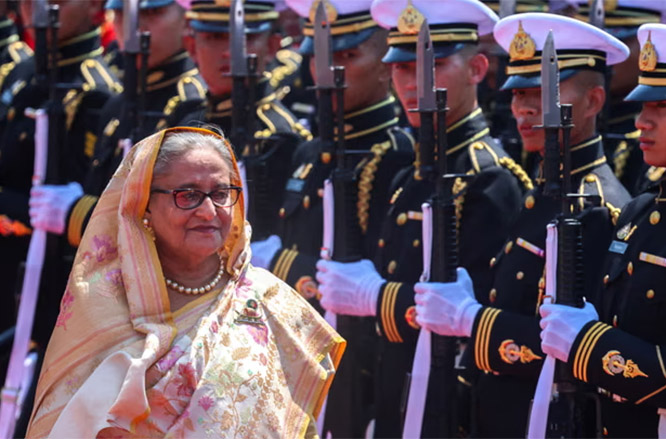
Bangladesh’s deposed prime minister Sheikh Hasina has been sentenced to death in absentia by the International Crimes Tribunal in Dhaka for alleged crimes against humanity linked to last year’s deadly crackdown on a student-led uprising.
A three-judge bench found Hasina guilty of incitement, issuing orders to kill, and failing to prevent atrocities committed during the state’s violent response to anti-government protests. Delivering the verdict, Justice Golam Mortuza Mozumder stated that the “accused prime minister committed crimes against humanity by ordering the use of drones, helicopters, and lethal weapons.”
Hasina, who denied all charges, had earlier dismissed the proceedings as a “politically motivated charade.” She fled the country in August last year and has since been living in exile in India, where she is reportedly under protection. New Delhi has so far ignored Dhaka’s requests seeking her extradition.
Family members of protesters killed during the uprising wept in the courtroom as judges handed down death sentences to both Hasina and her co-accused, former home minister Asaduzzaman Khan.
Hasina’s empty seat in the defendant’s box underscored her absence. In an audio message released prior to the verdict, she remained defiant: “Let them announce whatever verdict they want. It doesn’t matter to me. Allah gave me this life and only He can end it. I will still serve my people.”
Security across Dhaka had been tightened in anticipation of the ruling, with police, army, and paramilitary forces cordoning off the tribunal area. Authorities issued a “shoot-on-sight” directive against anyone found hurling crude bombs or torching vehicles. On Monday morning, a small explosive thrown near the court triggered panic and prompted an immediate lockdown of surrounding roads.
The mass movement that eventually toppled Hasina began as a student protest but soon swelled into a nationwide uprising — now referred to as the “July Revolution” — against what many described as her increasingly authoritarian rule. During her 15 years in power, Hasina faced persistent accusations of corruption, torture, and enforced disappearances, widely documented by human rights groups and the United Nations.
In response to the unrest, she oversaw a brutal state crackdown, with security forces allegedly using live ammunition on civilians. The UN human rights office estimates that up to 1,400 people were killed during the uprising, marking the deadliest political violence in Bangladesh since the 1971 war of independence.
Hasina’s prosecution was a key promise of the interim government led by Nobel laureate Muhammad Yunus, who was appointed by protest leaders last year. The tribunal proceedings were driven by chief prosecutor Mohammad Tajul Islam, tasked with building the landmark case against the former prime minister.


Comments
Add new comment