



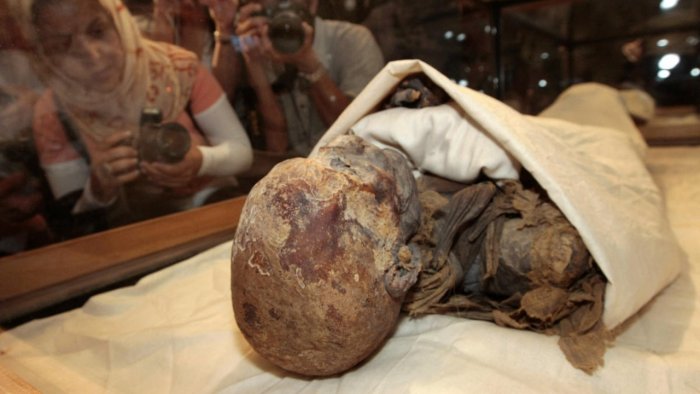
Egypt gears up for 'Golden Parade' of pharaohs

News Network
April 3, 2021

pharaoh.jpg

Cairo, Apr 3: The mummified remains of 22 Egyptian pharaohs, including the most powerful ancient queen, are to be paraded through the streets of Cairo Saturday, in a procession to a new resting place.

Under the watchful eyes of security forces, the mummies will be moved seven kilometres (four miles) across the capital from the iconic Egyptian Museum, where most have resided undisturbed for over a century, to the new National Museum of Egyptian Civilisation.

Dubbed the Pharaohs' Golden Parade, the 18 kings and four queens will travel in order, oldest first, each aboard a separate float decorated in ancient Egyptian style.

The interior ministry said both pedestrians and vehicles would be barred from Tahrir Square, site of the current museum, and other sections of the parade route, ahead of the 6:00 pm (1600 GMT) start.

"The whole world will be watching," said Egyptian archaeologist and former antiquities minister Zahi Hawass, who will commentate as the event unfolds live on state television.

"This is an important 40 minutes in the life of the city of Cairo."

Seqenenre Tao II, "the Brave", who reigned over southern Egypt some 1,600 years before Christ, will be on the first chariot, while Ramses IX, who reigned in the 12th century BC, will be at the rear.

Ramses II and Queen Hatshepsut, the most powerful female pharaoh, will also make the journey.

Emblazoned with the name of their allotted sovereign, the gold-coloured carriages will be fitted with shock absorbers for the trip, to ensure none of the precious cargos are accidentally disturbed.

Discovered near Luxor from 1881 onwards, most of the mummies have lain in the Egyptian Museum since the early 1900s.

Fascinating new details of the pharaohs' lives are still emerging.

A recent high-tech study of Seqenenre Tao II, involving CT scans and 3D images of his hands and long-studied skull fractures, indicated that he was likely killed in a post-battle execution ceremony.

For their procession through Cairo's streets, the mummies will be in special containers filled with nitrogen, under conditions similar to their regular display cases.

The mummies will be showcased individually at the National Museum of Egyptian Civilisation, in an environment redolent of underground tombs.

They will be signposted by a brief biography and, in some cases, copies of CT scans.

Upon arrival, they will occupy "slightly upgraded cases," said Salima Ikram, professor of Egyptology at the American University in Cairo.

"The temperature and humidity control will be even better than it was in the old museum," added Ikram, a mummification specialist.

The mummies' re-housing "marks the end of much work to improve their conservation and exhibition," said UNESCO Director-General Audrey Azoulay.

"This raises emotions that go much further than the mere relocation of a collection -- we will see the history of Egyptian civilisation unfold before our eyes," she added.

The National Museum of Egyptian Civilisation was completed in 2010, and Hawass said he had planned to open it in 2012. But the process was delayed by the Arab Spring revolution of 2011 and subsequent turmoil.

The new museum opened its doors to limited exhibits from 2017 and will open fully on Sunday, before the mummies go on display to the general public from April 18.

In the coming months, the country is due to inaugurate another new showcase, the Grand Egyptian Museum, near the Giza pyramids.

It too will house pharaonic collections, including the celebrated treasure of Tutankhamun.

Discovered in 1922, the tomb of the young ruler, who took the throne briefly in the 14th century BC, contained treasures including gold and ivory.

A so-called "curse of the pharaoh" emerged in the wake of Tutankhamun's unearthing in 1922-23.

A key funder of the dig, Lord Carnarvon, died of blood poisoning months after the tomb was opened, while an early visitor likewise died abruptly in 1923.

With the planned parade coming only days after several disasters struck Egypt, some have inevitably speculated on social media about a new curse provoked by the latest move.

Recent days have seen a deadly rail collision and a building collapse in Cairo, while global headlines were dominated by the struggle to refloat the giant container ship MV Ever Given which blocked the Suez Canal for almost a week.


Comments

Add new comment

  • Coastaldigest.com reserves the right to delete or block any comments.
  • Coastaldigset.com is not responsible for its readers’ comments.
  • Comments that are abusive, incendiary or irrelevant are strictly prohibited.
  • Please use a genuine email ID and provide your name to avoid reject.
News Network
December 6,2025

pilot.jpg

New Delhi: IndiGo, India’s largest airline, faced major operational turbulence this week after failing to prepare for new pilot-fatigue regulations issued by the Directorate General of Civil Aviation (DGCA). The stricter rules—designed to improve flight safety—took effect in phases through 2024, with the latest implementation on November 1. IndiGo has acknowledged that inadequate roster planning led to widespread cancellations and delays.

Below are the key DGCA rules that affected IndiGo’s operations:

1. Longer Mandatory Weekly Rest

Weekly rest for pilots has been increased from 36 hours to 48 hours.

The government says the extended break is essential to curb cumulative fatigue. This rule remains in force despite the current crisis.

2. Cap on Night Landings

Pilots can now perform only two night landings per week—a steep reduction from the earlier limit of six.

Night hours, defined as midnight to early morning, are considered the least alert period for pilots.

Given the disruptions, this rule has been temporarily relaxed for IndiGo until February 10.

3. Reduced Maximum Night Flight Duty

Flight duty that stretches into the night is now capped at 10 hours.

This measure has also been kept on hold for IndiGo until February 10 to stabilize operations.

4. Weekly Rest Cannot Be Replaced With Personal Leave

Airlines can no longer count a pilot’s personal leave as part of the mandatory 48-hour rest.

Pilots say this closes a loophole that previously reduced actual rest time.

Currently, all airlines are exempt from this rule to normalise travel.

5. Mandatory Fatigue Monitoring

Airlines must submit quarterly fatigue reports along with corrective actions to DGCA.

This system aims to create a transparent fatigue-tracking framework across the industry.

The DGCA has stressed that these rules were crafted to strengthen flight safety and align India with global fatigue-management standards. The temporary relaxations are expected to remain until February 2025, giving IndiGo time to stabilise its schedules and restore normal air travel.

Comments

Add new comment

  • Coastaldigest.com reserves the right to delete or block any comments.
  • Coastaldigset.com is not responsible for its readers’ comments.
  • Comments that are abusive, incendiary or irrelevant are strictly prohibited.
  • Please use a genuine email ID and provide your name to avoid reject.
News Network
December 7,2025

SHRIMP.jpg

Mangaluru, Dec 7: A rare bamboo shrimp has been rediscovered on mainland India more than 70 years after it was last reported, confirming for the first time the presence of Atyopsis spinipes in the country. The find was made by researchers from the Centre for Climate Change Studies at Sathyabama Institute of Science and Technology, Chennai, during surveys in Karnataka and Odisha.

The team — shrimp expert Dr S Prakash, PhD scholar K Kunjulakshmi, and Mangaluru-based researcher Maclean Antony Santos — combined field surveys, ecological assessments and DNA analysis to identify the elusive species. Their findings, published in Zootaxa, resolve decades of taxonomic confusion stemming from a 1951 report that misidentified the species as Atyopsis moluccensis without strong evidence.

The shrimp has now been confirmed at two locations: the Mulki–Pavanje estuary near Mangaluru and the Kuakhai River in Bhubaneswar. Historical specimens from the Andaman Islands, previously labelled as A. moluccensis, were also found to be misidentified and actually belong to A. spinipes.

The rediscovery began after an aquarium hobbyist in Odisha spotted a shrimp in 2022, prompting systematic surveys across Udupi, Karwar and Mangaluru. Four female specimens were collected in Mulki and one in Odisha, all genetically matching.

Researchers warn the species may exist in very small, vulnerable populations as freshwater habitats face increasing pressure from pollution, sand mining and infrastructure development. All verified specimens have been deposited with the Zoological Survey of India for future reference.

Comments

Add new comment

  • Coastaldigest.com reserves the right to delete or block any comments.
  • Coastaldigset.com is not responsible for its readers’ comments.
  • Comments that are abusive, incendiary or irrelevant are strictly prohibited.
  • Please use a genuine email ID and provide your name to avoid reject.
News Network
December 4,2025

Udupi: A 40-year-old NRI from Udupi has reportedly lost more than Rs 12.25 lakh in an online investment scam operated through Telegram.

According to a complaint filed at the CEN police station, Leo Jerome Mendonsa, who has been working in Dubai for the past 15 years in computer accessories sales, maintains NRI accounts in Karkala and Nitte.

On November 12, 2025, Mendonsa was added to a Telegram group called Instaflow Earnings by unknown individuals. Users identified as Priya and Dipannita persuaded him to invest in “Revenue Tasks.” Initially, Mendonsa transferred Rs 1,100 multiple times and received the promised returns, encouraging him to continue.

On November 14, another user, Nishmitha Shetty, directed him to register on a website, digitvisionuoce.cc, and invest Rs 4 lakh in various shares. Over the next few days, he made multiple transfers totaling Rs 12,25,000, including Rs 50,000 via Google Pay, believing the scheme was legitimate.

After receiving the money, the alleged handlers stopped responding, and neither the invested amount nor the promised profits were returned.

The CEN police have registered a case under Sections 66(C) and 66(D) of the IT Act and Section 318(4) of the Bharatiya Nyaya Sanhita (BNS), and investigations are ongoing.

Comments

Add new comment

  • Coastaldigest.com reserves the right to delete or block any comments.
  • Coastaldigset.com is not responsible for its readers’ comments.
  • Comments that are abusive, incendiary or irrelevant are strictly prohibited.
  • Please use a genuine email ID and provide your name to avoid reject.
