Israel Bombed World's Largest Gas Field in Iran: World Can’t Ignore It!

Agencies
June 15, 2025

gasfield.jpg

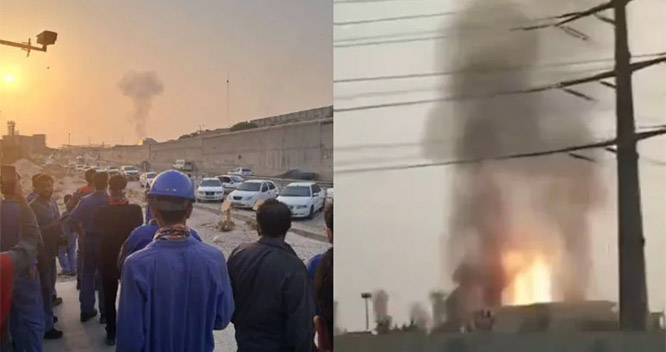
In a significant and highly provocative escalation, Israel launched a direct airstrike on Iran’s South Pars gas field, the largest natural gas reserve in the world. The strike hit Phase 14 of the offshore site, sparking a fire and forcing Iran to suspend production of 12 million cubic metres of gas per day.

This is believed to be the first direct Israeli strike on Iran’s civilian energy infrastructure, marking a sharp departure from previous attacks that primarily targeted military and nuclear facilities. The global implications of such a move are potentially severe, as the strike puts shared and strategic energy assets in the Persian Gulf in direct danger.

What Is South Pars and Why Is It So Important?

South Pars, located off the coast of Bushehr Province, is shared between Iran and Qatar (which calls its section the North Field). Together, this reservoir is the world’s largest source of natural gas.

Iran relies on South Pars for over 65 percent of its domestic gas consumption, which powers electricity generation, heating, and the petrochemical sector. While sanctions have limited Iran’s exports, countries like Iraq still receive Iranian gas.

Meanwhile, Qatar's portion of the same field helps supply Europe and Asia with 77 million tonnes of liquefied natural gas (LNG) each year. It is developed with the backing of energy giants such as Shell and ExxonMobil.

A direct strike on such an asset threatens not just Iran but the entire region's stability, raising alarm about the possibility of attacks on other energy hubs.

Has Israel Crossed a Red Line?

Energy experts and geopolitical analysts suggest this strike represents a strategic shift.

“This is probably the most significant attack on energy infrastructure since Abqaiq,” said Jorge Leon of Rystad Energy, referring to the 2019 drone strike on Saudi Arabia’s oil facilities that sent shockwaves through global markets.

The targeting of civilian energy infrastructure adds a new, dangerous dimension to the conflict, signaling that economic warfare is now part of the confrontation. With South Pars located near the Strait of Hormuz—a chokepoint for 21 percent of global LNG exports and 14 million barrels of oil daily—any escalation could have worldwide consequences.

Global Energy at Risk

Though South Pars primarily serves Iran’s domestic market, the potential for broader fallout is significant. Escalation could lead to retaliatory attacks on other vital infrastructure, including Qatar’s LNG terminals and Kharg Island, Iran’s main oil export hub.

Oil prices surged up to 14 percent, settling near $73 per barrel, amid fears of a broader energy crisis. With OPEC’s third-largest producer under attack, the possibility of disruptions in the Strait of Hormuz could cause dramatic spikes in fuel costs and inflation across Europe, Asia, and beyond.

Iran’s Response and Energy Crisis

Iranian President Masoud Pezeshkian denounced the strike, calling it a “cowardly attack on the lifeline of the Iranian people,” and vowed a strong response. Even before the strike, Iran was battling a worsening energy crisis, with blackouts and gas shortages costing the economy an estimated $250 million per day.

“Damaging this infrastructure is not only inhumane but economically catastrophic,” said Abdollah Babakhani, an Iranian energy expert based in Germany. “Repairing it will take months, possibly years.”

A Precedent With Global Fallout

The strike may signal a new phase of the Iran-Israel conflict, where energy infrastructure becomes a legitimate target. This shift could open the floodgates for regional instability and global energy insecurity, especially if other countries or non-state actors retaliate in kind.

The international community must recognize what’s at stake. If the world’s largest gas field can be bombed with impunity, no energy hub is truly safe—a scenario that could lead to spiraling conflict, inflation, and disruption on a global scale.

Comments

Add new comment

  • Coastaldigest.com reserves the right to delete or block any comments.
  • Coastaldigset.com is not responsible for its readers’ comments.
  • Comments that are abusive, incendiary or irrelevant are strictly prohibited.
  • Please use a genuine email ID and provide your name to avoid reject.
News Network
January 14,2026

utifti.jpg

The National Commission for Allied and Healthcare Professions (NCAHP) has announced that admissions to undergraduate programmes in physiotherapy and occupational therapy will henceforth be conducted exclusively through the National Eligibility-cum-Entrance Test (NEET).

In a press release issued by Prof. U. T. Iftikhar Ali Fareed, Chairman of the Karnataka State Allied and Healthcare Council, stated that the NCAHP has clarified the category-wise degree nomenclature and admission criteria for allied and healthcare undergraduate programmes, effective from the academic year 2026–27.

According to the notification, admissions to the Bachelor of Physiotherapy (BPT) – Category 3 and Bachelor of Occupational Therapy (BOT) – Category 6 will be conducted only through NEET, in accordance with the National Commission for Allied and Healthcare Professions Act, 2021.

All Vice-Chancellors of public, private, and deemed-to-be universities in Karnataka have been asked to ensure strict compliance with the NCAHP guidelines and to disseminate the information widely among affiliated colleges, faculty, and students.

Prof. Ifthikar Ali emphasized that universities must take necessary steps to implement the admission procedure for the academic year 2026–27 and subsequent years.
 

Comments

Add new comment

  • Coastaldigest.com reserves the right to delete or block any comments.
  • Coastaldigset.com is not responsible for its readers’ comments.
  • Comments that are abusive, incendiary or irrelevant are strictly prohibited.
  • Please use a genuine email ID and provide your name to avoid reject.
News Network
January 5,2026

indianwoman.jpg

Las Vegas/New York: A 27-year-old Indian woman who had been reported missing since New Year’s Eve was found murdered with stab wounds inside her ex-boyfriend’s apartment in the US state of Maryland, police said.

The victim has been identified as Nikitha Godishala, a data and strategy analyst from Ellicott City. Her body was discovered inside an apartment owned by Arjun Sharma (26), her former boyfriend, according to the Howard County Police Department.

Investigators have obtained an arrest warrant charging Sharma with first- and second-degree murder.

Police said Sharma filed a missing person complaint on January 2, claiming he last saw Godishala on December 31 at his apartment. On January 3, detectives executed a search warrant at the same residence and found Godishala dead with multiple stab wounds.

Authorities said Sharma left the United States for India on the same day he reported Godishala missing.

Based on the investigation so far, detectives believe Godishala was killed shortly after 7 pm on December 31. The motive behind the killing remains unknown, and the investigation is ongoing.

Howard County police said they are working with federal law enforcement agencies to locate and arrest the suspect.

Meanwhile, the Indian Embassy said it is in contact with Godishala’s family and is extending all possible consular assistance. “The Embassy is also following up the matter with the local authorities,” it said.

Notably, India and the United States have an extradition treaty that allows cooperation in serious criminal cases, although such proceedings typically involve legal reviews and diplomatic coordination and may take several months.

Comments

Add new comment

  • Coastaldigest.com reserves the right to delete or block any comments.
  • Coastaldigset.com is not responsible for its readers’ comments.
  • Comments that are abusive, incendiary or irrelevant are strictly prohibited.
  • Please use a genuine email ID and provide your name to avoid reject.
News Network
January 6,2026

sharmila.jpg

Bengaluru A 34-year-old software engineer from Mangaluru lost her life due to asphyxiation after a fire broke out in her apartment in Ramamurthy Nagar late on Saturday night.

The deceased has been identified as Sharmila, a native of Kavoor in Mangaluru. She had relocated to Bengaluru about a year ago in search of better career prospects and was residing in an apartment complex at Subramanya Layout.

The incident occurred around 11 pm when Sharmila was alone in the flat, as her roommate had travelled out of town for the weekend. Preliminary investigations suggest that the fire may have been triggered by a short circuit in one of the rooms. Within a short span, the apartment was filled with dense, toxic smoke.

As the flames spread, the power supply to the building was cut off, plunging the flat into darkness. Police believe that Sharmila, trapped inside the smoke-filled apartment and unable to find an exit or a source of ventilation, succumbed to smoke inhalation.

The fire caused extensive damage to household items, with beds, curtains and other furniture completely gutted. Personnel from the Ramamurthy Nagar police shifted the body for post-mortem examination, which has since been completed. The mortal remains were later handed over to her family.

A case has been registered, and the police have launched a detailed investigation to determine the exact cause of the suspected electrical failure.

Comments

Add new comment

  • Coastaldigest.com reserves the right to delete or block any comments.
  • Coastaldigset.com is not responsible for its readers’ comments.
  • Comments that are abusive, incendiary or irrelevant are strictly prohibited.
  • Please use a genuine email ID and provide your name to avoid reject.