Syrup from India caused mass child deaths in Gambia, confirms panel of experts

News Network
May 24, 2023

syrup.jpg

Tainted syrup medicine imported from India was the cause of an outbreak of kidney failure that killed more than 60 children in the West African nation of Gambia last year, according to a report by a team of international experts.

The report, submitted to the Gambian health ministry earlier this year and not yet made public, is the most definitive statement yet on the cause of the episode. It contradicts the official position of Indian authorities, who insist that the country’s products weren’t to blame. A director for the Gambian ministry of health didn’t respond to calls and an emailed request for comment.

Although the committee was able to establish that a child drank the contaminated medicine from an Indian drugmaker, Maiden Pharmaceuticals Ltd., in only 22 deaths from so-called acute kidney injury, or AKI, it said that symptoms in 30 others were consistent with the poison’s effects and no other cause could be found. It lacked enough information on 13 more cases. 

“The outbreak of AKI in children in the Gambia is attributable to medicines contaminated with DEG/EG,” the committee concluded, referring to the two contaminants, diethylene glycol and ethylene glycol.

Last year’s outbreak sparked concerns about the quality of generic medicine from India, an export powerhouse that calls itself the “pharmacy of the world.” Those concerns intensified this year when exported syrups from two other Indian manufacturers were found to be tainted in the same way, leading in one case to about 20 deaths in Uzbekistan.

“We have made our stand clear that as per our testing, the product had no issue,” said Rajeev Raghuvanshi, the Indian drug controller general, in a text message to Bloomberg. He referred further questions to the health ministry, which didn’t respond to requests for comment. A representative of Maiden also didn’t respond to inquiries.

India’s central government this week imposed a new regulation requiring cough syrup to be tested by a government lab before it can be exported.

Products from Maiden, a small New Delhi firm, fell under suspicion in Gambia last September, when health officials investigating the outbreak arranged tests of several drugs given to children prior to their deaths. Three labs in three different countries would eventually confirm the presence of the contaminants in Maiden products, the committee said in its report. 

The World Health Organization issued a public alert in October and Gambia recalled the drugs.

“After the poisonous medicines were withdrawn, there were no further cases,” said Kalle Hoppu, one of the committee members, in an email to Bloomberg. He called that “a very definitive sign that this outbreak was caused by these medicines.” Hoppu is a former director of the Poison Information Center at Helsinki University Hospital in Finland.

Indian authorities have defended the drugs. In December, the Indian drug controller general at the time, V.G. Somani, told the WHO that his organization’s own tests of Maiden drugs found no contamination. He went on to accuse the agency of acting on flimsy evidence and having “adversely impacted the image of Indian pharmaceutical products across the globe.” As recently as March, the Indian government said in a statement that the drugs weren’t tainted and didn’t kill anyone. 

Earlier reports by a Gambian parliamentary committee and by the U.S. Centers for Disease Control and Prevention both pointed to the Maiden drugs as the most plausible explanation for the outbreak. But the report by the 11-member expert committee was the first charged specifically with establishing the cause. 

The panel was set up by Gambia’s health ministry and consisted of five clinicians from local hospitals, two WHO officials, and four consultants from Senegal, Finland, and the UK. It was chaired by Abdou Niang, a nephrologist and professor at Cheikh Anta Diop University in Senegal. Members met for a week in December, and Hoppu said the report was submitted to the health ministry sometime around February. It’s unclear why the report has not been made public.

At the time the committee convened in December, Gambian authorities had logged 70 deaths of children suffering from AKI. Of those, the committee couldn’t get detailed information on 13, and it concluded that one death wasn’t consistent with AKI. That left 56 deaths that it examined in detail. The children in this group were about two years old on average, the committee report said.

In only four of the 56 cases did the committee find a possible alternative or contributing cause, such as Covid-19 or severe malaria. That left the 22 it tied to consumption of Maiden drugs, and 30 others where consumption of the drugs wasn’t established but the symptoms were consistent with exposure to the contaminants and no alternative cause was found. The report noted that parents can’t always recall the brand of medications they give their children. 

Comments

Add new comment

  • Coastaldigest.com reserves the right to delete or block any comments.
  • Coastaldigset.com is not responsible for its readers’ comments.
  • Comments that are abusive, incendiary or irrelevant are strictly prohibited.
  • Please use a genuine email ID and provide your name to avoid reject.
News Network
December 2,2025

DKSsiddu.jpg

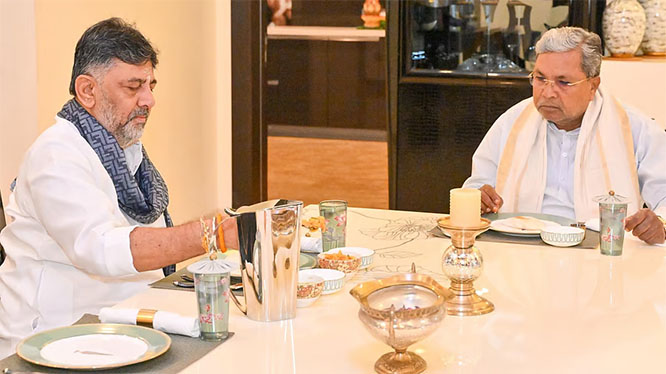
Bengaluru: 'Nati koli saaru' (country chicken curry) considered one of Chief Minister Siddaramaiah’s favourites along with steaming hot idlis was on the breakfast menu at Deputy CM D K Shivakumar’s residence on Tuesday, according to official sources.

The spread also included 'nati koli' fry, vada and pongal, among other items, they said.

In an apparent show of unity, Siddaramaiah visited Shivakumar’s residence for breakfast, just days after the two leaders shared a meal amid a simmering power tussle in the state Congress.

Siddaramaiah drove to the Deputy CM’s residence in Sadashivanagar, where he was received by Shivakumar and his brother D K Suresh, who is a former Congress MP.

Suresh and Kunigal MLA H D Ranganath, a relative of Shivakumar, joined them for breakfast, which featured a mix of vegetarian and non-vegetarian dishes.

Speaking to reporters later, Siddaramaiah said Shivakumar had invited him during his visit to the CM’s residence for breakfast on Saturday.

Asked about the difference between the two meals, the chief minister said, "At his (Shivakumar’s) house it was non-veg, while at my house it was veg. He is a vegetarian, I am a non-vegetarian. I had not prepared non-veg. I told DK to get chicken from the village as you won’t get the original in Bengaluru."

Shivakumar said he had initially invited Siddaramaiah to his residence, but the CM had suggested visiting his place first and reciprocating later. "It was a vegetarian breakfast at the CM’s house on Saturday," he noted.

"Today, I invited him (the CM) to my house. He enjoyed the breakfast, which had his Mysuru taste," Shivakumar added. At this point, Siddaramaiah remarked that Shivakumar’s wife is also from Mysuru.

Saturday’s breakfast at Siddaramaiah’s official residence, held as part of efforts by the Congress high command to ease tensions in the leadership dispute between the two, reportedly included idlis and sambar, according to official sources.

Comments

Add new comment

  • Coastaldigest.com reserves the right to delete or block any comments.
  • Coastaldigset.com is not responsible for its readers’ comments.
  • Comments that are abusive, incendiary or irrelevant are strictly prohibited.
  • Please use a genuine email ID and provide your name to avoid reject.
News Network
December 7,2025

Mangaluru, Dec 7: A 34-year-old fruit and vegetable trader in Mangaluru has reportedly lost ₹33.1 lakh after falling victim to an online investment scam run through a fake mobile app.

Police said the scam began in September, when the victim received a link on Facebook. Clicking it connected him to a WhatsApp number, where an unidentified person introduced a high-return investment scheme and instructed him to download an app.

To build trust, the fraudster asked him to invest ₹30,000 on September 24. The trader soon received ₹34,000 as “profit,” convincing him the scheme was genuine. Over the next two months, he transferred money in multiple instalments via Google Pay and IMPS to different scanner codes and bank accounts shared by the scammers. Between September 24 and December 3, he ended up sending a total of ₹33.1 lakh.

When he later requested a refund of his investment and promised returns, the scammers demanded additional payments, claiming he needed to pay a “service tax” first. Even after he paid a small amount, no money was returned, and the scammers continued pressuring him for more.

A case has been registered at the CEN Crime Police Station.

Comments

Add new comment

  • Coastaldigest.com reserves the right to delete or block any comments.
  • Coastaldigset.com is not responsible for its readers’ comments.
  • Comments that are abusive, incendiary or irrelevant are strictly prohibited.
  • Please use a genuine email ID and provide your name to avoid reject.
News Network
December 5,2025

Mangaluru: In a significant step to curb online hate and intimidation, Mangaluru City Police have registered a suo motu case against multiple Instagram accounts accused of circulating alleged provocative and threatening content.

While monitoring social media activity on Tuesday, Kankanady Town PSI Anitha Nikkam identified the Instagram handle ‘team_targetttt_900’ for posting a hate message alongside images of lethal weapons. Another account, ‘team_nagara_900’, allegedly shared a threatening post targeting activist Bharath Kumdelu, tagging additional pages such as KARAVALI-OFFICIAL.

Several other accounts — including ‘immu_bhai.fan’, ‘target_boy_900’, ‘kings_of_manglore’, ‘team_target_boys.900’, ‘arshad_mangalore’, ‘target_ka19_ullal’, ‘team_target__’, ‘troll_tigersz_900’, ‘tr_group_900’, and ‘team_target_900’ — are also under scrutiny for spreading similar inflammatory material, police said.

Authorities have urged citizens, especially young social media users, to report suspicious pages and avoid engaging with groups that glorify violence or threaten individuals. Online hate can quickly escalate into real-world harm, and police stress that sharing or promoting such content can attract legal consequences.

Comments

Add new comment

  • Coastaldigest.com reserves the right to delete or block any comments.
  • Coastaldigset.com is not responsible for its readers’ comments.
  • Comments that are abusive, incendiary or irrelevant are strictly prohibited.
  • Please use a genuine email ID and provide your name to avoid reject.