World's largest hotel with 12 towers, 10,000 rooms to open in Makkah

May 23, 2015

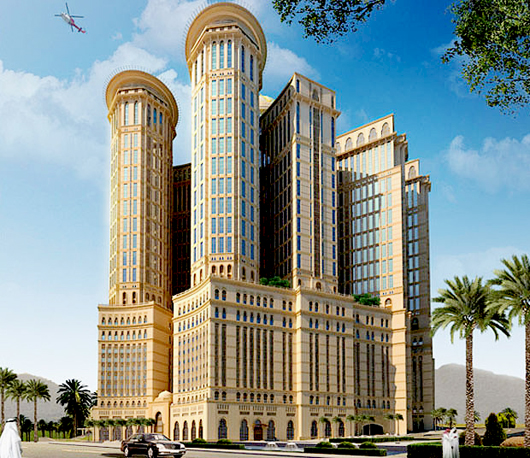
Makkah, May 23: Four helipads will cluster around one of the largest domes in the world, like sideplates awaiting the unveiling of a momentous main course, which will be jacked up 45 storeys into the sky above the deserts of Makkah. It is the crowning feature of the holy city’s crowning glory, the superlative summit of what will be the world’s largest hotel when it opens in 2017.
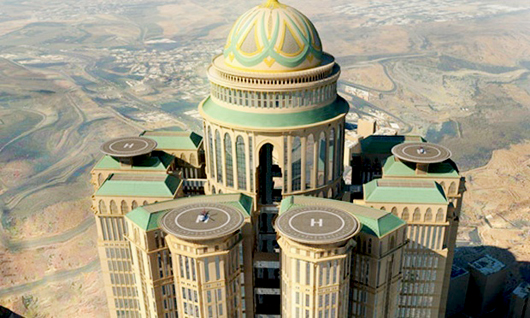
hotel

With 10,000 bedrooms and 70 restaurants, plus five floors for the sole use of the Saudi royal family, the £2.3bn Abraj Kudai is an entire city of five-star luxury, catering to the increasingly high expectations of well-heeled pilgrims from the Gulf.

Modelled on a “traditional desert fortress”, seemingly filtered through the eyes of a Disneyland imagineer with classical pretensions, the steroidal scheme comprises 12 towers teetering on top of a 10-storey podium, which houses a bus station, shopping mall, food courts, conference centre and a lavishly appointed ballroom.
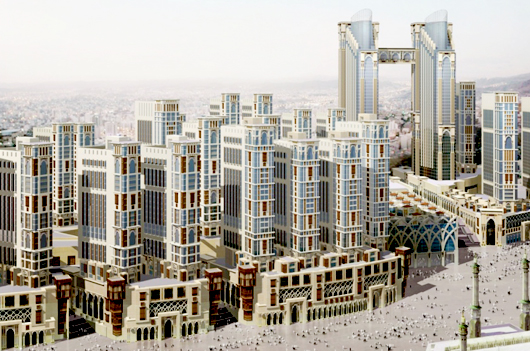
largest hotel 1

Located in the Manafia district, just over a mile south of the Grand Mosque, the complex is funded by the Saudi Ministry of Finance and designed by the Dar Al-Handasah group, a 7,000-strong global construction conglomerate that turns its hand to everything from designing cities in Kazakhstan to airports in Dubai. For the Abraj Kudai, it has followed the wedding-cake pastiche style of the city’s recent hotel boom: cornice is piled upon cornice, with fluted pink pilasters framing blue-mirrored windows, some arched with a vaguely Ottoman air. The towers seem to be packed so closely together that guests will be able to enjoy views into each other’s rooms.
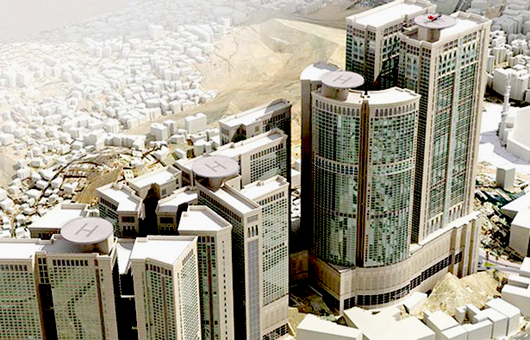
largest hotel 1

“The city is turning into Makkah-hattan,” says Irfan Al-Alawi, director of the UK-based Islamic Heritage Research Foundation, which campaigns to try to save what little heritage is left in Saudi Arabia’s holy cities. “Everything has been swept away to make way for the incessant march of luxury hotels, which are destroying the sanctity of the place and pricing normal pilgrims out.”

The Grand Mosque is now loomed over by the second tallest building in the world, the Abraj al-Bait clocktower, home to thousands more luxury hotel rooms, where rates can reach £4,000 a night for suites with the best views of the Kaaba – the black cube at the centre of the mosque around which Muslims must walk. The hotel rises 600m (2,000ft) into the air, projecting a dazzling green laser-show by night, on a site where an Ottoman fortress once stood – razed for development, along with the hill on which it sat.

The list of heritage crimes goes on, driven by state-endorsed Wahhabism, the hardline interpretation of Islam that perceives historical sites as encouraging sinful idolatry – which spawned the ideology that is now driving Isis’s reign of destruction in Syria and Iraq. In Makkah and Medina, meanwhile, anything that relates to the prophet could be in the bulldozer’s sights. The house of Khadijah, his first wife, was crushed to make way for public lavatories; the house of his companion Abu Bakr is now the site of a Hilton hotel; his grandson’s house was flattened by the king’s palace. Moments from these sites now stands a Paris Hilton store and a gender-segregated Starbucks.
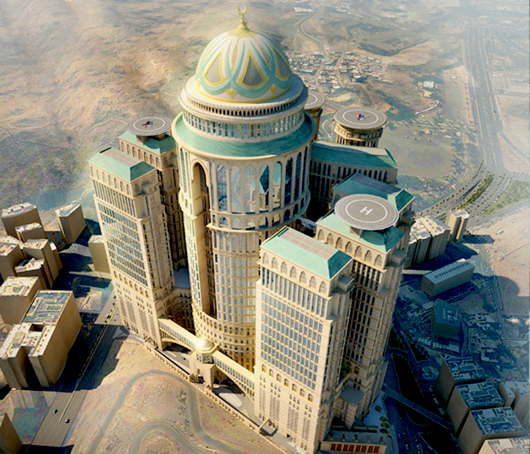
largest hotel 1

“These are the last days of Makkah,” says Alawi. “The pilgrimage is supposed to be a spartan, simple rite of passage, but it has turned into an experience closer to Las Vegas, which most pilgrims simply can’t afford.”

The city receives around 2 million pilgrims for the annual Hajj, but during the rest of the year more than 20 million visit the city, which has become a popular place for weddings and conferences, bringing in annual tourism revenue of around £6bn. The skyline bristles with cranes, summoning thickets of hotel towers to accommodate the influx. Along the western edge of the city the Jabal Omar development now rises, a sprawling complex that will eventually accommodate 100,000 people in 26 luxury hotels – sitting on another gargantuan plinth of 4,000 shops and 500 restaurants, along with its own six-storey prayer hall.

The Grand Mosque, meanwhile, is undergoing a £40bn expansion to double the capacity of its prayer halls – from 3 million worshippers currently to nearly 7 million by 2040. Planned like a vast triangular slice of cake, the extension goes so far back that most worshippers won’t even be able to see the Kaaba.

“It is just like an airport terminal,” says Alawi. “People have been finding they’re praying in the wrong direction because they simply don’t know which way the mosque is any more. It has made a farce of the whole place.”

largest hotel 1

Comments

Add new comment

  • Coastaldigest.com reserves the right to delete or block any comments.
  • Coastaldigset.com is not responsible for its readers’ comments.
  • Comments that are abusive, incendiary or irrelevant are strictly prohibited.
  • Please use a genuine email ID and provide your name to avoid reject.
News Network
December 3,2025

arrival.jpg

Mangaluru, Dec 3: A group of Congress workers gathered at the Mangaluru International Airport on Wednesday to welcome AICC general secretary K C Venugopal, but the reception quickly turned into a display of support for Deputy Chief Minister D K Shivakumar.

Venugopal arrived in the city to participate in the centenary commemoration of the historic dialogue between Mahatma Gandhi and Narayana Guru. The event, organised by the Sivagiri Mutt, Varkala, in association with the Mangalore University Sri Narayana Guru Study Chair, is being held on the university’s Konaje campus.

KPCC general secretary Mithun Rai and several party workers had assembled at the airport to receive Venugopal. However, the moment he stepped out, workers began raising slogans backing Shivakumar.

The university programme will be inaugurated by Chief Minister Siddaramaiah.

This show of support comes just a day after Siddaramaiah remarked that Shivakumar would lead the government “when the high command decides.” The chief minister made the comment after a breakfast meeting at Shivakumar’s residence—another public display of camaraderie between the two leaders amid ongoing attempts by the party high command to downplay their leadership rivalry.

Comments

Add new comment

  • Coastaldigest.com reserves the right to delete or block any comments.
  • Coastaldigset.com is not responsible for its readers’ comments.
  • Comments that are abusive, incendiary or irrelevant are strictly prohibited.
  • Please use a genuine email ID and provide your name to avoid reject.
News Network
December 4,2025

Mangaluru: Chaos erupted at Mangaluru International Airport (MIA) after IndiGo flight 6E 5150, bound for Mumbai, was repeatedly delayed and ultimately cancelled, leaving around 100 passengers stranded overnight. The incident highlights the ongoing country-wide operational disruptions affecting the airline, largely due to the implementation of new Flight Duty Time Limitations (FDTL) norms for crew.

The flight was initially scheduled for 9:25 PM on Tuesday but was first postponed to 11:40 PM, then midnight, before being cancelled around 3:00 AM. Passengers expressed frustration over last-minute communication and the lack of clarity, with elderly and ailing travellers particularly affected. “Though the airline arranged food, there was no proper communication, leaving us confused,” said one family member.

An IndiGo executive at MIA cited the FDTL rules, designed to prevent pilot fatigue by limiting crew working hours, as the cause of the cancellation. While alternative arrangements, including hotel stays, were offered, about 100 passengers chose to remain at the airport, creating tension. A replacement flight was arranged but also faced delays due to the same constraints, finally departing for Mumbai around 1:45 PM on Wednesday. Passengers either flew, requested refunds, or postponed their travel.

The Mangaluru delay is part of a broader crisis for IndiGo. The airline has been forced to make “calibrated schedule adjustments”—a euphemism for widespread cancellations and delays—after stricter FDTL norms came into effect on November 1.

While an IndiGo spokesperson acknowledged unavoidable flight disruptions due to technology issues, operational requirements, and the updated crew rostering rules, the DGCA has intervened, summoning senior airline officials to explain the chaos and outline corrective measures.

The ripple effect has been felt across the country, with major hubs like Bengaluru and Mumbai reporting numerous cancellations. The Mangaluru incident underscores the systemic operational strain currently confronting India’s largest carrier, leaving passengers nationwide grappling with uncertainty and delays.

Comments

Add new comment

  • Coastaldigest.com reserves the right to delete or block any comments.
  • Coastaldigset.com is not responsible for its readers’ comments.
  • Comments that are abusive, incendiary or irrelevant are strictly prohibited.
  • Please use a genuine email ID and provide your name to avoid reject.
News Network
December 15,2025

Mangaluru, Dec 15: Air India Express has announced that it will resume direct flight services between Mangaluru and Muscat from March 2026, restoring an important international air link for passengers from the coastal region.

Airport authorities said the service will operate twice a week—on Sundays and Tuesdays—from March 1. The initial flights are scheduled on March 3, 8 and 10, followed by March 15 and 17, with the same operating pattern to continue thereafter. The flight duration is approximately three hours and 25 minutes.

The Mangaluru–Muscat route was earlier operated under the 2025 summer schedule, with services beginning on July 14. At that time, Air India Express had operated four flights a week before suspending the service.

Officials said the summer schedule will come into effect from March 29, after which changes in flight timings and departure schedules from Mangaluru are expected. Passengers have been advised to check the latest schedules while planning their travel.

The resumption of direct flights to Muscat is expected to significantly benefit expatriates, business travellers and others, further strengthening Mangaluru’s air connectivity with the Gulf region.

Comments

Add new comment

  • Coastaldigest.com reserves the right to delete or block any comments.
  • Coastaldigset.com is not responsible for its readers’ comments.
  • Comments that are abusive, incendiary or irrelevant are strictly prohibited.
  • Please use a genuine email ID and provide your name to avoid reject.