



367 domestic flights operated till 5 pm on Thursday; WB airports to resume services

News Network
May 29, 2020

May 29: A total of 367 domestic flights, carrying 30,136 passengers, operated throughout the country till 5 pm on Thursday, Civil Aviation Minister Hardeep Singh Puri said.

Airports in West Bengal also started operations on Thursday, three days after domestic air travel resumed in India after a gap of two months.

All scheduled domestic passenger services were suspended in India from March 25 to May 24 due to restrictions in the wake of the coronavirus pandemic.

Earlier in the day, Puri had said that 460 domestic flights carrying 34,336 passengers were operated on Wednesday.

In the case of West Bengal, the minister on Sunday had said that the state will handle domestic flights from Thursday.

"Figures for domestic flights for 28th May 2020 are in. Departures 367, 30,136 passengers handled. Arrivals 310, 25,530 passengers handled. Total movements 677 with 55,666 passenger footfalls at airports.

 “Total number of flyers 30,136. These are numbers till 1700 hrs for Day 4," Puri said in a tweet.

A total of 428 domestic flights carrying 30,550 passengers and 445 domestic services carrying 62,641 flyers were operated in the country on Monday and Tuesday, respectively.

In February this year, when the lockdown was not imposed, around 4.12 lakh passengers travelled daily through domestic flights in India, according to Directorate General of Civil Aviation (DGCA) data.

During the pre-lockdown period, Indian airports handled around 3,000 daily domestic flights, aviation industry sources said. A total of 16 asymptomatic passengers on seven different flights including 13 of them who travelled by IndiGo have tested positive for COVID-19 since the resumption of domestic air services on Monday, according to airlines data.

Two of the three asymptomatic passengers who tested positive for the infection had travelled by Spicejet while one took a flight of Air India subsidiary Alliance Air.

The Karnataka government, meanwhile, said on Thursday it has requested the civil aviation ministry to reduce the number of flights originating from five states--Maharashtra, Gujarat, Tamil Nadu, Madhya Pradesh and Rajasthan--in the light of the high number of COVID-19 cases there, hours after a minister said it has "suspended" air travel from these states.

Seeking to clarify his statement, Law and Parliamentary Affairs Minister J C Madhuswamy maintained that Karnataka has not sought imposing a ban on flights from the five states as reported in some sections of the media. "India is flying high. Domestic operation figures for May 27, 2020 (till 23.59 hrs): Departures 460 with 34,336 passengers handled. Arrivals 464 with 33,525 passengers handled," Puri had said earlier in the day on Twitter.

If a flight takes off before midnight and lands in another airport after midnight, its departure and arrival are counted on different days, leading to a seeming mismatch in the figures of a particular day.

The Delhi airport, India's busiest airport, is scheduled to handle 147 departures and 145 arrivals on Thursday, said senior government officials. The Mumbai airport's operator MIAL said it handled a total of 50 domestic flights on Thursday. International passenger flights continue to remain suspended in the country.

Airports in West Bengal, Andhra Pradesh, Maharashtra, Telangana and Tamil Nadu have been allowed to handle a restricted number of daily flights as these states do not want a huge influx of flyers amid the rising number of COVID-19 cases.

While domestic services resumed in Andhra Pradesh on Tuesday, they restarted in West Bengal on Thursday.

Though domestic flight operations across the country began on May 25, they could not be restarted in Kolkata and Bagdogra as the state's machinery was involved in relief and restoration work after cyclone Amphan's devastation.

"Welcome Back, Passengers! Kolkata Airport saw the arrival of 122 passengers from @DelhiAirport after two long months and 40 passengers departed to Guwahati. Proper checks were followed, and regular sanitization was carried out in the terminal which was abuzz with passengers," the Kolkata airport tweeted.

On Thursday, eleven flights took off from Kolkata and an equal number arrived in the city, sources at the Netaji Subhas Chandra Bose International Airport said.

"A total of 1,745 passengers arrived and 1,214 passengers flew out of the city today (Thursday)," airport sources said.

The airports in Kolkata and Bagdogra are permitted to handle 20 daily flights each from Thursday onwards.

While it is not clear how many flights were handled by the Bagdogra airport on Thursday, the officials said 899 passengers arrived while 484 passengers departed from the airport during the day.

The West Bengal government recently came up with a set of guidelines for people arriving in the state on domestic flights.

According to it, those entering the state from Thursday must submit a self-declaration form, stating that they have not tested positive for COVID-19 in the past two months.

The passengers will also need to undergo health screening after they arrive at the airport, the state's guidelines said.

Comments

Add new comment

  • Coastaldigest.com reserves the right to delete or block any comments.
  • Coastaldigset.com is not responsible for its readers’ comments.
  • Comments that are abusive, incendiary or irrelevant are strictly prohibited.
  • Please use a genuine email ID and provide your name to avoid reject.
News Network
December 5,2025

indigoCEO.jpg

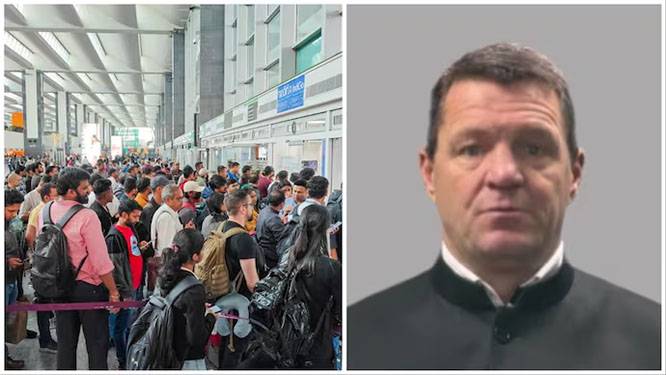
New Delhi, Dec 5: IndiGo CEO Pieter Elbers issued a public apology this evening after more than a thousand flights were cancelled today, making it the "most severely impacted day" in terms of cancellations. The biggest airline of the country cancelled "more than half" of its daily number of flights on Friday, said Elbers. He also said that even though the crisis will persist on Saturday, the airline anticipates fewer than 1,000 flight cancellations.

"Full normalisation is expected between December 10 and 15, though IndiGo cautions that recovery will take time due to the scale of operations," the IndiGo CEO said. 

IndiGo operates around 2,300 domestic and international flights daily.

Pieter Elbers, while apologising for the major inconvenience due to delays and cancellations, said the situation is a result of various causes.

The crisis at IndiGo stems from new regulations that boost pilots' weekly rest requirements by 12 hours to 48 and allow only two night-time landings per week, down from six. IndiGo has attributed the mass cancellations to "misjudgment and planning gaps".

Elbers also listed three lines of action that the airline will adopt to address the issue.

"Firstly, customer communication and addressing your needs, for this, messages have been sent on social media. And just now, a more detailed communication with information, refunds, cancellations and other customer support measures was sent," he said.

The airline has also stepped up its call centre capacity.

"Secondly, due to yesterday's situation, we had customers stranded mostly at the nation's largest airports. Our focus was for all of them to be able to travel today itself, which will be achieved. For this, we also ask customers whose flights are cancelled not to come to the airports as notifications are sent," the CEO said.

"Thirdly, cancellations were made for today to align our crew and planes to be where they need to start tomorrow morning afresh. Earlier measures of the last few days, regrettable, have proven not to be enough, but we have decided today to reboot all our systems and schedules, resulting in the highest numbers of cancellations so far, but imperative for progressive improvements starting from tomorrow," he added.

As airports witnessed chaotic scenes, the Directorate General of Civil Aviation (DGCA) stepped in to grant IndiGo a temporary exemption from stricter night duty rules for pilots. It also allowed substitution of leaves with a weekly rest period. 

Civil Aviation Minister Ram Mohan Naidu has said a high-level inquiry will be ordered and accountability will be fixed.

Comments

Add new comment

  • Coastaldigest.com reserves the right to delete or block any comments.
  • Coastaldigset.com is not responsible for its readers’ comments.
  • Comments that are abusive, incendiary or irrelevant are strictly prohibited.
  • Please use a genuine email ID and provide your name to avoid reject.
News Network
December 6,2025

pilot.jpg

New Delhi: IndiGo, India’s largest airline, faced major operational turbulence this week after failing to prepare for new pilot-fatigue regulations issued by the Directorate General of Civil Aviation (DGCA). The stricter rules—designed to improve flight safety—took effect in phases through 2024, with the latest implementation on November 1. IndiGo has acknowledged that inadequate roster planning led to widespread cancellations and delays.

Below are the key DGCA rules that affected IndiGo’s operations:

1. Longer Mandatory Weekly Rest

Weekly rest for pilots has been increased from 36 hours to 48 hours.

The government says the extended break is essential to curb cumulative fatigue. This rule remains in force despite the current crisis.

2. Cap on Night Landings

Pilots can now perform only two night landings per week—a steep reduction from the earlier limit of six.

Night hours, defined as midnight to early morning, are considered the least alert period for pilots.

Given the disruptions, this rule has been temporarily relaxed for IndiGo until February 10.

3. Reduced Maximum Night Flight Duty

Flight duty that stretches into the night is now capped at 10 hours.

This measure has also been kept on hold for IndiGo until February 10 to stabilize operations.

4. Weekly Rest Cannot Be Replaced With Personal Leave

Airlines can no longer count a pilot’s personal leave as part of the mandatory 48-hour rest.

Pilots say this closes a loophole that previously reduced actual rest time.

Currently, all airlines are exempt from this rule to normalise travel.

5. Mandatory Fatigue Monitoring

Airlines must submit quarterly fatigue reports along with corrective actions to DGCA.

This system aims to create a transparent fatigue-tracking framework across the industry.

The DGCA has stressed that these rules were crafted to strengthen flight safety and align India with global fatigue-management standards. The temporary relaxations are expected to remain until February 2025, giving IndiGo time to stabilise its schedules and restore normal air travel.

Comments

Add new comment

  • Coastaldigest.com reserves the right to delete or block any comments.
  • Coastaldigset.com is not responsible for its readers’ comments.
  • Comments that are abusive, incendiary or irrelevant are strictly prohibited.
  • Please use a genuine email ID and provide your name to avoid reject.
News Network
December 13,2025

New Delhi: School-going children are picking up drug and smoking habits and engaging in consumption of alcohol, with the average age of introduction to such harmful substances found to be around 13 years, suggesting a need for earlier interventions as early as primary school, a multi-city survey by AIIMS-Delhi said.

The findings also showed substance use increased in higher grades, with grade XI/XII students two times more likely to report use of substances when compared with grade VIII students. This emphasised the importance of continued prevention and intervention through middle and high school.

The study led by Dr Anju Dhawan of AIIMS's National Drug Dependence Treatment Centre, published in the National Medical Journal of India this month, looks at adolescent substance use across diverse regions.

The survey included 5,920 students from classes 8, 9, 11 and 12 in urban government, private and rural schools across 10 cities -- Bengaluru, Chandigarh, Delhi, Dibrugarh, Hyderabad, Imphal, Jammu, Lucknow, Mumbai, and Ranchi. The data were collected between May 2018 and June 2019.

The average age of initiation for any substance was 12.9 (2.8) years. It was lowest for inhalants (11.3 years) followed by heroin (12.3 years) and opioid pharmaceuticals (without prescription; 12.5 years).

Overall, 15.1 per cent of participants reported lifetime use, 10.3 per cent reported past year use, and 7.2 per cent reported use in the past month of any substance, the study found.

The most common substances used in the past year, after tobacco (4 per cent) and alcohol (3.8 per cent), were opioids (2.8 per cent), followed by cannabis (2 per cent) and inhalants (1.9 per cent). Use of non-prescribed pharmaceutical opioids was most common among opioid users (90.2 per cent).

On being asked, 'Do you think this substance is easily available for a person of your age' separately for each substance category, nearly half the students (46.3 per cent) endorsed that tobacco products and more than one-third of the students (36.5 per cent) agreed that a person of their age can easily procure alcohol products.

Similarly, for Bhang (21.9 per cent), ganja/charas (16.1 per cent), inhalants (15.2 per cent), sedatives (13.7 per cent), opium and heroin (10 per cent each), the students endorsed that these can be easily procured.

About 95 per cent of the children, irrespective of their grade, agreed with the statement that 'drug use is harmful'.

The rates of substance use (any) among boys were significantly higher than those of girls for substance use (ever), use in the past year and use in the past 30 days. Compared to grade VIII students, grade IX students were more likely, and grade XI/XII students were twice as likely to have used any substance (ever).

The likelihood of past-year use of any substance was also higher for grade IX students and for grade XI/XII students as compared to grade VIII students.

About 40 per cent of students mentioned that they had a family member who used tobacco or alcohol each. The use of cannabis (any product) and opioid (any product) by a family member was reported by 8.2 per cent and 3.9 per cent of students, respectively, while the use of other substances, such as inhalants/sedatives by family was 2-3 per cent, the study found.

A relatively smaller percentage of students reported use of tobacco or alcohol among peers as compared to among family members, while a higher percentage reported inhalants, sedatives, cannabis or opioid use among peers.

Children using substances (past year) compared to non-users reported significantly higher any substance use by their family members and peers.

There were 25.7 per cent students who replied 'yes' to the question 'conflicts/fights often occur in your family'. Most students also replied affirmatively to 'family members are aware of how their time is being spent' and 'damily members are aware of with whom they spend their time'.

Comments

Add new comment

  • Coastaldigest.com reserves the right to delete or block any comments.
  • Coastaldigset.com is not responsible for its readers’ comments.
  • Comments that are abusive, incendiary or irrelevant are strictly prohibited.
  • Please use a genuine email ID and provide your name to avoid reject.
