Aadhaar Programme Will Hollow Out Constitution: Petitioners To Top Court

Agencies
January 18, 2018

New Delhi, Jan 18:  Terming Aadhaar as "an electronic leash", a senior lawyer on Wednesday told the Supreme Court that the government could completely destroy an individual by "switching off" the 12-digit unique identifier number.

The argument was made before a five-judge Constititution bench headed by Chief Justice Dipak Misra which commenced hearing on a batch of petitions challenging the constitutional validity of the government's flagship Aadhaar programme and its enabling Act of 2016.

However, the bench, also comprising Justices AK Sikri, AM Khanwilkar, DY Chandrachud and Ashok Bhushan, countered senior advocate Shyam Divan, asking whether the state "cannot say that it has every right to find out the number of schools, children or the real beneficiaries of a welfare scheme and verify the real beneficiaries of huge funds which it is spending, it needs Aadhaar number. This is a valid argument."

It posed whether the government does not have the right to say that it was spending crores of rupees on welfare schemes and needed to verify whether benefits reached the needy and the leakages or pilferage of resources stopped.

The bench also asked what will happen to the biometric data collected before the Aadhaar Act, 2016 -- whether they will be destroyed if the petitioners challenging the validity of the Aadhaar programme succeeded.

Mr Divan, who opened arguments on behalf of petitioners, said that through a succession of "marketing stratagems" and by employing "smoke and mirrors", the government has rolled out a "little understood" programme that seeks to "tether every resident of India to an electronic leash".

"This leash is connected to a central database that is designed to track transactions across the life of the citizen. This record will enable the State to profile citizens, track their movements, assess their habits and silently influence their behaviour. Over time, the profiling enables the State to stifle dissent and influence political decision making," he argued.

Mr Divan said that "the State is empowered with a 'switch' by which it can cause the civil death of an individual. Where every basic facility is linked to Aadhaar and one cannot live in society without an Aadhaar number, the switching off of Aadhaar completely destroys the individual."

He said the petitioners are certain that if the Aadhaar Act and the programme were allowed to operate "unimpeded", it would "hollow out" the Constitution, particularly the great rights and liberties it has assured to its citizens.

Mr Divan is representing several petitioners like former Karnataka High Court judge Justice KS Puttaswamy, several activists Aruna Roy, Shantha Sinha and veteran CPI(M) leader VS Achuthanandan.

Mr Divan, who argued through the day and would continue his submissions tomorrow, said "a person cannot avail the facility of a welfare scheme, if the finger prints do not match the templates set by UIDAI," he said, adding that for seven years, biometric data of individuals were collected without any legal framework but only on executive orders.

Moreover, over three crore citizens have not been able to register their biometric data, he said and asked how can the government exclude such a big part of the population who could not be registered without any fault on their part, from availing benefits.

Mr Divan contended that at its core, Aadhaar alters the relationship between the citizen and the State and diminishes the status of the citizen.

Observing that the case at hand was unique as the programme was itself without any precedent, the senior lawyer said "no democratic society has adopted a programme that is similar in its command and sweep. There are few judicial precedents to guide us. The closest foreign cases have all been decided in favour of the citizens, repelling the invasive programmes by the State."

He said this case was about a new technology that the government has sought to deploy and a new architecture of governance has been built on this technology.

A people's Constitution will transform into a State Constitution, Mr Divan said and asked whether the Constitution allowed the State to embrace this new programme or whether the key document repudiates "the giant electronic mesh that Aadhaar was creating."

He also expressed concern over extending the Aadhaar platform to private corporations, the degree of tracking and extent of profiling will "exponentially increase".

"Rights freely exercised, liberties freely enjoyed, entitlements granted by the Constitution and laws are all made conditional. Conditional on a compulsory barter. The barter compels the citizen to give up her biometrics 'voluntarily', allow her biometrics and demographic information to be stored by the State and private operators and then used for a process termed as 'authentication'," he said.

Mr Divan said the Constitution balances rights of an individual against the State interest and "Aadhaar completely upsets this balance and skews the relationship between the citizen and the State...".

"The Constitution is not a charter of servitude. Aadhaar, if allowed to roll out unimpeded reduces citizens to servitude," Mr Divan said.

Just before the end of the hearing, he said that if Aadhaar Act is upheld, then in the alternative, no citizen should be deprived of any right or benefit for lack of an Aadhaar card.

The top court had on December 15 last year extended till March 31 the deadline for mandatory linking of Aadhaar with various services and welfare schemes of all ministries and departments of the Centre, states and union territories.

A nine-judge constitution bench of the top court had last year, held that Right to Privacy was a Fundamental Right under the Constitution. Several petitioners challenging the validity of Aadhaar had claimed it violated privacy rights.


Comments

Add new comment

  • Coastaldigest.com reserves the right to delete or block any comments.
  • Coastaldigset.com is not responsible for its readers’ comments.
  • Comments that are abusive, incendiary or irrelevant are strictly prohibited.
  • Please use a genuine email ID and provide your name to avoid reject.
News Network
December 3,2025

arrival.jpg

Mangaluru, Dec 3: A group of Congress workers gathered at the Mangaluru International Airport on Wednesday to welcome AICC general secretary K C Venugopal, but the reception quickly turned into a display of support for Deputy Chief Minister D K Shivakumar.

Venugopal arrived in the city to participate in the centenary commemoration of the historic dialogue between Mahatma Gandhi and Narayana Guru. The event, organised by the Sivagiri Mutt, Varkala, in association with the Mangalore University Sri Narayana Guru Study Chair, is being held on the university’s Konaje campus.

KPCC general secretary Mithun Rai and several party workers had assembled at the airport to receive Venugopal. However, the moment he stepped out, workers began raising slogans backing Shivakumar.

The university programme will be inaugurated by Chief Minister Siddaramaiah.

This show of support comes just a day after Siddaramaiah remarked that Shivakumar would lead the government “when the high command decides.” The chief minister made the comment after a breakfast meeting at Shivakumar’s residence—another public display of camaraderie between the two leaders amid ongoing attempts by the party high command to downplay their leadership rivalry.

Comments

Add new comment

  • Coastaldigest.com reserves the right to delete or block any comments.
  • Coastaldigset.com is not responsible for its readers’ comments.
  • Comments that are abusive, incendiary or irrelevant are strictly prohibited.
  • Please use a genuine email ID and provide your name to avoid reject.
News Network
November 24,2025

israelsyra.jpg

Israeli forces have pushed over the Syrian frontier, erecting a checkpoint and stopping vehicles in the southwestern city of Quneitra, in yet another breach of the Arab country’s sovereignty.

The violation took place on Sunday, when the troops made their way across the border, setting up the outpost near the Ain al-Bayda junction in northern Quneitra, Syrian outlets reported.

According to the al-Ikhbariya paper, an Israeli detachment positioned itself at the junction, halting cars and conducting searches.

The Syrian Arab News Agency (SANA) reported that three Israeli military vehicles then moved further into the northern countryside, deploying between the town of Jubata al-Khashab and the villages of Ofaniya and Ain al-Bayda. The agency added that a separate Israeli unit mounted a new incursion in the central region, approaching the villages of Umm Batina and al-Ajraf.

Residents said such activities have surged in recent months, pointing to Israeli advances onto farmland, leveling of extensive forested areas, arrests, and spread of mobile checkpoints.

The Israeli regime began markedly increasing its military aggression against Syria last year.

The escalation coincided with increasingly ferocious onslaughts throughout the country by the so-called Hay'at Tahrir al-Sham (HTS) Takfiri terrorist group, which the government of President Bashar al-Assad had confined to northwestern Syria. The HTS, however, managed to overthrow the government as the Israeli attacks would pummel the country’s civilian and defensive infrastructure.

Various reports have shown that, during the escalation, the regime conducted more than 1,000 airstrikes on the Syrian territory and over 400 ground raids into the south.

Following the collapse of the Assad government, Tel Aviv also widened its grip over the occupied Golan Heights by taking control of a demilitarized buffer zone, in defiance of a 1974 Disengagement Agreement. Earlier this month, senior Israeli officials, including Prime Minister Benjamin Netanyahu, visited the buffer zone, prompting expressions of alarm on the part of the United Nations.

The United States, the regime’s biggest ally, has, meanwhile, been fraternizing the HTS head Abu Mohammed al-Jolani amid the widely reported prospect of rapprochement with Tel Aviv.

Comments

Add new comment

  • Coastaldigest.com reserves the right to delete or block any comments.
  • Coastaldigset.com is not responsible for its readers’ comments.
  • Comments that are abusive, incendiary or irrelevant are strictly prohibited.
  • Please use a genuine email ID and provide your name to avoid reject.
News Network
December 3,2025

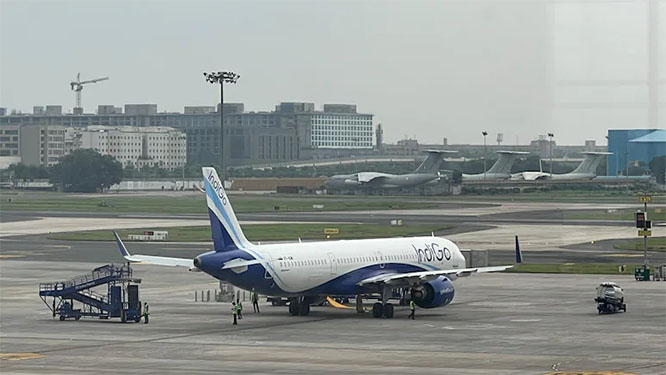
indigo.jpg

IndiGo, India’s largest airline, is battling one of its worst operational disruptions in recent years, with hundreds of delays and cancellations throwing domestic travel into chaos.

Government data on Tuesday showed its on-time performance plunging to 35%, an unusual dip for a carrier long associated with punctuality.

By Wednesday afternoon, airports in Delhi, Mumbai, Bengaluru and Hyderabad had collectively reported close to 200 cancellations, stranding travellers across the country.

Crew Shortage After New Duty Norms

A major trigger behind the meltdown is a severe crew shortage, especially among pilots, following the rollout of revised Flight Duty Time Limitation (FDTL) norms last month.

The rules mandate longer rest hours and more humane rosters — a shift IndiGo has struggled to incorporate across its vast network.

Sources said several flights were grounded due to lack of cabin crew, while some delays stretched upwards of eight hours.

With IndiGo controlling over 60% of India’s domestic aviation market, the ripple effect has impacted airports nationwide.

IndiGo Issues Apology, Lists “Compounding Factors”

In a statement, IndiGo acknowledged the large-scale disruption:

“We sincerely apologise to customers. A series of unforeseen operational challenges — technology glitches, winter schedule changes, adverse weather, system congestion and updated FDTL norms — created a compounding impact that could not have been anticipated.”

To stabilise operations, the airline has begun calibrated schedule adjustments for the next 48 hours, aiming to restore punctuality. Affected passengers are being offered refunds or alternate travel arrangements, IndiGo said.

What the FDTL Rules Require

The FDTL norms, designed to reduce pilot fatigue, cap duty and flying hours as follows:
•    Maximum 8 hours of flying per day
•    35 hours per week
•    125 hours per month
•    1,000 hours per year

Crew must also receive rest equalling twice the flight duration, with a minimum 10-hour rest period in any 24-hour window.

The DGCA introduced these limits to enhance flight safety.

Hyderabad: 33 Flights Cancelled, Long Queues Reported

Hyderabad’s Rajiv Gandhi International Airport saw heavy early-morning crowds as 33 IndiGo flights (arrivals and departures) were cancelled.

The airport clarified on X that operations were normal, advising passengers to contact IndiGo directly for latest flight status.

Cancellations included flights to and from Visakhapatnam, Goa, Ahmedabad, Delhi, Bengaluru, Chennai, Madurai, Hubli, Bhopal and Bhubaneswar.

Bengaluru: 42 Flights Disrupted

Bengaluru’s Kempegowda International Airport recorded 42 cancellations — 22 arrivals and 20 departures — affecting routes to Delhi, Mumbai, Chennai, Hyderabad, Goa, Kolkata and Lucknow.

Passengers Vent on Social Media

Irate travellers took to X to share their experiences. One passenger stranded in Hyderabad wrote: “I have been here since 3 a.m. and missed an important meeting.”

Another said: “My flight was pushed from 1:55 PM to 2:55 PM and now 4:35 PM. I was informed only three minutes before entering the airport.”

Delhi Airport Hit by Tech Glitch

At Delhi Airport, the disruption deepened due to a slowdown in the Amadeus system — used for reservations, check-ins and departure control.

The technical issue led to longer queues and sluggish processing, adding to delays already worsened by staff shortages.

Comments

Add new comment

  • Coastaldigest.com reserves the right to delete or block any comments.
  • Coastaldigset.com is not responsible for its readers’ comments.
  • Comments that are abusive, incendiary or irrelevant are strictly prohibited.
  • Please use a genuine email ID and provide your name to avoid reject.