Abu Salem, 1993 Mumbai Blasts Case Convict, Denied Parole To Get Married

Agencies
April 21, 2018

Mumbai, Apr 21: 1993 Mumbai blasts case convict Abu Salem's parole application to get married for a second time was rejected by Navi Mumbai Commissioner on Saturday.

The 48-year-old gangster had sought parole for 45 days to get married to Sayed Bahar Kausar alias Heena.

He is currently serving life term in Mumbai's Taloja jail for his role in the 1993 serial blasts in Mumbai that had killed 257 and left over 700 people seriously injured.

Abu Salem was sentenced to life imprisonment by a special Terrorist and Disruptive Activity (TADA) Court last year.

On March 12, 1993, a series of 13 blasts in quick succession ripped through various locations in Mumbai. The targets included the Air India Building, the Bombay Stock Exchange, Zaveri Bazar, hotels SeaRock and Hotel Juhu Centaur. Property worth Rs. 27 crore was damaged.

Salem was the mastermind of the blasts, along with Mustafa Dossa, who was extradited from the UAE. Dossa died of a heart attack after his conviction in June last year.

Abu Salem, accused of transporting weapons from Gujarat to Mumbai, was arrested in Portugal in 2002.

Abu Salem was extradited in 2005 from Portugal and he escaped the death sentence because India, to bring him back to face trial, guaranteed to the Portuguese that he would not be hanged.

More than 100 people were convicted in the case. One of them, Yakub Memon, was hanged in 2015 after the Supreme Court rejected his mercy plea in a historic middle-of-the-night hearing.


Comments

Add new comment

  • Coastaldigest.com reserves the right to delete or block any comments.
  • Coastaldigset.com is not responsible for its readers’ comments.
  • Comments that are abusive, incendiary or irrelevant are strictly prohibited.
  • Please use a genuine email ID and provide your name to avoid reject.
News Network
December 7,2025

Mangaluru, Dec 7: A 34-year-old fruit and vegetable trader in Mangaluru has reportedly lost ₹33.1 lakh after falling victim to an online investment scam run through a fake mobile app.

Police said the scam began in September, when the victim received a link on Facebook. Clicking it connected him to a WhatsApp number, where an unidentified person introduced a high-return investment scheme and instructed him to download an app.

To build trust, the fraudster asked him to invest ₹30,000 on September 24. The trader soon received ₹34,000 as “profit,” convincing him the scheme was genuine. Over the next two months, he transferred money in multiple instalments via Google Pay and IMPS to different scanner codes and bank accounts shared by the scammers. Between September 24 and December 3, he ended up sending a total of ₹33.1 lakh.

When he later requested a refund of his investment and promised returns, the scammers demanded additional payments, claiming he needed to pay a “service tax” first. Even after he paid a small amount, no money was returned, and the scammers continued pressuring him for more.

A case has been registered at the CEN Crime Police Station.

Comments

Add new comment

  • Coastaldigest.com reserves the right to delete or block any comments.
  • Coastaldigset.com is not responsible for its readers’ comments.
  • Comments that are abusive, incendiary or irrelevant are strictly prohibited.
  • Please use a genuine email ID and provide your name to avoid reject.
News Network
December 6,2025

pilot.jpg

New Delhi: IndiGo, India’s largest airline, faced major operational turbulence this week after failing to prepare for new pilot-fatigue regulations issued by the Directorate General of Civil Aviation (DGCA). The stricter rules—designed to improve flight safety—took effect in phases through 2024, with the latest implementation on November 1. IndiGo has acknowledged that inadequate roster planning led to widespread cancellations and delays.

Below are the key DGCA rules that affected IndiGo’s operations:

1. Longer Mandatory Weekly Rest

Weekly rest for pilots has been increased from 36 hours to 48 hours.

The government says the extended break is essential to curb cumulative fatigue. This rule remains in force despite the current crisis.

2. Cap on Night Landings

Pilots can now perform only two night landings per week—a steep reduction from the earlier limit of six.

Night hours, defined as midnight to early morning, are considered the least alert period for pilots.

Given the disruptions, this rule has been temporarily relaxed for IndiGo until February 10.

3. Reduced Maximum Night Flight Duty

Flight duty that stretches into the night is now capped at 10 hours.

This measure has also been kept on hold for IndiGo until February 10 to stabilize operations.

4. Weekly Rest Cannot Be Replaced With Personal Leave

Airlines can no longer count a pilot’s personal leave as part of the mandatory 48-hour rest.

Pilots say this closes a loophole that previously reduced actual rest time.

Currently, all airlines are exempt from this rule to normalise travel.

5. Mandatory Fatigue Monitoring

Airlines must submit quarterly fatigue reports along with corrective actions to DGCA.

This system aims to create a transparent fatigue-tracking framework across the industry.

The DGCA has stressed that these rules were crafted to strengthen flight safety and align India with global fatigue-management standards. The temporary relaxations are expected to remain until February 2025, giving IndiGo time to stabilise its schedules and restore normal air travel.

Comments

Add new comment

  • Coastaldigest.com reserves the right to delete or block any comments.
  • Coastaldigset.com is not responsible for its readers’ comments.
  • Comments that are abusive, incendiary or irrelevant are strictly prohibited.
  • Please use a genuine email ID and provide your name to avoid reject.
News Network
December 2,2025

DKSsiddu.jpg

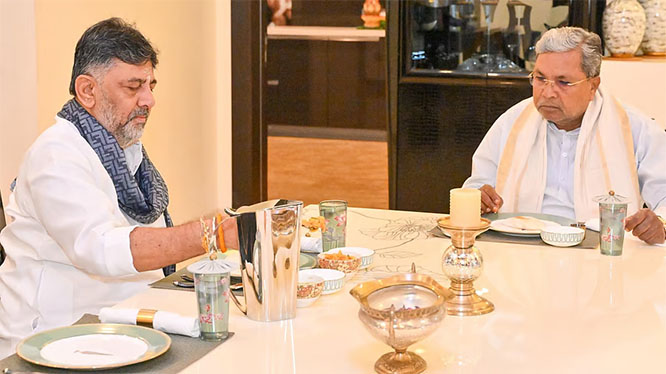
Bengaluru: 'Nati koli saaru' (country chicken curry) considered one of Chief Minister Siddaramaiah’s favourites along with steaming hot idlis was on the breakfast menu at Deputy CM D K Shivakumar’s residence on Tuesday, according to official sources.

The spread also included 'nati koli' fry, vada and pongal, among other items, they said.

In an apparent show of unity, Siddaramaiah visited Shivakumar’s residence for breakfast, just days after the two leaders shared a meal amid a simmering power tussle in the state Congress.

Siddaramaiah drove to the Deputy CM’s residence in Sadashivanagar, where he was received by Shivakumar and his brother D K Suresh, who is a former Congress MP.

Suresh and Kunigal MLA H D Ranganath, a relative of Shivakumar, joined them for breakfast, which featured a mix of vegetarian and non-vegetarian dishes.

Speaking to reporters later, Siddaramaiah said Shivakumar had invited him during his visit to the CM’s residence for breakfast on Saturday.

Asked about the difference between the two meals, the chief minister said, "At his (Shivakumar’s) house it was non-veg, while at my house it was veg. He is a vegetarian, I am a non-vegetarian. I had not prepared non-veg. I told DK to get chicken from the village as you won’t get the original in Bengaluru."

Shivakumar said he had initially invited Siddaramaiah to his residence, but the CM had suggested visiting his place first and reciprocating later. "It was a vegetarian breakfast at the CM’s house on Saturday," he noted.

"Today, I invited him (the CM) to my house. He enjoyed the breakfast, which had his Mysuru taste," Shivakumar added. At this point, Siddaramaiah remarked that Shivakumar’s wife is also from Mysuru.

Saturday’s breakfast at Siddaramaiah’s official residence, held as part of efforts by the Congress high command to ease tensions in the leadership dispute between the two, reportedly included idlis and sambar, according to official sources.

Comments

Add new comment

  • Coastaldigest.com reserves the right to delete or block any comments.
  • Coastaldigset.com is not responsible for its readers’ comments.
  • Comments that are abusive, incendiary or irrelevant are strictly prohibited.
  • Please use a genuine email ID and provide your name to avoid reject.