Amazon CEO Jeff Bezos and wife MacKenzie to divorce

Agencies
January 10, 2019

Jan 10: Amazon.com Inc founder and Chief Executive Jeff Bezos, the world's richest person, and his wife MacKenzie Bezos are divorcing after 25 years of marriage, the couple said on Twitter on Wednesday.

Jeff Bezos, 54, has a fortune that has soared as high as $160 billion thanks to his stake in Amazon, which again became Wall Street's most valuable company this week, surpassing Microsoft Corp.

Bezos has credited MacKenzie, 48, for her support when he uprooted the young couple to Seattle from New York to launch Amazon, an online bookseller that grew into the world's largest internet retailer.

MacKenzie Bezos, a Princeton graduate who is now a novelist, did accounting for Amazon for its first year after it was founded in 1994.

The couple decided to divorce after a long period of "loving exploration" and trial separation, and expect to remain partners in ventures and projects, according to the joint statement.

Amazon shares ended up 0.2 percent on Wednesday. The divorce should have no material impact on the company and its shares, said Tom Forte, an analyst at DA Davidson & Co.

According to Refinitiv Eikon data, MacKenzie does not hold any Amazon shares directly, while Bezos has a 16.1 percent stake worth about $130 billion. Forbes magazine now estimates his overall net worth at $137.1 billion.

Liat Sadler, a San Francisco matrimonial lawyer, noted that spouses owe a fiduciary duty to one another.

“They have duties not to waste or devalue marital resources, and to keep the value of marital property as high as possible,” she said. “I don't think there is an issue of concern for shareholders as to what will happen to Amazon because of the divorce."

Sadler said the main options facing the couple regarding Amazon stock were for Jeff Bezos to buy out his wife, or for MacKenzie Bezos to retain shares.

"If she trusts that he would manage Amazon well, either he should pay her for her share of the stock, or they could enter a more complicated agreement where she keeps stock and he keeps voting rights,” she said.

It is unlikely that many details of the divorce will become public, according to New York lawyer Bernard Clair, who represents Judith Giuliani in her divorce from Rudolph Giuliani, the former New York City mayor and current lawyer for U.S. President Donald Trump.

"These two have been separated for a not insignificant time, and I would assume ... they would have used the time to reach a private, confidential agreement,” Clair said, referring to Jeff and MacKenzie Bezos.

Reuters was unable to determine any further financial details of the planned divorce.

"Jeff remains focused on and engaged in all aspects of Amazon," said Drew Herdener, vice president of communications for the company. He declined to comment on how the divorce might affect the ownership stake.

MacKenzie Bezos met her husband when interviewing for a job at a New York hedge fund, according to a 2013 profile in Vogue.

The two were engaged after three months of dating and married three months after that, according to the magazine. They have four children.

Speaking at an event in Berlin last April, Jeff Bezos said his wife's support was instrumental when he founded Amazon.

"When you have loving and supportive people in your life, like MacKenzie, my parents, my grandfather, my grandmother, you end up being able to take risks," he said.

Jeff Bezos in September committed $2 billion through the Bezos Day One Fund to helping homeless families and starting pre-schools for low-income communities. He had solicited ideas on Twitter in 2017 for ways to donate some of his wealth.

Last January, the couple donated $33 million to fund college scholarships for U.S. high schoolers with Deferred Action for Childhood Arrivals (DACA) status, an Obama-era program protecting young immigrants brought to the United States illegally by their parents.

In 2012, they donated $2.5 million to a Washington state campaign to legalize same-sex nuptials there.

From modest beginnings, Amazon branched out into almost every product category, taking on established retailers such as Walmart Inc.

In November, Amazon picked America's financial and political capitals for massive new offices, branching out from its home base in Seattle with plans to create more than 25,000 jobs in New York City and a Virginia suburb of Washington, D.C.

Jeff Bezos also founded space company Blue Origin in 2000, and is funneling more than $1 billion a year of his own fortune into pulling it out of start-up mode and into production.

He also owns the Washington Post, which has been a frequent target of criticism from Trump.

Comments

Add new comment

  • Coastaldigest.com reserves the right to delete or block any comments.
  • Coastaldigset.com is not responsible for its readers’ comments.
  • Comments that are abusive, incendiary or irrelevant are strictly prohibited.
  • Please use a genuine email ID and provide your name to avoid reject.
News Network
November 28,2025

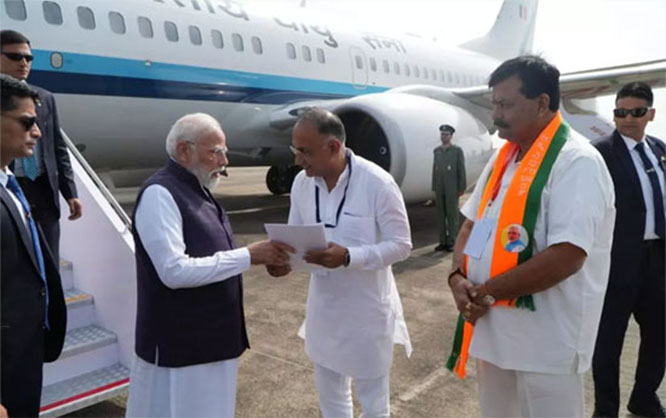
ministerPM.jpg

Mangaluru, Nov 28: Karnataka Health Minister and Dakshina Kannada district in-charge minister Dinesh Gundu Rao on Friday handed over Chief Minister Siddaramaiah’s letter to Prime Minister Narendra Modi, highlighting the severe distress faced by farmers due to crashing crop prices.

PM Modi arrived at the Mangaluru International Airport en route to Udupi, where Gundu Rao welcomed him and submitted the letter. The chief minister’s message stressed that farmers are suffering heavy losses because maize and green gram are being bought far below the Minimum Support Price (MSP). The state urged the Centre to immediately begin procurement at MSP.

According to the letter, Karnataka has a bumper harvest this year—over 54.74 lakh metric tons of maize and 1.98 lakh metric tons of green gram—yet farmers are unable to secure fair prices. Against the MSP of ₹2,400/MT for maize and ₹8,768/MT for green gram, market rates have plunged to ₹1,600–₹1,800 and ₹5,400 respectively.

The chief minister has requested the Centre to:

• Direct NAFED, FCI and NCCF to start MSP procurement immediately.
• Ensure ethanol units purchase maize directly from farmers or FPOs.
• Increase Karnataka’s ethanol allocation, citing high production capacity.
• Stop maize imports, which have depressed domestic prices.
• Relax quality norms for green gram, allowing up to 10% discoloration due to rains.

The letter stresses that MSP is crucial for farmer dignity and income stability and calls for swift central intervention to prevent a deepening crisis.

Comments

Add new comment

  • Coastaldigest.com reserves the right to delete or block any comments.
  • Coastaldigset.com is not responsible for its readers’ comments.
  • Comments that are abusive, incendiary or irrelevant are strictly prohibited.
  • Please use a genuine email ID and provide your name to avoid reject.
News Network
December 6,2025

pilot.jpg

New Delhi: IndiGo, India’s largest airline, faced major operational turbulence this week after failing to prepare for new pilot-fatigue regulations issued by the Directorate General of Civil Aviation (DGCA). The stricter rules—designed to improve flight safety—took effect in phases through 2024, with the latest implementation on November 1. IndiGo has acknowledged that inadequate roster planning led to widespread cancellations and delays.

Below are the key DGCA rules that affected IndiGo’s operations:

1. Longer Mandatory Weekly Rest

Weekly rest for pilots has been increased from 36 hours to 48 hours.

The government says the extended break is essential to curb cumulative fatigue. This rule remains in force despite the current crisis.

2. Cap on Night Landings

Pilots can now perform only two night landings per week—a steep reduction from the earlier limit of six.

Night hours, defined as midnight to early morning, are considered the least alert period for pilots.

Given the disruptions, this rule has been temporarily relaxed for IndiGo until February 10.

3. Reduced Maximum Night Flight Duty

Flight duty that stretches into the night is now capped at 10 hours.

This measure has also been kept on hold for IndiGo until February 10 to stabilize operations.

4. Weekly Rest Cannot Be Replaced With Personal Leave

Airlines can no longer count a pilot’s personal leave as part of the mandatory 48-hour rest.

Pilots say this closes a loophole that previously reduced actual rest time.

Currently, all airlines are exempt from this rule to normalise travel.

5. Mandatory Fatigue Monitoring

Airlines must submit quarterly fatigue reports along with corrective actions to DGCA.

This system aims to create a transparent fatigue-tracking framework across the industry.

The DGCA has stressed that these rules were crafted to strengthen flight safety and align India with global fatigue-management standards. The temporary relaxations are expected to remain until February 2025, giving IndiGo time to stabilise its schedules and restore normal air travel.

Comments

Add new comment

  • Coastaldigest.com reserves the right to delete or block any comments.
  • Coastaldigset.com is not responsible for its readers’ comments.
  • Comments that are abusive, incendiary or irrelevant are strictly prohibited.
  • Please use a genuine email ID and provide your name to avoid reject.